Retail People Counting & Customer Footfall Analytics System
People Counting · Entry & Exit Tracking · Repeat Customer Analysis · Age Group Estimation · Gender Classification · Occupancy Monitoring · Customer Footfall Analytics · Interactive Dashboards
Retail & E-commerce · Enterprise Software · Business Intelligence · Video Analytics
8–10 Weeks (Estimated)
India
Transforming Existing Retail CCTV Cameras Into a Real-Time Customer Footfall and Store Traffic Analytics System.
A computer vision solution designed to detect and track store visitors, measure entry and exit traffic, estimate occupancy, and convert camera footage into actionable retail insights through a centralized analytics dashboard.

Understanding Customer Footfall, Visit Patterns & Retail Demographics
Retail businesses need to understand how many customers visit their stores, when traffic peaks, how visitors move through different areas, and how customer demographics vary over time. Without structured analytics, these insights can be difficult to obtain from traditional CCTV monitoring and manual counting processes.
The proposed Retail People Counting & Customer Footfall Analytics System uses computer vision and video analytics to transform compatible camera feeds into structured retail insights.
The system detects and tracks people, counts store entries and exits, estimates occupancy, and generates footfall reports. Additional analytics can estimate broad age-group distributions, provide carefully validated appearance-based demographic classifications, and analyze repeat visits where an appropriate cross-visit measurement method is available.
A centralized dashboard brings these insights together through visitor metrics, traffic trends, demographic charts, occupancy summaries, and historical reports.
This enables retail teams to make more informed decisions about staffing, store layouts, traffic management, and customer experience while incorporating appropriate privacy and data-governance controls.
Key Challenges in Retail Customer Analytics
Traditional visitor counting and basic CCTV monitoring leave retail managers with limited visibility into customer return frequency, store traffic flow, and aggregate shopper demographics.
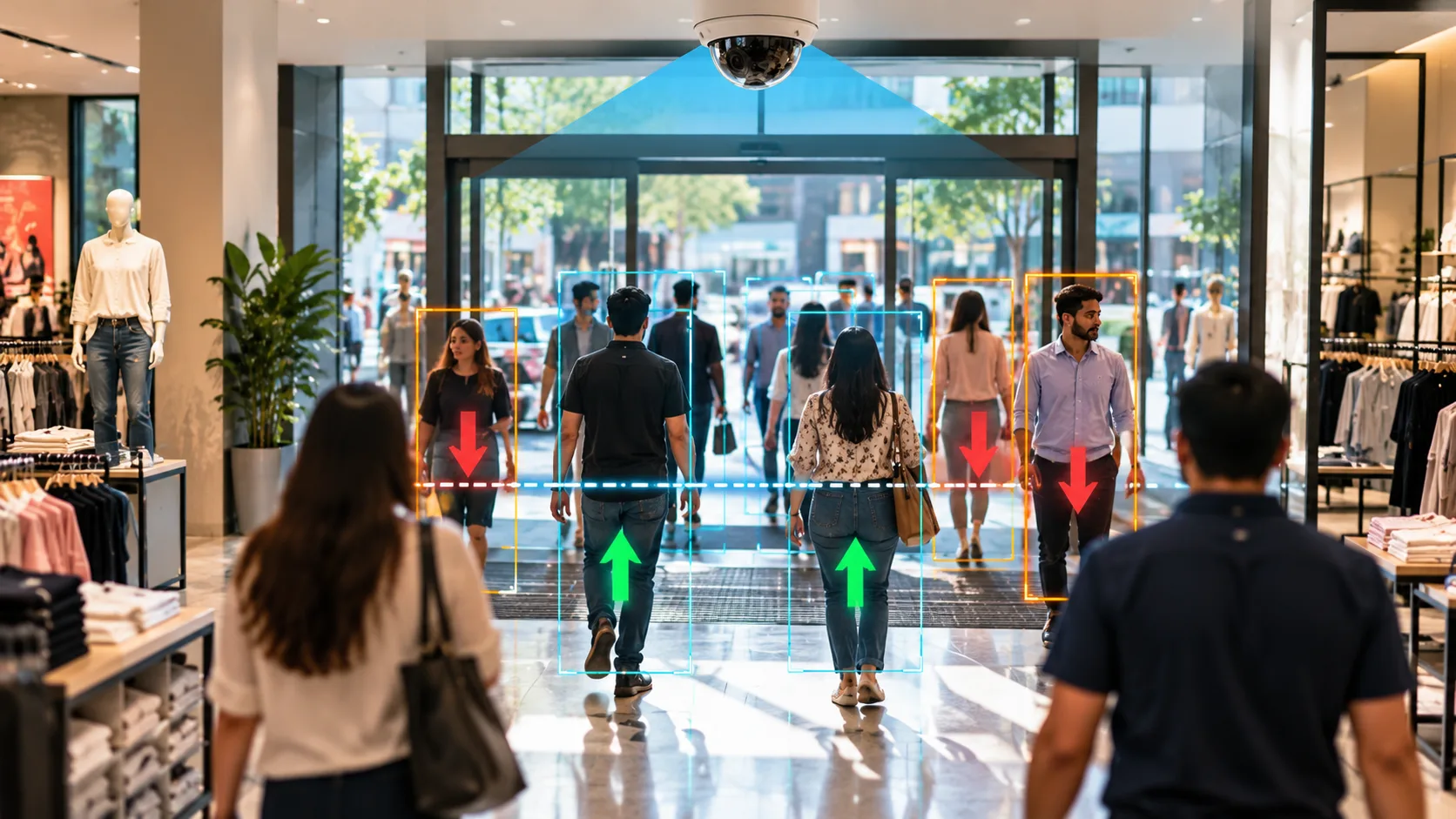
Manual Visitor Counting
Traditional counting methods require staff to observe store entrances or maintain manual visitor records, making consistent measurement difficult during busy periods.
Limited Repeat Visit Insights
Basic CCTV monitoring does not automatically establish whether a visitor has returned on another day. Retailers may lack reliable information about aggregate repeat-visit patterns.
Limited Demographic Visibility
Retail managers may not have access to structured estimates of broad customer age-group distributions or other relevant aggregate demographic trends.
Occupancy & Customer Movement Monitoring
Without automated analytics, identifying busy store areas, estimating occupancy, and comparing visitor distribution across zones can be challenging.
Disconnected Reporting
Visitor counts, camera monitoring, and business reports may be maintained across separate systems, making historical analysis and cross-store comparisons more difficult.
Four Phases. From Camera Integration to Retail Customer Intelligence.
A structured four-phase implementation workflow that converts existing camera streams into real-time retail visitor intelligence, demographic distributions, and customer analytics.
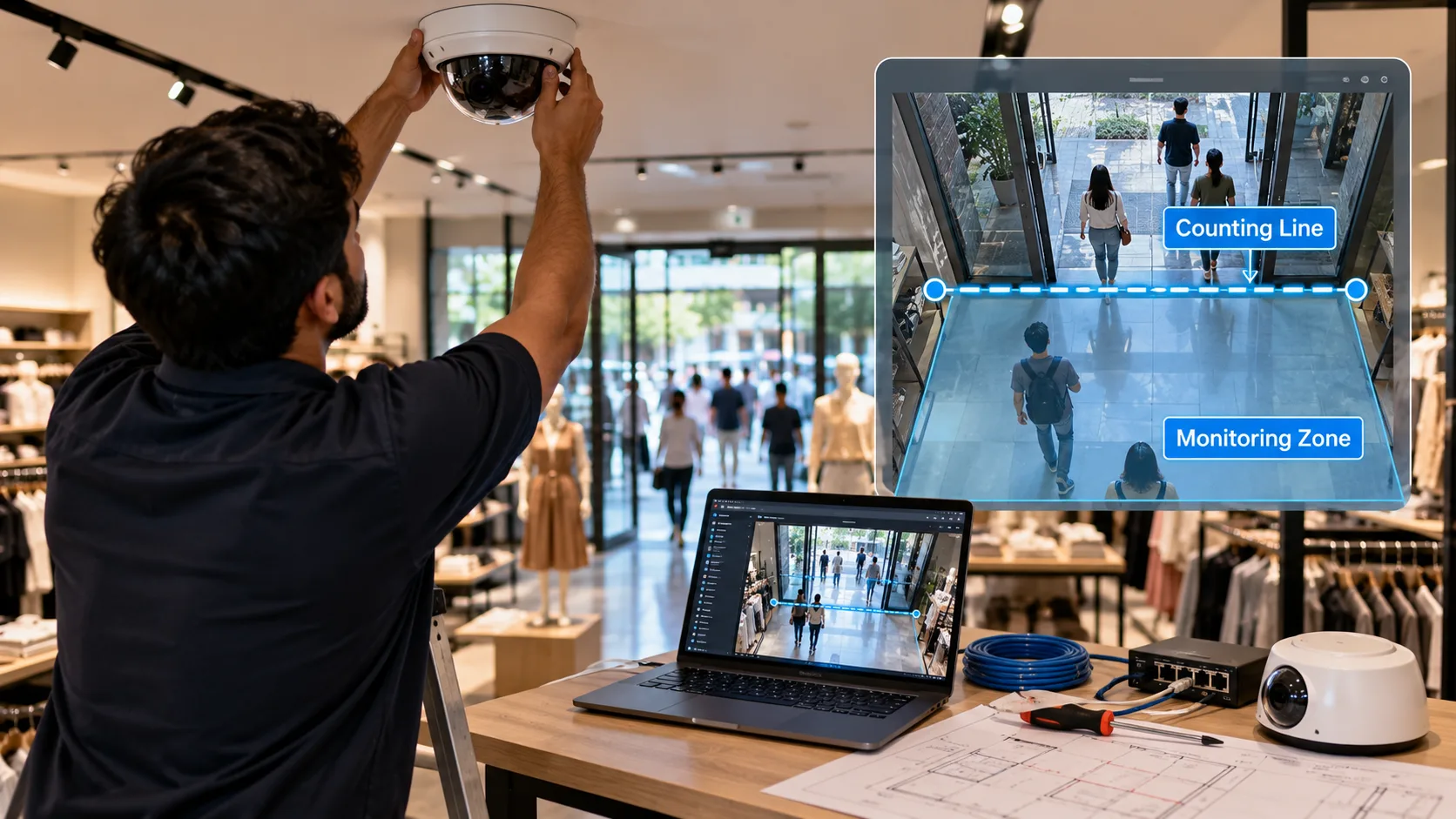
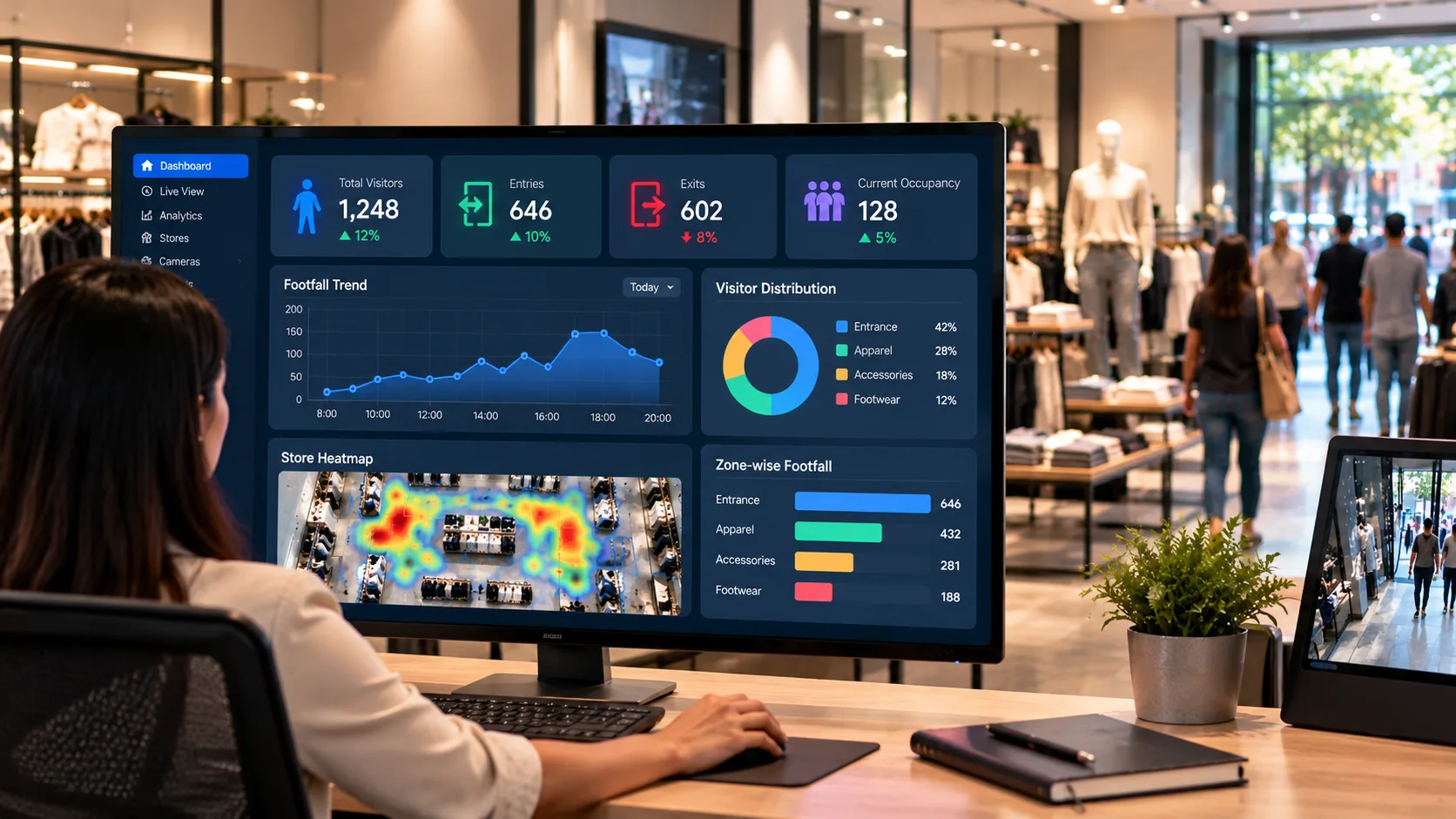
The first phase establishes the camera infrastructure and configuration required for consistent visitor counting and customer analytics. Assess compatible CCTV and IP camera infrastructure, review camera angles, video quality, lighting, and coverage, configure entrance and exit counting lines, define store sections and monitoring zones, identify camera limitations that may affect detection and demographic estimation, and establish database, access-control, privacy, and retention requirements.
Outcome: A configured foundation for video processing, visitor counting, and analytics.
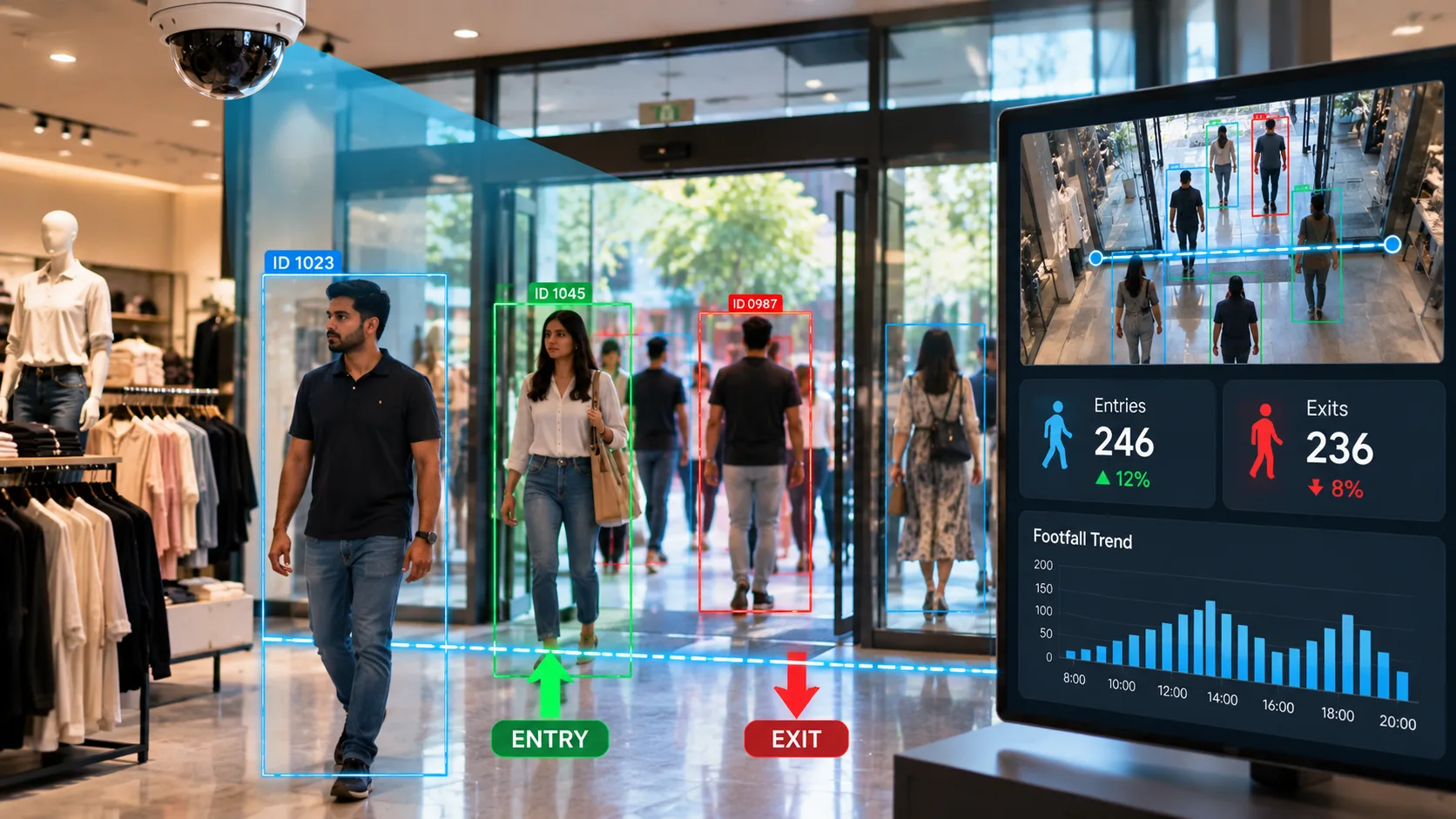
The second phase introduces the computer vision pipeline used to detect and track people in camera footage, with optional models for estimating broad demographic attributes. Detect people in supported camera streams, track people across consecutive video frames, count entries and exits using virtual counting lines, reduce duplicate counts through tracking logic, estimate broad age groups where image quality supports meaningful results, evaluate optional appearance-based gender classification where appropriate and legally permitted, and test model performance under different lighting, camera angles, and crowd conditions.
Outcome: Structured people-counting data and validated, optional demographic estimates.
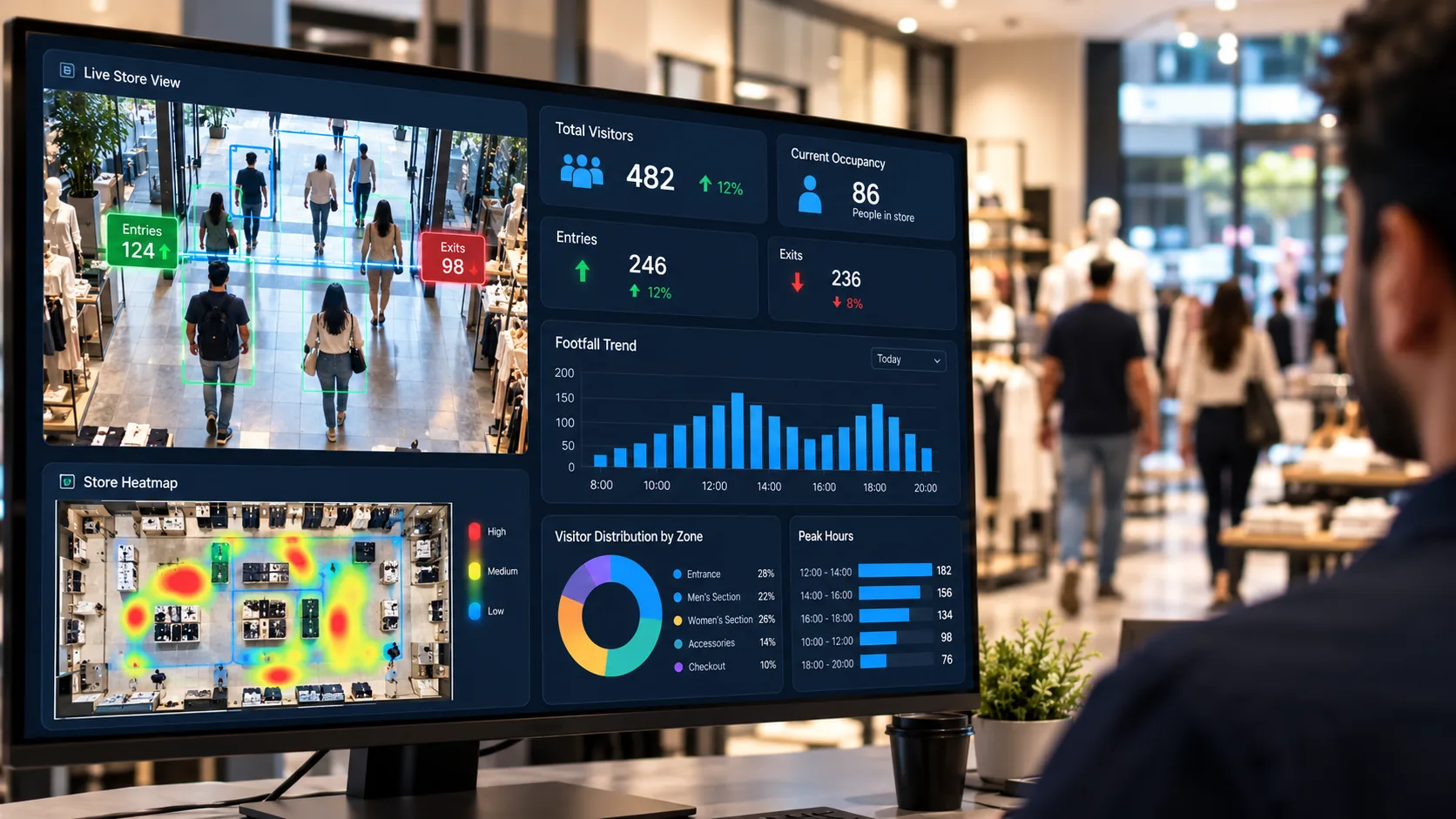
The third phase converts detection events into useful operational metrics and aggregate customer analytics. Generate hourly, daily, and weekly footfall reports, calculate entry and exit totals, estimate occupancy across configured zones, analyze traffic distribution and peak periods, generate age-group distribution charts, analyze aggregate repeat-visit trends when a suitable cross-visit measurement method is implemented, compare traffic patterns across stores and selected time periods, and apply data-quality checks, privacy controls, and reporting rules.
Outcome: A structured analytics layer for visitor traffic, occupancy, demographic estimates, and supported repeat-visit trends.
The final phase presents processed information through an interactive dashboard for monitoring and business reporting. Display total visitors, entries, exits, and occupancy estimates, visualize hourly and daily footfall trends, present age-group distribution charts, display validated demographic analytics where enabled, show new-versus-returning visitor trends where repeat visits can be measured reliably, provide store, date, camera, and zone filters, generate historical reports and exportable summaries, monitor camera connectivity and video-processing status, and validate dashboard metrics against recorded counting events.
Outcome: A centralized interface for reviewing retail traffic and supported customer analytics.
From Camera Footage to Actionable Customer Insights
The system provides a centralized interface for reviewing visitor activity and analyzing store traffic patterns. Workflow: 1. Capture Store Activity → 2. Detect & Track People → 3. Count & Analyze Visits → 4. Generate Customer Analytics → 5. Visualize Retail Insights.
The Technology Behind Retail Customer Analytics
The following technologies power video processing, person detection, movement tracking, demographic estimation, and the centralized analytics dashboard. Final configurations adapt to existing store camera infrastructure and deployment environments.

Python
Coordinates video-processing workflows, counting logic, analytics calculations, and model integration.

OpenCV
Supports camera-stream handling, frame processing, and integration with computer vision components.
Turning Retail Footfall into Actionable Business Insights
The proposed solution is designed to make store traffic more measurable and customer analytics more accessible through structured reporting. These are expected benefits of the proposed solution, not measured deployment results. Counting accuracy, demographic estimation quality, processing latency, and repeat-visit reliability must be validated during implementation. Repeat-customer analysis across different visits requires an appropriate cross-visit measurement method; ordinary person tracking within a single camera session is not sufficient. Age and appearance-based gender classifications are estimates and may be inaccurate or biased. Such demographic features should be used only where justified, legally permitted, transparently communicated, and appropriately validated. Basic people counting does not require identifying individual customers.
AI Development Case Studies With Measured Results
Read about our collaborative journeys with clients, showcasing how AtlasML's tailored AI solutions have empowered them to achieve their strategic goals.
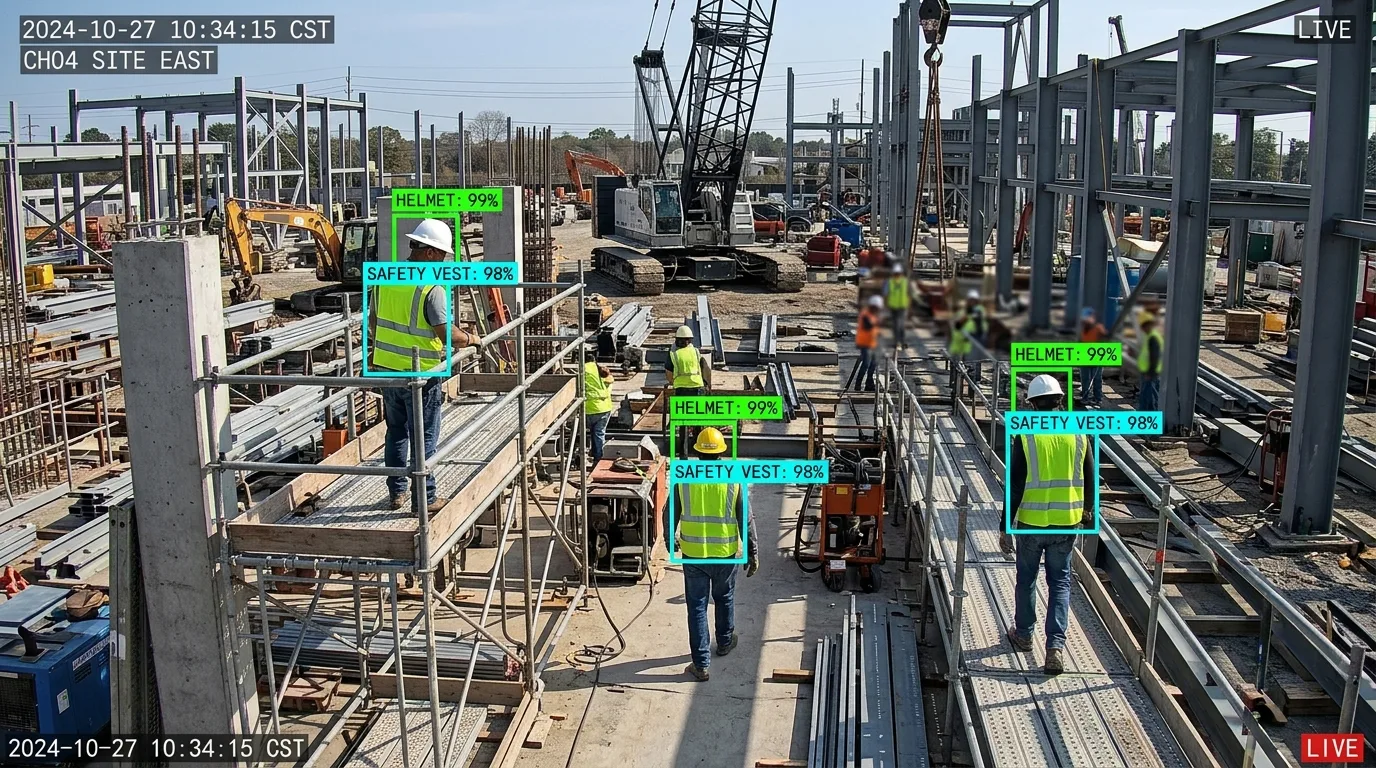
Intelligent PPE Detection & Workplace Safety System: Real-Time Computer Vision Across Active Industrial Jobsites.
An automated video monitoring system that uses existing factory and jobsite cameras to detect safety gear compliance in real time, reducing safety violations by 94% with instant alerts.
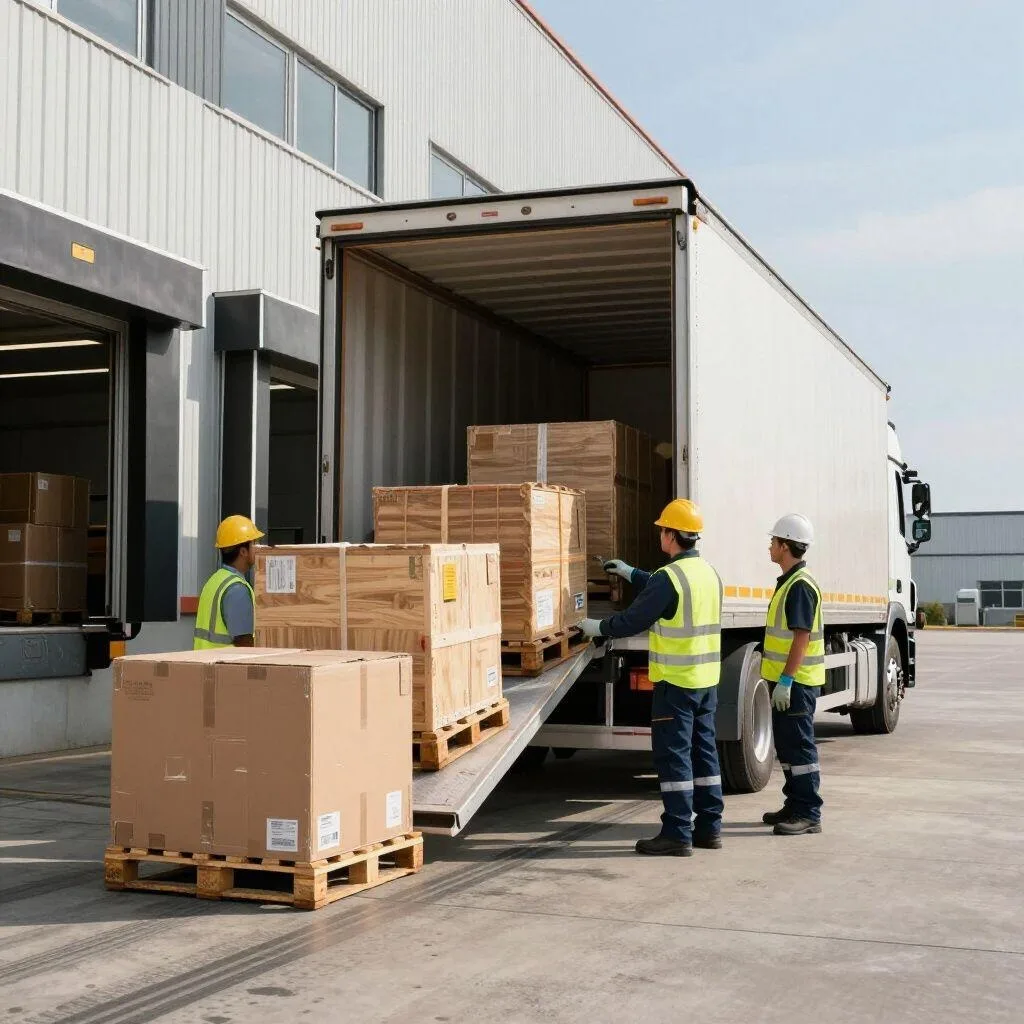
Loading & Unloading Monitoring System: Accurate Tracking & Shipment Verification.
A video-based monitoring solution using existing CCTV cameras and video analytics to track goods during loading and unloading, verify shipment quantities, and maintain clear records.
Don't Just Witness the AI Shift. Lead Your Organization's Transformation Journey Today.
We don’t just speculate on AI; we build it. Drawing on production systems delivered across 6 industries, we will analyze your requirement and architect a precise, executable technical blueprint for your team.
Schedule Your Technical Deep Dive
Got a Project For Us?
Skip the sales deck. Speak directly to an AI systems engineer about your data, models, and timeline.
The Engineering Guarantee, We do not route inputs through generic filters. A technical architect will review your project parameters and respond within 1 business day.
Let's Build Something Smart Together
Tell us about your data infrastructure and project goals. Our engineering team will review your requirements and provide a preliminary technical scoping framework within 24 hours.