
Introduction
Healthcare organizations manage large volumes of information every day, including patient records, diagnostic reports, medical images, appointment schedules, laboratory results, and treatment histories. Managing this information efficiently is essential for delivering timely care and maintaining smooth clinical operations.
Traditional healthcare processes often involve repetitive administrative work, disconnected systems, and time-consuming data analysis. These challenges can limit operational efficiency and make it harder for healthcare professionals to access relevant information when they need it.
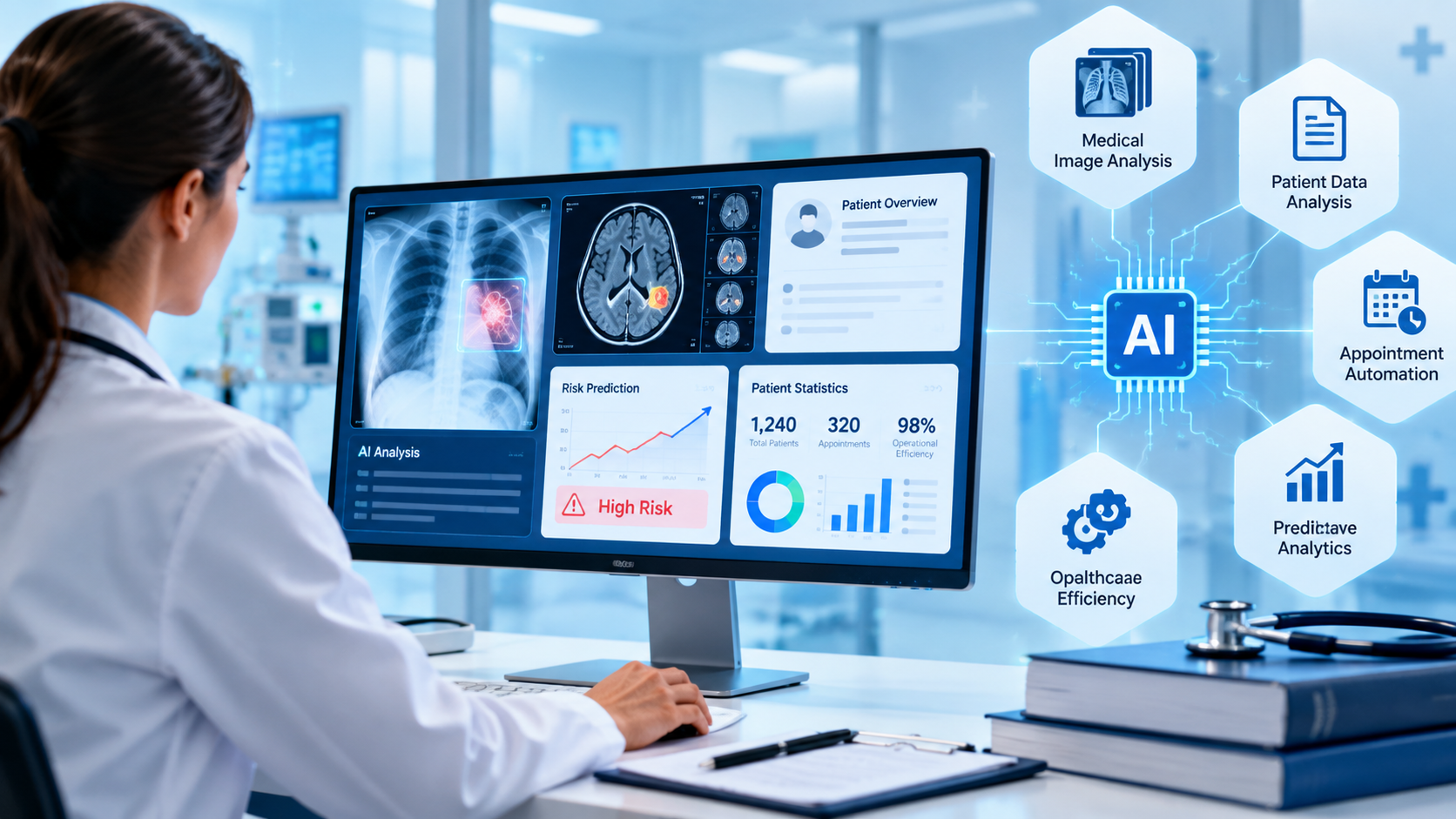
Artificial intelligence (AI) and machine learning (ML) are helping healthcare organizations analyze medical data, automate administrative tasks, identify patterns, and support clinical decision-making.
From medical image analysis and patient risk prediction to appointment management and intelligent healthcare assistants, AI can support a wide range of healthcare workflows.
However, successful implementation requires more than selecting an AI model. Healthcare organizations must also consider data quality, patient privacy, clinical validation, regulatory requirements, and integration with existing systems.
What Is AI in Healthcare?
AI in healthcare refers to the use of artificial intelligence technologies to analyze healthcare information, recognize patterns, automate selected processes, and support clinical or operational decisions.
Machine learning is a subset of AI that enables systems to learn patterns from data and use those patterns to make predictions or classifications.
Depending on the application, healthcare AI solutions may use:
Machine learning: Identifies patterns in historical and current data.
Deep learning: Processes complex information such as medical images and signals.
Computer vision: Analyzes images and video for supported medical or operational tasks.
Natural language processing (NLP): Processes clinical notes, reports, and other text.
Generative AI: Assists with drafting, summarization, and conversational information retrieval.
Predictive analytics: Estimates the likelihood of future events using relevant historical data.
Workflow automation: Connects data processing with predefined operational actions.
The goal is not to replace healthcare professionals. It is to provide tools that can help them manage information, reduce repetitive work, and make better-informed decisions within appropriate clinical and operational controls.
Why Is AI Becoming Important in Healthcare?
Healthcare organizations face growing demands for efficient service delivery, accurate documentation, accessible patient information, and effective resource management.
AI can help address selected challenges when the required data and workflows are suitable.
1. Large Volumes of Healthcare Data
Medical records, diagnostic images, laboratory results, and clinical documents can contain useful information that is difficult to review manually at scale.
Machine learning and NLP can help extract, classify, organize, and summarize relevant information.
2. Time-Consuming Administrative Work
Appointment scheduling, document processing, billing support, and patient inquiries can require significant staff time.
Workflow automation and conversational assistants can support routine tasks while allowing staff to review exceptions and sensitive decisions.
3. Need for Earlier Risk Identification
Historical patient data may contain patterns associated with certain clinical risks or changes in patient condition.
Predictive models can help identify patients who may need further assessment, provided that the models are appropriately validated and used under clinical oversight.
4. Disconnected Healthcare Systems
Hospitals and clinics may use separate systems for electronic health records, laboratory services, radiology, pharmacy, billing, and appointments.
AI solutions often need to integrate with these systems to access relevant information and deliver useful results within existing workflows.
5. Resource and Capacity Planning
Healthcare organizations must coordinate staff, equipment, beds, appointments, and other resources.
Analytics can help forecast demand and support planning, although actual decisions should also account for local operational conditions and professional judgment.
Top Machine Learning Applications in Healthcare
Machine learning can be applied to different types of healthcare data and workflows. The most appropriate application depends on the problem being addressed, data availability, and the level of risk involved.
1. Medical Image Analysis
Medical imaging is one of the established areas of healthcare AI research and application.
Deep learning models can analyze supported medical images, including X-rays, CT scans, MRI scans, and retinal images, to identify patterns that may require clinical attention.
Potential applications include:
Identifying suspicious patterns in medical images
Highlighting regions for radiologist review
Classifying images for specific, validated tasks
Prioritizing selected studies for review
Comparing image findings across time
Supporting image quality checks
For example, a validated model may flag an image with features associated with a particular condition so that a qualified clinician can review it.
AI-generated findings should not automatically be treated as a confirmed diagnosis. Performance depends on the model, image quality, patient population, and clinical setting.
2. Predictive Analytics for Patient Risk
Predictive analytics uses historical and current data to estimate the likelihood of defined future events.
Depending on the available data and validated use case, models may help estimate:
Risk of hospital readmission
Likelihood of missed appointments
Risk of clinical deterioration
Demand for specific healthcare services
Probability of complications in defined patient groups
For example, a hospital may use a validated model to identify patients who could benefit from additional follow-up after discharge.
Such predictions should support, rather than replace, clinical assessment. Models must also be evaluated for false positives, false negatives, bias, and performance across different patient groups.
3. Clinical Decision Support Systems
Clinical decision support systems provide healthcare professionals with relevant information during patient assessment and treatment planning.
AI-based systems may analyze structured records, laboratory results, medications, and other available information to generate alerts or recommendations for review.
Possible capabilities include:
Highlighting relevant patient history
Identifying potential medication-related risks
Flagging abnormal laboratory patterns
Supporting guideline-based workflows
Organizing information for clinical review
Identifying missing documentation
These systems require appropriate clinical validation and integration with professional workflows. Recommendations should be explainable enough for users to assess their relevance, and qualified clinicians should retain appropriate decision-making authority.
4. Natural Language Processing for Medical Records
Healthcare information is often stored in unstructured text, including clinical notes, discharge summaries, referral letters, and diagnostic reports.
NLP can help transform this text into organized and searchable information.
Applications include:
Extracting selected clinical entities
Classifying medical documents
Summarizing patient records
Identifying relevant information in clinical notes
Supporting medical coding workflows
Searching clinical knowledge repositories
For example, a document-processing system could identify patient details, document type, dates, and selected clinical terms from incoming records.
Sensitive outputs must be checked for accuracy, and automated extraction should not silently introduce unsupported information into a medical record.
5. Healthcare Chatbots and Virtual Assistants
Healthcare chatbots can help patients access routine administrative information through websites, mobile applications, or messaging platforms.
Depending on their design and approved scope, they can support:
Appointment booking and rescheduling
Clinic hours and location inquiries
Preparation instructions for appointments
Basic navigation of healthcare services
Frequently asked administrative questions
Appointment reminders
Requests to contact the appropriate department
More advanced assistants can retrieve information from approved organizational knowledge sources.
A healthcare chatbot should clearly communicate its limitations, protect patient information, and direct urgent or clinically sensitive concerns to appropriate human support. It should not present unvalidated responses as medical diagnoses.
6. Personalized Treatment Support
Healthcare professionals sometimes need to consider multiple factors when evaluating treatment options, including patient history, test results, medications, and relevant clinical guidelines.
AI research explores how data-driven models can help identify patterns across patient populations and support personalized treatment planning.
Potential applications include treatment-response prediction for specific conditions, identifying relevant clinical evidence, and organizing patient-specific information.
These tools require careful validation for the intended population and clinical use. A model's output should not be treated as a guaranteed prediction of an individual's response.
7. Drug Discovery and Research
Developing a new medicine involves extensive research, experimentation, and testing.
AI can support selected stages of pharmaceutical research by helping researchers analyze large datasets, identify candidate molecules, and estimate properties that may be useful for further investigation.
Potential applications include:
Screening candidate compounds
Analyzing molecular structures
Predicting selected molecular properties
Identifying relationships in biomedical datasets
Supporting literature analysis
Organizing research data
AI can help prioritize research activities, but laboratory studies, clinical trials, and appropriate regulatory review remain essential.
8. Remote Patient Monitoring
Remote patient monitoring systems collect information from connected devices, such as wearable sensors and home monitoring equipment.
Machine learning may help analyze measurements over time and identify patterns that warrant further review.
Depending on the device and validated application, information may include heart rate, blood pressure, blood glucose, oxygen saturation, or activity levels.
Possible capabilities include trend analysis, threshold-based alerts, and identification of unusual patterns.
Monitoring systems must account for device accuracy, connectivity interruptions, false alarms, and the need for clinical follow-up.
9. Hospital Operations and Resource Forecasting
AI is also useful in non-clinical healthcare operations.
Hospitals can analyze historical activity and operational data to support planning for:
Appointment demand
Bed utilization
Staff scheduling
Equipment availability
Laboratory workload
Pharmacy inventory
Patient flow
Supply requirements
For example, forecasting appointment demand may help a clinic review staffing requirements for busy periods.
These applications can improve operational visibility, but results depend on data quality and the extent to which forecasts reflect real-world conditions.
10. Medical Billing and Document Automation
Healthcare administration involves forms, invoices, insurance documents, referral letters, and other records.
AI-based document processing can combine OCR, classification, information extraction, and workflow automation to reduce repetitive manual work.
Potential applications include:
Extracting information from submitted documents
Classifying insurance and medical records
Identifying missing fields
Supporting invoice processing
Routing documents to appropriate teams
Flagging records that need manual review
Automated processing can reduce administrative effort, but billing and insurance decisions should follow applicable rules and include review mechanisms for ambiguous or high-impact cases.
Business Use Cases of AI in Healthcare
Healthcare AI is not limited to clinical applications. It can also support the business operations of hospitals, clinics, diagnostic laboratories, and healthcare service providers.
Business Area | AI Application | Potential Business Value |
Hospitals | Patient flow and demand forecasting | Better operational planning |
Clinics | Appointment and no-show prediction | More informed scheduling |
Diagnostic centers | Image analysis and report workflows | Support for diagnostic processes |
Insurance providers | Document classification and claims support | Reduced repetitive processing |
Pharmacies | Demand and inventory forecasting | Improved stock planning |
Healthcare administration | Document extraction and summarization | Reduced manual data entry |
Patient services | Administrative virtual assistants | More accessible routine information |
Research organizations | Research data analysis | Faster organization and prioritization of research |
Home healthcare | Remote monitoring analytics | Better visibility into patient measurements |
These are potential applications, not guaranteed outcomes. Each organization should define measurable objectives and validate performance before relying on an AI solution in production.
Real-World Example: AI-Assisted Healthcare Document Processing
Consider a healthcare organization that receives large numbers of referral letters, laboratory reports, insurance forms, and discharge summaries.
If staff members must manually classify every document and enter relevant information into separate systems, processing can become time-consuming.
An AI-assisted document workflow could operate as follows:
Step 1: Document Upload
Documents are received through an approved portal, email integration, or internal system.
Step 2: OCR and Text Extraction
OCR extracts readable text from supported scanned documents, while digital documents may be processed directly.
Step 3: Document Classification
The system identifies the likely document category, such as a referral letter, laboratory report, or insurance form.
Step 4: Information Extraction
The system extracts selected fields according to predefined rules, such as document date, reference number, and other required information.
Step 5: Validation and Human Review
Low-confidence results, missing information, and conflicting values are sent to authorized staff for review.
Step 6: System Integration
Approved information is transferred to the relevant workflow or healthcare system through controlled integrations.
Step 7: Audit and Monitoring
The organization tracks processing status, corrections, errors, and system performance.
This example illustrates how AI can support healthcare administration without requiring the system to make clinical decisions.
Generative AI in Healthcare
Generative AI introduces additional capabilities for working with healthcare documents and organizational knowledge.
Unlike traditional predictive models that classify or estimate specific outcomes, generative AI can produce text and other content based on its input and training.
Potential applications include:
Clinical Documentation Assistance
Assist with drafting or summarizing clinical documentation for professional review.
Medical Knowledge Search
Help authorized staff retrieve relevant information from approved clinical guidelines, internal policies, and reference materials.
Patient Communication Drafting
Generate drafts of appointment instructions, administrative notifications, and patient education materials that can be reviewed before use.
Internal Healthcare Support
Help employees search operational policies, process documents, and approved organizational knowledge.
Research Summarization
Assist researchers in organizing and summarizing scientific literature for further evaluation.
Generative AI can produce incorrect or unsupported information. Healthcare implementations therefore need appropriate source grounding, access controls, human review, and clear boundaries around clinical use.
Technology Stack for Healthcare AI Development
A healthcare AI solution typically combines data processing, machine learning, backend services, application development, and secure infrastructure.
Technology | Typical Role |
Python | Data processing and AI model development |
Scikit-learn | Traditional machine learning |
PyTorch / TensorFlow | Deep learning and image analysis |
OpenCV | Image and video processing |
NLP libraries and language models | Clinical text processing and summarization |
FastAPI | Backend APIs and model integration |
PostgreSQL / Microsoft SQL Server | Structured application and analytics data |
React / Angular | Web dashboards and healthcare applications |
FHIR / HL7 interfaces | Interoperability with compatible healthcare systems |
Cloud or on-premises infrastructure | Hosting, deployment, and processing |
Monitoring and logging tools | Performance tracking, error investigation, and auditability |
The exact technology stack depends on the use case, data sources, integration requirements, infrastructure, security needs, and applicable regulations.
Not every healthcare project needs a complex deep learning model. Some business problems can be addressed more effectively with standard analytics, rules-based automation, or conventional machine learning.
Challenges of Implementing AI in Healthcare
Healthcare AI requires careful planning because errors can affect patient care, privacy, and business operations.
1. Data Quality and Availability
Medical data may be incomplete, inconsistent, duplicated, or distributed across different systems.
Before model development, organizations should assess data quality, availability, representativeness, and permitted use.
2. Patient Privacy and Data Security
Healthcare data can contain highly sensitive personal information.
Solutions should implement appropriate access controls, encryption, secure data handling, audit logs, retention policies, and data-minimization practices.
3. Accuracy and Clinical Validation
A model that performs well in a development dataset may not perform equally well in a different hospital or patient population.
Testing should reflect the intended use, clinical setting, relevant patient groups, and potential consequences of incorrect outputs.
4. Bias and Fairness
If training data does not adequately represent the intended population, model performance may differ across groups.
Organizations should evaluate relevant performance differences and establish processes for ongoing monitoring and corrective action.
5. Integration With Existing Systems
Healthcare organizations may operate electronic health records, laboratory systems, radiology platforms, billing applications, and patient portals.
Integration requires careful consideration of APIs, data formats, interoperability, permissions, and workflow ownership.
6. Regulatory and Governance Requirements
Healthcare AI may be subject to privacy laws, medical-device requirements, healthcare regulations, and other obligations depending on its purpose and location.
Organizations should assess applicable requirements before deployment rather than assuming that every AI application is regulated in the same way.
7. Human Oversight
Clinical and high-impact administrative workflows need appropriate review, escalation, and override mechanisms.
Clear accountability is essential for determining who reviews outputs, handles exceptions, and responds when the system produces unreliable results.
How to Implement an AI Solution in Healthcare
A structured implementation process helps healthcare organizations validate the business value and manage risk.
Step 1: Define the Business or Clinical Problem
Identify a specific, measurable challenge.
Examples include reducing document-processing effort, forecasting appointment demand, organizing medical records, or supporting a defined image-analysis workflow.
Step 2: Assess Data Availability
Determine which data is required, where it is stored, who can access it, and whether it can legally be used for the intended purpose.
Step 3: Select the Appropriate Approach
Evaluate whether the problem requires rules-based automation, traditional machine learning, deep learning, NLP, computer vision, or generative AI.
Choose the simplest approach that can meet the requirement reliably.
Step 4: Develop a Proof of Concept
Test the approach on an appropriately authorized dataset and define evaluation criteria before development.
Metrics should reflect the intended use. For example, a document-processing project may evaluate field extraction accuracy and exception rates, while a clinical model may require more specialized performance measures.
Step 5: Validate With Relevant Users
Involve healthcare professionals, operational staff, security teams, and other relevant stakeholders.
Review incorrect predictions, edge cases, workflow impact, usability, and escalation requirements.
Step 6: Integrate With Existing Systems
Connect the validated solution to the relevant healthcare applications using controlled interfaces and appropriate permissions.
Step 7: Deploy and Monitor
Track model performance, errors, user corrections, system availability, data changes, and relevant safety indicators.
Define procedures for investigating issues, updating models, and disabling functionality when necessary.
How Much Does Healthcare AI Development Cost?
There is no universal cost for developing a healthcare AI solution.
The overall investment depends on several factors:
Complexity of the business or clinical problem
Availability and quality of training data
Model development requirements
Number of integrations
Application and dashboard scope
Security and compliance requirements
Infrastructure and deployment approach
Clinical validation and testing
Ongoing monitoring and maintenance
A focused administrative automation project may require considerably less effort than a clinical decision support system or a medical imaging solution that needs extensive validation.
A reliable estimate should follow requirements discovery, technical assessment, data evaluation, and agreement on the intended use and acceptance criteria.
What Is the Future of AI in Healthcare?
Healthcare AI is evolving across clinical research, administrative workflows, patient communication, and operational analytics.
Several areas are receiving increasing attention:
Multimodal AI: Combining information from different data types, such as text, images, and structured records, for defined healthcare applications.
AI-assisted documentation: Supporting clinicians with drafting, summarization, and information organization.
Predictive analytics: Using relevant data to support demand planning and selected risk-assessment workflows.
Remote monitoring: Analyzing longitudinal measurements from connected devices.
Healthcare knowledge assistants: Helping authorized users find information within approved clinical and organizational resources.
Workflow automation: Coordinating routine tasks across connected healthcare applications with appropriate permissions and review.
The long-term value of these technologies will depend on their reliability, integration into real workflows, and ability to meet the needs of patients and healthcare professionals.
Conclusion
AI and machine learning are creating new opportunities to improve healthcare information management, clinical workflows, research, and operational planning.
From medical image analysis and predictive analytics to document processing, virtual assistants, and resource forecasting, healthcare AI can support a broad range of applications.
However, successful implementation requires a clear problem statement, suitable data, careful validation, privacy safeguards, and appropriate human oversight.
Healthcare organizations should begin with a focused use case, evaluate measurable outcomes, and expand only when the solution demonstrates sufficient value and reliability.
The objective is not to introduce AI into every healthcare process. It is to apply the right technology where it can provide meaningful, safe, and measurable support.
Frequently Asked Questions
What is AI in healthcare?
AI in healthcare uses technologies such as machine learning, deep learning, NLP, and generative AI to analyze healthcare information, automate selected processes, and support clinical or operational decisions.
What are the main applications of machine learning in healthcare?
Common applications include medical image analysis, predictive analytics, clinical decision support, document processing, remote monitoring, research support, and healthcare operations forecasting.
Can AI help doctors diagnose diseases?
AI can support specific diagnostic tasks, such as identifying patterns in medical images. Its use must be validated for the intended clinical setting, and outputs should be interpreted by qualified healthcare professionals as appropriate.
How is AI used in hospital management?
AI can help forecast appointment demand, analyze patient flow, support bed utilization planning, predict selected resource requirements, and automate administrative workflows.
Is patient data safe when using AI?
Patient data can be handled securely when systems are designed with appropriate privacy controls, access restrictions, encryption, auditability, and compliant data practices. Security depends on implementation and governance rather than the use of AI alone.
Can AI automate medical documentation?
AI can assist with extracting, organizing, and summarizing medical documents. Sensitive information and clinically relevant outputs should be reviewed according to the intended use and organizational policies.
What technologies are used to build healthcare AI solutions?
Common technologies include Python, machine learning frameworks, computer vision libraries, NLP tools, backend APIs, databases, web frameworks, and healthcare interoperability standards such as FHIR and HL7.
How long does it take to develop a healthcare AI solution?
The timeline depends on scope, data readiness, model complexity, integration requirements, testing, and regulatory considerations. A focused proof of concept is generally smaller than a production-grade clinical system.
Planning a Healthcare AI Solution?
Start by identifying a clear clinical or operational challenge, evaluating available data, and selecting an appropriate technology approach. A well-scoped proof of concept can help determine whether an AI solution is technically feasible, operationally useful, and suitable for further development.