
1. Introduction
Customer service plays an important role in building customer trust, maintaining long-term relationships, and improving business performance. Customers expect quick answers, accurate information, and convenient support whenever they need assistance. However, businesses that handle large volumes of customer calls often struggle with long waiting times, repetitive inquiries, limited support availability, and increasing operational costs.
Traditional call center systems depend heavily on human agents to answer questions, check account information, update records, schedule appointments, and resolve customer issues. While human support remains essential for complex situations, many routine inquiries follow predictable patterns and can be handled through automation.
This is where AI voice agent development for customer service becomes valuable.
AI voice agents are software-based assistants that communicate with customers through spoken conversations. They use speech recognition, natural language processing, large language models, and speech synthesis to understand customer requests and generate spoken responses.
Unlike traditional automated phone menus that require customers to select numbered options, modern AI voice agents can understand conversational requests, ask follow-up questions, retrieve relevant information, and guide customers through supported workflows.
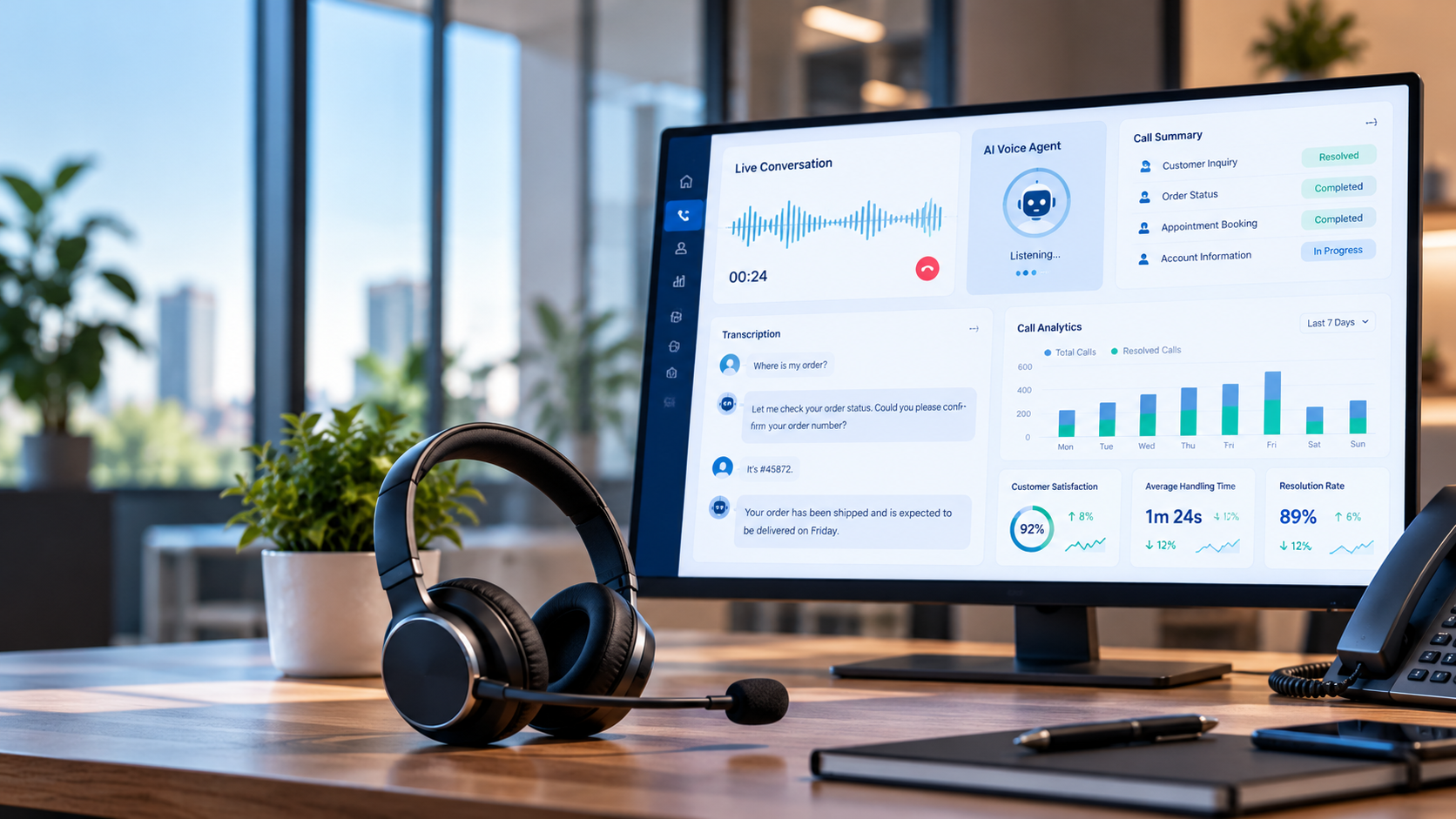
For example, a customer calling an online store might ask, “Where is my order?” An AI voice agent can identify the customer's intent, verify their identity when required, retrieve the order status from the connected system, and explain the latest delivery information.
Similarly, a service company could use a voice agent to schedule appointments, answer frequently asked questions, collect customer details, or route calls to the appropriate department.
When integrated with existing Customer Relationship Management (CRM), Enterprise Resource Planning (ERP), booking, and support systems, AI voice agents can do more than answer questions. They can retrieve relevant business information and initiate approved actions through existing workflows.
2. What Is an AI Voice Agent?
An AI voice agent is a software application that understands spoken language, interprets a user's request, and responds through natural-sounding speech.
It combines several technologies to support conversational interactions between people and business systems.
A typical AI voice agent can:
Understand customer questions through speech recognition.
Identify the customer's intent and relevant details.
Maintain context across multiple conversation turns.
Retrieve information from approved business systems.
Answer questions using verified information.
Collect details required to complete a workflow.
Schedule appointments or create support tickets when authorized.
Transfer complex or sensitive cases to a human agent.
For example, a customer might say:
“I want to reschedule my appointment for Friday afternoon.”
The voice agent can identify the requested action, determine the relevant appointment, check available time slots through a booking system, confirm the customer's preference, and submit the change if the user is authorized and the required business rules are satisfied.
If the requested time is unavailable, the agent can offer alternatives or transfer the call to a human representative.
AI Voice Agents vs. Traditional IVR Systems
Interactive Voice Response (IVR) systems commonly guide callers through predefined menus, such as pressing one for sales or two for support.
AI voice agents provide a more flexible conversational experience.
Feature | Traditional IVR | AI Voice Agent |
Interaction | Predefined menus and options | Conversational speech |
Understanding | Menu selection or limited commands | Natural-language interpretation |
Follow-up questions | Usually limited | Can maintain conversational context |
Personalization | Depends on configured menus | Can use authorized customer context |
Business system integration | Often routes calls or triggers predefined actions | Can retrieve information and initiate approved workflows |
Complex requests | Usually requires menu navigation or transfer | Can clarify requests and escalate when needed |
Response generation | Predefined recordings or prompts | Dynamic spoken responses |
Implementation | Often simpler for fixed routing | Requires AI orchestration, testing, and ongoing monitoring |
AI voice agents do not eliminate the need for IVR in every situation. A business may combine traditional call routing with conversational AI to support both straightforward routing and more flexible customer interactions.
3. How AI Voice Agents Work
An AI voice agent processes a spoken request through several connected components. These components work together to understand the caller, determine the appropriate response, and deliver it through speech.
Step 1: Voice Input
The customer speaks into a telephone or another supported voice interface.
For example:
“Can you tell me whether my order has been shipped?”
The system captures the audio through the telephony provider or application.
Step 2: Speech-to-Text Conversion
Automatic Speech Recognition (ASR), also called Speech-to-Text (STT), converts the spoken audio into text.
The resulting text might be:
“Can you tell me whether my order has been shipped?”
The quality of this conversion depends on audio quality, background noise, accents, language, speaking speed, and the capabilities of the selected speech recognition model.
Step 3: Intent Recognition and Context Understanding
The AI interprets the request and identifies what the customer wants.
In this example, the intent is order-status checking. The agent may also need to identify the order number or verify the customer's identity before retrieving information.
If required details are missing, the agent can ask a follow-up question.
Step 4: AI Reasoning and Response Planning
A language model or conversational orchestration component determines how to respond based on the user's request, available context, and permitted actions.
The agent may decide to answer a general question, retrieve order information, request additional details, or transfer the caller to a human agent.
The model should operate within defined instructions and tool permissions. It should not independently decide that it can access or change any business record.
Step 5: Business System Integration
If the request requires live information, the agent calls an approved API or tool.
For example, an order-status workflow might:
Verify the customer's identity using the configured process.
Retrieve the relevant order record.
Check the current shipment status.
Return the permitted fields to the voice agent.
The response should be based on the actual system result rather than the language model's assumptions.
Step 6: Response Generation
The AI generates a response based on the retrieved information and the conversation context.
For example:
“Your order has been shipped and is currently in transit. The latest delivery estimate is Friday.”
This is an illustrative response; an actual system should provide only the information returned by the connected order-management service.
Step 7: Text-to-Speech Conversion
Text-to-Speech (TTS) converts the response into spoken audio.
Modern TTS systems can provide natural-sounding speech, suitable pacing, and support for different languages and voices.
Step 8: Conversation Continuation or Escalation
The customer may ask another question, provide additional information, or request a human representative.
The agent continues the conversation when the request is supported. Otherwise, it can transfer the call along with a summary of the conversation, subject to the configured workflow.
4. Key Benefits of AI Voice Agents for Customer Service
AI voice agents can improve customer service operations when they are implemented for suitable use cases and connected to reliable business data.
4.1 24/7 Customer Support
Traditional customer support often depends on staffed operating hours. AI voice agents can provide support outside those hours, depending on the telephony setup and system availability.
They can handle common questions about business hours, order status, appointment availability, product information, and service procedures.
This helps customers access basic information without waiting for the next available human agent.
4.2 Faster Response Times
Customers may experience long queues when support teams receive large volumes of calls.
An AI voice agent can handle supported inquiries without requiring a human agent to answer each call individually. This can reduce waiting time for routine requests and allow human representatives to focus on cases requiring more attention.
Actual improvements depend on call volume, system capacity, integration quality, and the percentage of inquiries the agent can resolve successfully.
4.3 Reduced Repetitive Work
Customer service teams frequently answer similar questions throughout the day.
AI voice agents can automate supported tasks such as checking order status, explaining standard policies, collecting appointment details, and creating support tickets.
This can reduce repetitive administrative work while allowing employees to concentrate on complex customer concerns.
4.4 Consistent Customer Communication
A properly configured voice agent can use approved knowledge sources and business rules to provide consistent responses to common questions.
For example, it can explain return policies or service procedures using the latest approved information available to the system.
Knowledge sources must be maintained regularly. An outdated or incomplete knowledge base can cause the agent to provide incorrect information.
4.5 Improved Call Handling Capacity
AI voice systems can support multiple concurrent conversations, subject to the capacity and limits of the voice platform, AI services, and telephony infrastructure.
This can help businesses manage seasonal demand, campaign-related call spikes, and repetitive service inquiries without scaling human staffing at the same rate.
However, higher call capacity does not automatically mean that every inquiry will be resolved successfully. Conversation quality, latency, and escalation capacity must also be monitored.
4.6 Better Use of Human Support Teams
Human agents remain important for complaints, sensitive situations, exceptions, and cases requiring judgment or empathy.
AI can handle suitable routine interactions and transfer more complex cases with relevant context.
This allows human representatives to focus on situations where personal attention is particularly valuable.
4.7 Improved Customer Service Insights
Voice interactions can provide useful information about customer questions, common complaints, service gaps, and recurring operational issues.
With appropriate consent, privacy controls, and data governance, businesses can analyze interaction metadata and conversation records to identify patterns.
These insights can help organizations improve FAQs, service processes, training, and product documentation.
5. Real-World Use Cases of AI Voice Agents
AI voice agents can support different customer service workflows depending on the industry, business systems, and level of automation required.
5.1 E-Commerce and Order Management
Online retailers receive frequent questions about order status, shipping, returns, refunds, and product availability.
An AI voice agent can help customers retrieve information without navigating a website or waiting for a support representative.
Possible capabilities include:
Checking order status.
Providing shipment updates.
Explaining return procedures.
Checking product availability.
Creating support tickets.
Collecting information for return requests.
Routing refund-related exceptions to the appropriate team.
For example, a customer could ask, “Has my replacement order been dispatched?”
The agent can retrieve the relevant order record and explain the current status.
Refund approval or changes to an order should follow the retailer's authorization rules rather than relying solely on the AI's response.
5.2 Healthcare Appointment Management
Healthcare organizations may use voice agents to assist with administrative inquiries and appointment scheduling.
Potential use cases include:
Checking appointment availability.
Scheduling or rescheduling appointments.
Sending appointment reminders.
Providing clinic hours and location information.
Explaining administrative procedures.
Routing calls to the appropriate department.
The agent must protect patient information and follow applicable privacy requirements. It should not be treated as a substitute for a qualified healthcare professional when a caller needs clinical advice or emergency assistance.
5.3 Banking and Financial Services
Financial institutions handle customer inquiries about accounts, transactions, cards, payments, and service requests.
A voice agent may support approved, low-risk information retrieval and service workflows, such as explaining general procedures, checking application status, or routing a request to the correct department.
Depending on the institution's policies, additional identity verification may be required before disclosing account-specific information.
Sensitive transactions, account changes, and financial decisions need strong authentication, fraud controls, and explicit authorization.
5.4 Travel and Hospitality
Travel agencies, airlines, hotels, and booking platforms receive inquiries about reservations, cancellations, itinerary details, and availability.
AI voice agents can help with:
Checking reservation details.
Providing booking status.
Explaining cancellation policies.
Checking room or appointment availability.
Collecting booking requirements.
Routing complicated itinerary changes.
Providing information about travel services.
For example, a hotel guest could ask whether early check-in is available. The agent can check the booking system or route the request to the hotel team when availability requires human confirmation.
5.5 Telecommunications
Telecommunications providers manage inquiries about service interruptions, billing, plan details, technical issues, and account changes.
Voice agents can assist with basic troubleshooting, explain approved billing information, check service status, and create support tickets.
More complex technical issues can be transferred to a human support representative with a summary of the steps already attempted.
5.6 Real Estate and Property Management
Property managers and real estate agencies receive inquiries about property availability, viewing appointments, rental procedures, and maintenance requests.
An AI voice agent can collect customer requirements, schedule property viewings, answer questions using approved property information, and register maintenance requests.
Availability and pricing information should be retrieved from the current property-management system rather than generated from memory.
5.7 Logistics and Delivery Services
Logistics companies manage frequent inquiries about shipment status, delivery schedules, pickup requests, and delivery exceptions.
AI voice agents can retrieve shipment information, collect missing delivery details, register service requests, and route unresolved delivery problems to operations teams.
When integrated with a transport management system or ERP, the agent can provide information from the latest available shipment records.
6. AI Voice Agent Integration with CRM and ERP Systems
AI voice agents become more useful when they can retrieve relevant information from existing business applications.
Without integration, an agent may answer general questions but cannot reliably provide current order status, customer-specific information, appointment availability, or support history.
Connecting the agent with CRM and ERP systems enables contextual conversations and approved workflow automation.
CRM Integration
CRM integration allows the voice agent to access authorized customer information and service records.
Potential capabilities include:
Retrieving customer profiles after verification.
Checking previous interactions.
Identifying open support tickets.
Creating new service requests.
Recording call summaries.
Updating approved customer fields.
Scheduling follow-up activities.
For example, when a customer calls about an unresolved issue, the voice agent could retrieve the related CRM ticket and provide its current status.
If the issue requires human attention, the agent can transfer the caller to the relevant team and provide the context collected during the conversation.
ERP Integration
ERP integration allows the voice agent to retrieve operational and transaction information.
Potential capabilities include:
Checking order and shipment status.
Retrieving approved invoice information.
Checking product availability.
Providing delivery updates.
Retrieving purchase or service order details.
Initiating approved operational requests.
For example, a customer could ask whether a product is available at a particular warehouse. The agent can retrieve the relevant inventory information through an approved ERP API or inventory service.
Example: End-to-End Customer Support Workflow
Consider a customer who calls an online retailer to ask about a delayed delivery.
The voice agent answers the call and identifies the customer's request.
The system verifies the customer using the retailer's approved authentication process.
The agent retrieves the relevant order information from the order-management or ERP system.
It checks shipment status and the latest available delivery estimate.
It explains the information to the customer.
If the delivery is delayed beyond the permitted threshold, the agent creates a support ticket in the CRM.
The agent summarizes the issue and routes it to the appropriate support team if necessary.
This workflow connects conversational AI with real business data while preserving the existing systems as the authoritative source of order and support records.
Suggested image placement: Add a diagram here showing the connection between the customer, AI voice agent, CRM, ERP, and human support team. This helps readers understand how the complete workflow operates.
7. Technologies Used in AI Voice Agent Development
Developing an AI voice agent requires several technologies that work together to support real-time conversations.
7.1 Automatic Speech Recognition
Speech recognition converts spoken audio into text.
It is responsible for identifying the words spoken by the customer. Its performance depends on audio quality, accents, language support, background noise, and the recognition model.
7.2 Natural Language Processing
Natural Language Processing helps the system interpret customer intent, extract relevant details, and understand conversational context.
It can help distinguish between requests such as checking an order, cancelling an appointment, requesting a refund, or speaking with a human representative.
7.3 Large Language Models
Large Language Models (LLMs) can interpret flexible questions, generate responses, summarize conversations, and coordinate supported tools.
They should be grounded in approved business information and configured with explicit limits on the actions they can perform.
7.4 Text-to-Speech
Text-to-Speech converts generated text into audio.
Voice selection, pronunciation, speaking speed, pauses, and language support can influence how natural and understandable the conversation feels.
7.5 Telephony Integration
Telephony integration connects the AI application to telephone calls.
Depending on the deployment, this may involve a cloud telephony provider, Session Initiation Protocol (SIP), a voice API, or an existing contact center platform.
The telephony layer manages call connections, routing, audio streaming, transfers, and call termination.
7.6 Backend and API Development
The backend coordinates speech processing, AI requests, authentication, business rules, and communication with existing systems.
Technologies such as Python, FastAPI, ASP.NET Core, and other backend frameworks may be suitable depending on the project requirements.
7.7 Real-Time Audio Processing
Real-time voice interactions require efficient handling of incoming audio, partial speech recognition, model responses, and generated speech.
Low latency is important because long pauses can make a conversation feel unnatural.
The system should also support interruption handling, background noise management, timeouts, and recovery from temporary service failures.
7.8 Monitoring and Analytics
Monitoring helps businesses evaluate call outcomes, response latency, transfer rates, failed requests, and conversation quality.
Analytics can help identify common customer questions, recurring failures, and areas where the agent needs better instructions or improved knowledge sources.
8. How to Develop an AI Voice Agent for Customer Service
A structured development process helps organizations select an appropriate use case, validate the technology, and integrate the solution into existing operations.
Step 1: Identify the Customer Service Problem
Start by understanding which calls consume the most time or create the greatest operational burden.
Examples include order-status inquiries, appointment scheduling, billing questions, delivery updates, and frequently asked questions.
Review call volumes, common customer intents, current resolution processes, and the circumstances that require human intervention.
Step 2: Define the Scope
Determine exactly what the first version of the voice agent should and should not do.
Define:
Supported customer questions.
Languages and accents to support.
Required customer verification.
Business systems to connect.
Actions the agent may initiate.
Situations requiring human transfer.
Expected response time.
Success and acceptance criteria.
A narrow, well-defined scope makes it easier to test the system and evaluate its performance.
Step 3: Design the Conversation Flow
Map the expected conversation paths for each supported customer request.
For an order-status workflow, this may include greeting the customer, identifying the request, verifying identity, collecting an order reference, retrieving the status, delivering the response, and offering additional assistance.
Include alternative paths for missing information, unsuccessful verification, unavailable data, customer interruptions, and requests outside the agent's capabilities.
Step 4: Select the AI Voice Technology
Choose appropriate speech recognition, language model, speech synthesis, and telephony components.
Evaluate language support, latency, voice quality, reliability, pricing, privacy, and integration requirements.
The technology selection should match the business problem rather than relying only on model popularity or voice quality demonstrations.
Step 5: Develop the Backend and AI Workflow
Implement the orchestration layer that connects the voice interface, AI model, business rules, and system APIs.
The workflow should control the available tools, validate inputs, handle errors, and prevent unsupported actions.
Step 6: Integrate Existing Business Systems
Connect the voice agent to CRM, ERP, booking, order-management, or support platforms using approved interfaces.
Implement authentication, data mapping, permission checks, and error handling.
Test that the information returned to the customer matches the actual source records.
Step 7: Implement Human Handover
Define when the voice agent should transfer a call to a human representative.
Typical triggers include:
Customer requests a human.
Identity verification fails.
The issue falls outside the supported scope.
The agent cannot retrieve reliable information.
The request requires a sensitive decision.
The customer becomes frustrated or repeatedly indicates that the response is unhelpful.
Where supported, the agent should provide the receiving representative with a concise summary and relevant case details.
Step 8: Test Realistic Conversations
Test the system with representative conversations, accents, noisy environments, incomplete requests, interruptions, and unexpected questions.
Validate both the conversational experience and the underlying business workflow.
Important tests include incorrect order references, unavailable appointments, failed API calls, unauthorized requests, and repeated customer interruptions.
Step 9: Deploy a Pilot
Begin with a limited use case, department, customer group, or call category.
Monitor call outcomes, accuracy, latency, customer feedback, and the rate at which conversations require human intervention.
Use the results to improve the system before expanding to additional workflows.
Step 10: Monitor and Improve
Review performance regularly and update the knowledge sources, conversation flows, integrations, and validation rules as business requirements change.
Ongoing monitoring should cover both technical reliability and the quality of customer interactions.
9. Challenges in AI Voice Agent Development
AI voice agents offer useful capabilities, but their performance depends on how well the system handles real-world conversations and business requirements.
Speech Recognition Errors
Background noise, accents, poor phone connections, and unfamiliar names can cause incorrect transcription.
Approach: Test with representative audio, select suitable speech recognition technology, allow customers to repeat information, and confirm critical details before taking action.
Latency and Natural Conversation
Long pauses between a customer's question and the agent's response can make conversations frustrating.
Approach: Optimize audio streaming, model response time, API calls, and speech generation. Use concise responses and appropriate turn-taking behavior.
Hallucinations and Incorrect Answers
A language model may generate an answer that sounds convincing but is not supported by the business data.
Approach: Ground responses in approved knowledge sources and actual API results. If information is unavailable, the agent should explain the limitation or escalate the request.
Complex Customer Requests
Customers may combine multiple questions, change their requests mid-conversation, or describe problems in unexpected ways.
Approach: Maintain conversation context, clarify ambiguous requests, test multi-step scenarios, and define clear limits for unsupported tasks.
System Integration Failures
CRM, ERP, and telephony APIs may become unavailable, return incomplete information, or respond slowly.
Approach: Implement timeouts, retries where appropriate, clear error handling, and fallback procedures. Never claim an action succeeded unless the business system confirms it.
Customer Trust and Acceptance
Some customers may prefer human support or may be uncomfortable speaking with an automated system.
Approach: Be transparent about the use of AI, provide an accessible human-transfer option, and ensure that the voice agent communicates clearly and respectfully.
Data Privacy and Security
Voice calls may contain personal information, account details, and confidential business information.
Approach: Implement appropriate identity verification, access controls, encryption, data retention policies, and safeguards for call recordings and transcripts.
10. Security and Privacy Considerations
Security is particularly important when an AI voice agent can retrieve customer records or initiate business actions.
Customer Authentication
The system should verify the caller's identity before providing protected account information or allowing sensitive actions.
The appropriate verification method depends on the type of information and the risk of the requested action.
Role-Based Access
The voice agent should access only the data required for the supported workflow.
For example, a customer-service agent should not be able to retrieve unrestricted financial or employee records merely because the database connection permits it.
Secure API Communication
Use supported authentication mechanisms, encrypted communication, secure credential storage, and appropriately restricted API permissions.
Protection of Voice Recordings
If calls are recorded or transcribed, explain the relevant recording practices and apply the required consent, retention, access, and deletion policies.
Avoid storing sensitive information unnecessarily.
Human Approval for High-Impact Actions
Actions such as financial transactions, sensitive account changes, and exceptions to established business policies may require additional verification or human approval.
Audit Logging
Maintain suitable records of requests, system actions, API results, call transfers, and failures.
Logs should support troubleshooting and accountability without exposing unnecessary personal or confidential information.
Continuous Security Testing
Test for unauthorized data access, malicious spoken instructions, prompt injection through retrieved content, and attempts to bypass business rules.
The AI model should never be the only security control. The application and connected business systems must enforce permissions independently.
11. Measuring AI Voice Agent Performance
Businesses should evaluate an AI voice agent using both technical and customer-service metrics.
Metric | What It Measures |
Call Resolution Rate | Percentage of calls resolved successfully within the defined scope |
First-Contact Resolution | Percentage of customer issues resolved without requiring another contact |
Average Handling Time | Average duration of supported customer interactions |
Human Transfer Rate | Percentage of calls transferred to human agents |
Speech Recognition Accuracy | Accuracy of the transcribed customer speech |
Response Latency | Time taken to begin delivering a response |
Task Completion Rate | Percentage of supported workflows completed successfully |
Customer Satisfaction | Customer feedback about the interaction |
Integration Failure Rate | Frequency of failed or incomplete system requests |
Cost per Resolved Call | Average operating cost for each successfully resolved call |
These metrics should be interpreted together.
For example, a low human-transfer rate is not necessarily positive if customers are receiving incorrect answers. Similarly, a short handling time may indicate efficiency, but it could also indicate that the agent is ending calls prematurely.
Establish a baseline before deployment and compare results against clear acceptance criteria.
12. The Future of AI Voice Agents in Customer Service
AI voice technology is evolving toward more natural, context-aware, and integrated customer interactions.
More Natural Real-Time Conversations
Improvements in speech recognition, voice generation, and streaming architectures can make voice interactions more responsive and natural.
Multilingual Customer Support
Businesses serving customers across different regions can use voice systems that support multiple languages, provided the selected models and workflows have been tested for those languages.
Context-Aware Customer Service
Voice agents can use authorized information from CRM records, order histories, support tickets, and other business systems to provide more relevant responses.
Integration with AI Agents and Automation
Voice interfaces can become entry points to broader business workflows, allowing customers to request supported actions through natural conversation.
Improved Quality Monitoring
Analytics can help organizations identify recurring customer concerns, failed conversations, and areas where the agent needs better instructions or more reliable data.
Human and AI Collaboration
The future of customer service is likely to combine automation with human expertise. AI voice agents can handle suitable routine requests, while human representatives focus on complex problems, sensitive situations, and decisions that require judgment.
13. Conclusion
AI voice agent development is helping businesses rethink how they manage customer service calls. By combining speech recognition, language models, speech synthesis, and business system integrations, organizations can build conversational interfaces that answer common questions, retrieve information, and support approved workflows.
Applications include order tracking, appointment management, customer support, billing inquiries, delivery updates, and service request handling.
When integrated with existing CRM and ERP systems, AI voice agents can provide more contextual responses and reduce the need for employees to retrieve information manually. However, successful implementation requires careful planning, reliable integrations, secure data access, realistic testing, and clear escalation procedures.
The most effective approach is to begin with a specific customer service problem, define what the agent is authorized to do, and evaluate its performance through real conversations and measurable business outcomes.
Planning to Develop an AI Voice Agent for Your Business?
Start by identifying the most common customer inquiries, the systems needed to answer them, and the situations that require human support. A focused proof of concept can help determine whether voice automation is suitable for your customer service workflow.
With the right architecture and safeguards, AI voice agents can become a practical extension of existing customer service operations.
Frequently Asked Questions
1. What is AI voice agent development?
AI voice agent development is the process of building software that understands spoken requests, responds through natural-sounding speech, and performs supported tasks using AI models and connected business systems.
2. How do AI voice agents work in customer service?
They capture customer audio, convert speech into text, interpret the request, retrieve information or execute approved actions, and convert the response into spoken audio.
3. Can an AI voice agent replace a call center?
AI voice agents can automate suitable routine inquiries, but human representatives remain important for complex issues, complaints, sensitive decisions, and cases requiring judgment. Most organizations should design an appropriate combination of automation and human support.
4. Can AI voice agents integrate with CRM systems?
Yes. With suitable APIs and permissions, they can retrieve customer records, check support tickets, create service requests, summarize conversations, and update approved fields.
5. Can AI voice agents integrate with ERP systems?
Yes. They can retrieve authorized information about orders, inventory, invoices, and deliveries through supported ERP APIs or other approved integration methods.
6. Which technologies are required to build an AI voice agent?
Common components include speech recognition, natural language processing, large language models, text-to-speech, telephony integration, backend APIs, business rules, and monitoring tools.
7. Are AI voice agents available 24/7?
They can provide continuous support when the voice platform, AI services, integrations, and operational setup are configured for that availability. Businesses should also plan for outages and fallback procedures.