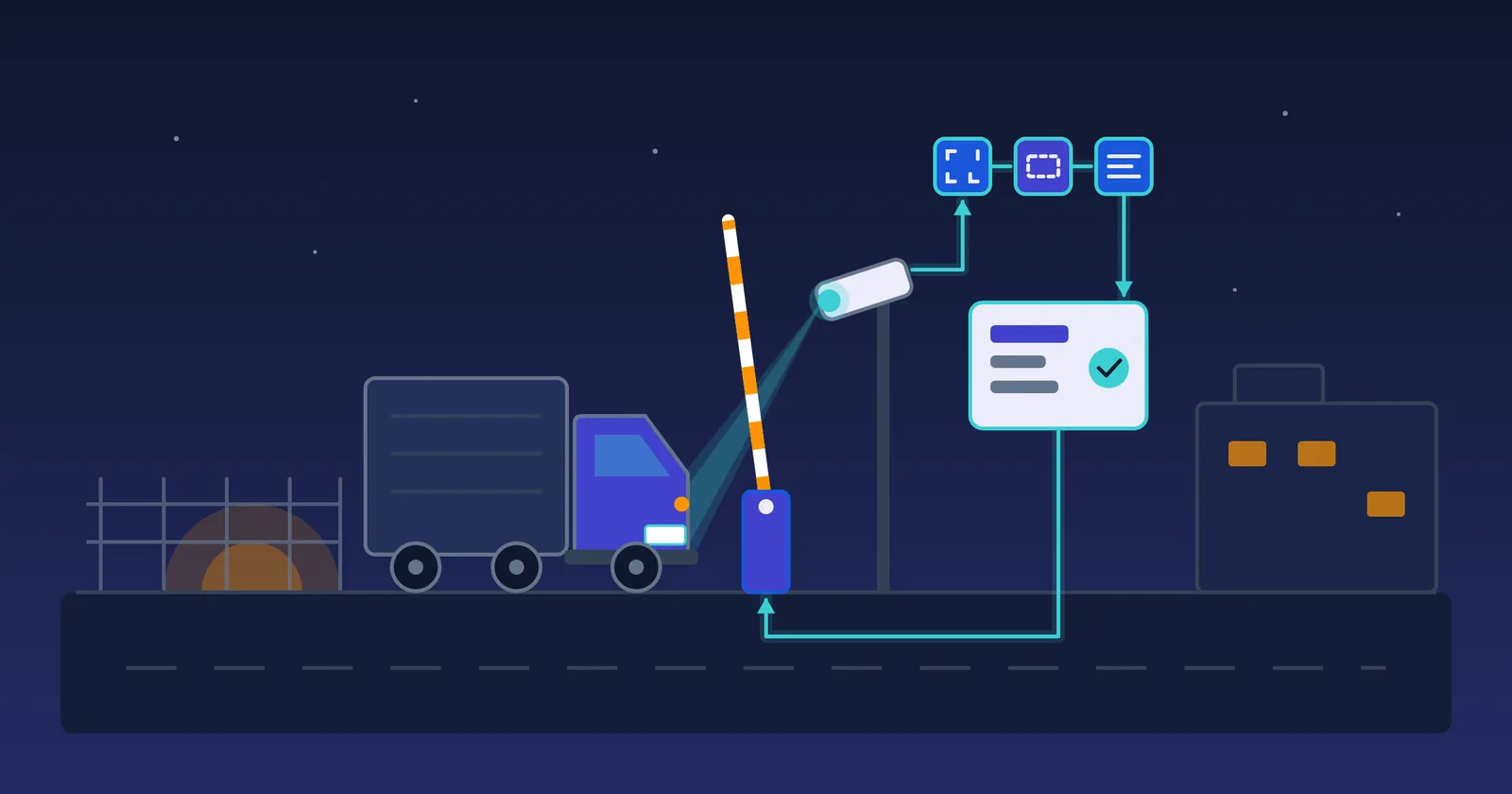

Automatic number plate recognition (ANPR) reads a vehicle's registration plate from camera video and turns it into a record that another system can act on. That might mean opening a boom barrier, attaching a truck to a weighbridge ticket, logging a visitor, or flagging a vehicle that shouldn't be on site. You'll also see it called licence plate recognition (LPR) or ALPR. The problem is the same under every name.
Most people picture the model reading the characters, but that is rarely the part that breaks. The failures happen around it: a camera mounted at the wrong angle, a plate that is dirty, hand-painted or half-hidden, one truck that produces twelve reads and three events, and a gate controller that never gets the result because the network dropped.
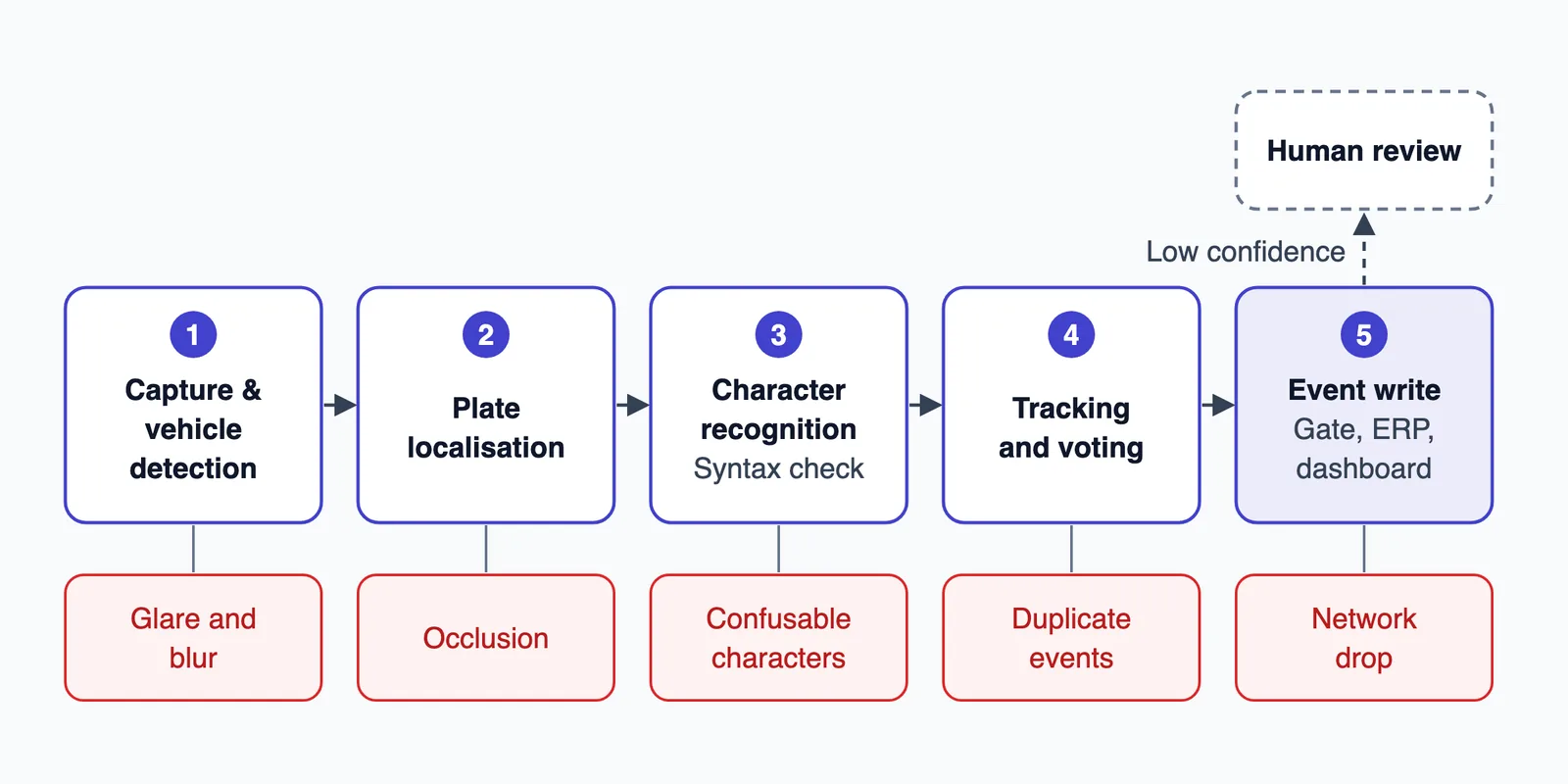
This guide follows one vehicle through the five stages of an ANPR system. For each stage it covers what can go wrong and what you control. It then explains why Indian plates are harder than the datasets most models are trained on, how to measure accuracy on your own footage, and what to check before you deploy. Most published ANPR figures come from companies that sell cameras, so each number below is labelled by the type of source it comes from.
How automatic number plate recognition works: the five-stage pipeline
Wikipedia describes the ANPR algorithm in seven steps: plate localisation, orientation and sizing, normalisation, character segmentation, optical character recognition, syntactic/geometric analysis, and averaging across multiple images. It also notes that overall accuracy depends on how well each step is done (Wikipedia, [Encyclopedia]). For a site deployment it helps to regroup those seven steps into five stages and add the two that the classic list leaves out: detecting the vehicle first, and handing the result to something that acts on it.
In the ANPR and vehicle monitoring system we designed for gated sites, vehicle detection, plate localisation and character recognition run as separate stages, and the output is a structured event rather than a raw string. The separation is deliberate. When accuracy drops, you can see which stage caused it.
| Stage | Input | Output | Typical failure |
|---|---|---|---|
| 1. Capture and vehicle detection | Video stream from the lane camera | Vehicle bounding box, class (car, truck, two-wheeler), colour | Motion blur, headlight glare, plate too small in pixels |
| 2. Plate localisation | Vehicle crop | Plate crop, corrected for angle and size | Occlusion, plate-like stickers, small two-wheeler plates |
| 3. Character recognition | Plate crop | Plate string with per-character confidence | Confusable characters, multi-line plates, unusual fonts |
| 4. Tracking and voting | Per-frame reads | One final plate per vehicle passage | Duplicate events, two vehicles merged into one |
| 5. Event write | Final read plus images | Event in the gate controller, ERP, dashboard or review queue | No low-confidence path, events lost when the network drops |
Stage 1: Capturing the frame and detecting the vehicle
Camera geometry decides most of your accuracy
A model can't recover characters that the camera never resolved. If a character stroke is smeared across two pixels by motion blur, or the whole plate is 25 pixels wide, no amount of model training will bring the missing information back. Wikipedia's list of ANPR difficulties starts with the image itself: poor resolution, motion blur, reflections and shadows (Wikipedia, [Encyclopedia]).
Plate Recognizer, which sells a recognition engine, publishes some of the more specific setup guidance available (Plate Recognizer, [Vendor]):
- Angle: keep it to 45° at most. Their engine can still read at up to 53° of tilt and 70° of side angle, but not at 75°.
- Plate size in the image: aim for roughly 100 pixels across the plate. The engine can read at around 30 px, but with little margin for blur or dirt.
- Shutter speed: 1/300 s for parking lots (1/600 s for faster or darker scenes), and 1/1500 s for highways (up to 1/2500 s when dark).
- Distance: a maximum advisable distance of 35 m.
- Headlights: don't point the camera straight into them.
Wikipedia gives similar shutter guidance: 1/1000 s is ideal for dedicated cameras, and 1/500 s works for traffic up to 65 km/h ([Encyclopedia]). Camera makers quote higher limits. Avigilon lists a maximum detection speed of 100 mph (160 km/h) and 850 nm infrared night vision on some models (Avigilon, [Vendor]). Axis notes that some lighting conditions need IR-capable cameras or extra light (Axis, [Vendor]). Neither publishes read rates under those conditions.
For a gate or yard, speed is usually low, but angle and glare are the real problems. A camera bolted to the guard cabin and looking sideways across the lane, or a general surveillance camera covering the whole forecourt, often fails the 45° and 100 px guidance before any model runs.
Why detect the vehicle before the plate
Running a vehicle detector first does three useful jobs. It narrows where the plate search has to look, which cuts false plate detections on signboards and painted text. It gives you the vehicle's class and colour, which you can use to cross-check the read. And it starts a track, so every later read can be tied to one physical vehicle.
The cross-check matters more than it sounds. In Mumbai in 2019, one motorist received an e-challan whose photo showed a black bike, while the bike registered to that number was red (Free Press Journal, [News]). A simple check of colour and class against the registration record would have caught that before the challan went out. Vehicle detection also lets you count vehicles whose plates were never read, which is the only honest way to measure capture rate.
Stage 2: Finding the plate
Plate localisation finds the plate inside the vehicle crop, then corrects for orientation and size so the reader gets a flat, consistently scaled image. Wikipedia's orientation, sizing and normalisation steps belong here.
It fails in predictable ways:
- Occlusion. Wikipedia notes that tow bars and similar obstructions can hide one or two characters ([Encyclopedia]). Bike racks, dirt, bumper guards and decorations hung across the front of a vehicle do the same.
- Things that look like plates. Stickers, company names painted on truck cabins, slogans and dealer frames all have plate-like rectangles and text.
- Small plates. Two-wheeler plates take up a fraction of the frame that a car plate does, so they hit the minimum pixel size first.
- Front and rear plates that differ. Wikipedia lists this for trailers ([Encyclopedia]). A tractor-trailer entering a yard may show the tractor's number at the front and the trailer's at the back.
What you control: a region of interest per lane, so the detector ignores the opposite lane and the parked vehicles behind it; a minimum plate size, below which the system treats the frame as unreadable rather than guessing; and a decision on which plate is the record for articulated vehicles, front or rear, made before you mount the camera.
Stage 3: Reading the characters
Segment-then-classify vs. sequence models
The classic approach splits the plate into individual characters and classifies each one. It's easy to debug, because you can see which character box went wrong. But it breaks when characters touch, when spacing is irregular, or when the font is hand-painted and the segmenter can't find clean gaps.
Newer readers take the whole plate image and output the string directly. A 2022 paper on Indian commercial truck plates for weighbridge automation used YOLOv7 for plate detection and PARSeq, a sequence-recognition model, for reading. It reports 95.82% accuracy on the authors' own dataset, against under 90% in the prior work they cite, and notes that handwritten plates and varied fonts make generalisation hard (Agrawal and Joshi, arXiv 2211.13194, [Academic]). That figure applies to their data. It isn't a number you should expect at your gate without testing.
Sequence models do have a weak spot on multi-line plates. The model has to learn a reading order across lines as well as along them. When it gets that wrong, it can repeat a character from the first line or drop one at the join. If your traffic includes many two-line plates, test that subset on its own. Small, square two-wheeler plates and commercial plates are the usual cases, and they are also why custom computer vision models trained on your own camera footage tend to beat generic readers on local plates.
Syntax checks and confusable characters
Wikipedia's "syntactic/geometric analysis" step checks the read against what a valid plate can look like. In India, a standard registration is a state code, an RTO number, series letters, then a number from 1 to 9999, such as AN 01 Z 0123 (Wikipedia: Vehicle registration plates of India, [Encyclopedia]). The BH series follows a different pattern, "12 BH 3456 XX", so a rule set that only knows the state format will reject valid BH plates.
Format rules help most with confusable characters: 0 and O, 1 and I, 5 and 6, 8 and B. If a position can only hold a digit, a low-confidence "O" there is almost certainly a zero. Be careful with automatic correction, though. A misread that the rules "correct" into another valid plate is worse than one that fails validation, because it looks trustworthy. Use the rules to fix obvious position errors, and send anything that fits no pattern to review instead of forcing a match.
Stage 4: Tracking across frames and voting on the read
A vehicle approaching a gate is visible for many frames, and each frame can produce a read. Some of those reads will be wrong: the first is blurred, one catches headlight glare, another is half-occluded by the barrier arm. Wikipedia's final step, averaging across multiple images, handles this ([Encyclopedia]). In practice it takes three pieces.
- Tracking links the detections of one vehicle across frames, so its reads are grouped together.
- Voting combines those reads into one string. A per-character vote weighted by confidence usually works better than picking the single most confident frame.
- De-duplication makes sure one passage through the gate creates one event, even if the vehicle sits in view for two minutes.
To vote, you need enough frames. Plate Recognizer suggests 4–5 fps below 30 mph (about 48 km/h), 8–10 fps between 30 and 60 mph, and 12 fps above 60 mph (Plate Recognizer, [Vendor]). At 30 km/h a vehicle covers about 8 m per second, so at 5 fps it moves more than a metre and a half between frames. The readable zone in front of the camera has to be long enough to collect several good frames.
Tracking fails when a vehicle changes lanes inside the camera's view, which Wikipedia lists as a known difficulty ([Encyclopedia]). It also fails when two vehicles tailgate closely and merge into one track, and when a truck stops at the boom barrier, reverses and comes forward again. That last case is common at weighbridges and site gates. Decide up front whether a reverse-and-return within a short window counts as one event or two, and record the direction of travel so entries and exits are separate.
Stage 5: Writing the event to a downstream system
ANPR only becomes useful when the read reaches something that acts on it. The output should be a structured event, not just a string. The AtlasML case study design carries a timestamp, camera location, and the vehicle and plate images with each event, and feeds them into a searchable dashboard. A workable schema looks like this:
{
  "event_id": "gate2-lane1-20261110-083214-0042",
  "plate": "MH12AB1234",
  "confidence": 0.93,
  "timestamp": "2026-11-10T08:32:14+05:30",
  "camera_id": "gate2-cam1",
  "lane": "inbound-1",
  "direction": "entry",
  "vehicle_class": "truck",
  "vehicle_colour": "white",
  "plate_crop": "s3://anpr/crops/...jpg",
  "vehicle_image": "s3://anpr/frames/...jpg",
  "review_status": "auto_accepted"
}
The plate number above is a placeholder. Keep the images. They are what a reviewer uses to fix a read, and what you need when a driver disputes a record.
Decide what happens at low confidence
Every system will produce reads it isn't sure about. What matters is what happens to them. You have three options:
- Auto-accept above a confidence threshold. This is fine for logging and analytics, and risky for anything that charges money or opens a barrier.
- Human review queue. Low-confidence events go to a screen with the crop and the vehicle image, and a person confirms or corrects the read. This suits weighbridges, billing and compliance records.
- Fallback at the gate. The guard keys in the plate, or the barrier stays shut until someone confirms. This suits access control, where a wrong "yes" matters more than a short delay.
Getting this workflow right usually does more for real-world outcomes than another point of model accuracy. The threshold can also differ by lane and use: lower on an exit lane used for logging, higher where the read raises an invoice.
Allow lists, gates and business systems
For access control, the event is matched against an allow list and triggers a relay on the barrier controller. Resist fuzzy matching on allow lists. Accepting a plate that is one character off makes the system easier to fool. For logistics, the event opens or closes a record in the ERP, or attaches to a weighbridge ticket so the gross and tare weights belong to the right truck. How the event reaches the gate controller, ERP or weighbridge software is an integration question with its own failure modes.
One of those failure modes is network loss, and vendor pages rarely mention it. If the processing box can't reach the server, it should queue events locally and forward them when the link returns, with idempotent event IDs so a retry doesn't create a duplicate. The barrier decision should not depend on a round trip to the cloud.
Once every passage is a row with a timestamp, lane and direction, ANPR becomes a data source for operational analytics and dashboards: dwell time, peak-hour load and repeat visits. For how plate events feed shipment and fleet decisions, see AI in logistics tracking and monitoring.
Automatic number plate recognition on Indian plates
What the rules say a plate looks like
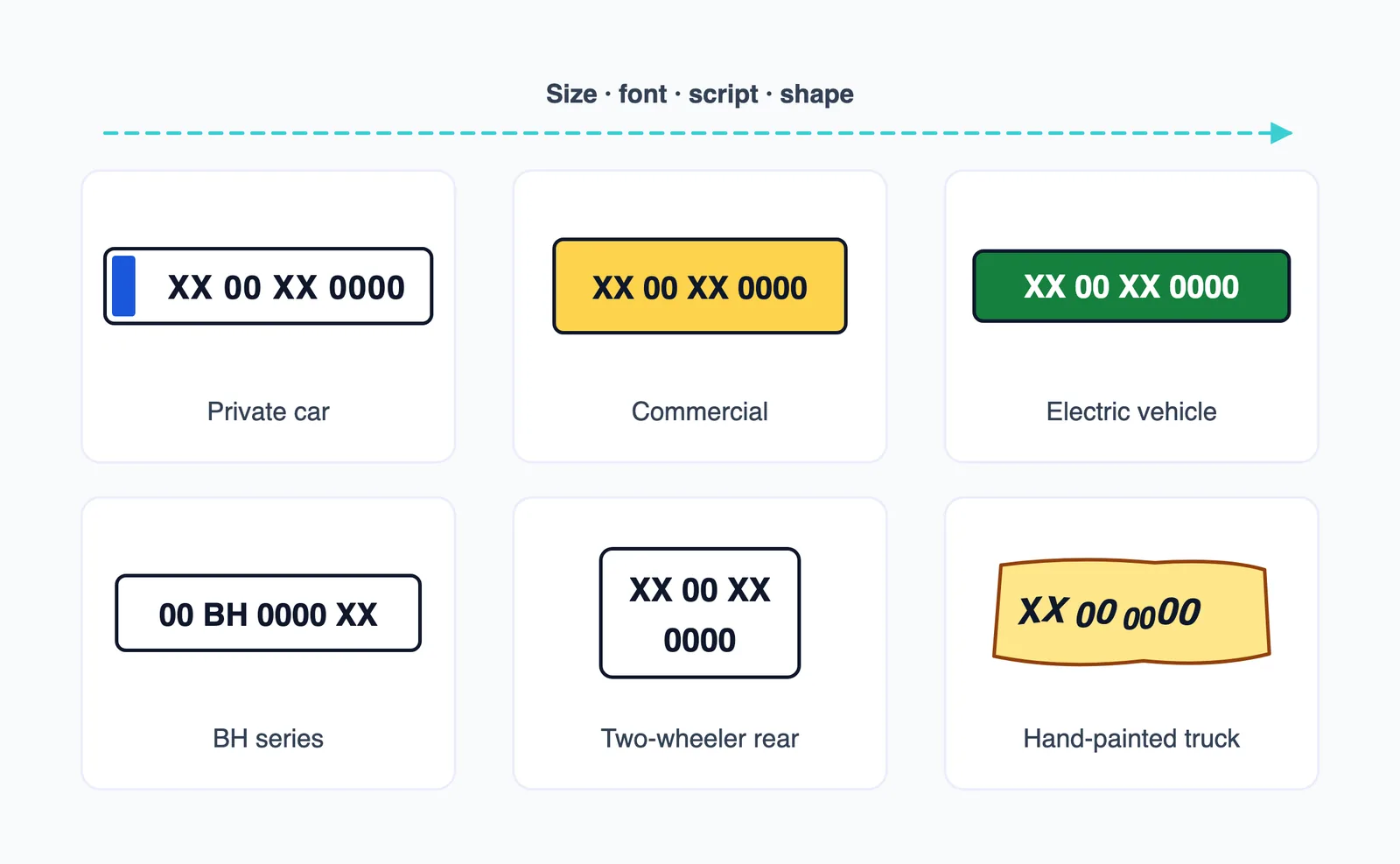
On paper, Indian plates are well defined. Plates must use Hindu-Arabic numerals and Latin letters, in the state–RTO–series–number format. Colour indicates the vehicle type: black on white for private vehicles, black on yellow for commercial, yellow on black for rentals, green for electric vehicles, red on yellow for temporary registration, white on red for trade plates, and white on blue for diplomatic vehicles. The BH series was notified on 26 August 2021 (Wikipedia, [Encyclopedia]). Plate colour is a useful second signal: a yellow plate on a vehicle detected as a private car is worth a second look.
High-security registration plates (HSRP) were mandated by a June 2005 amendment to Rule 50 of the Central Motor Vehicles Rules, 1989. They have a chromium hologram, laser numbering, retro-reflective film and embossed characters, and come in four sizes: 34 × 20 cm for medium and heavy commercial vehicles, 50 × 12 cm for light motor vehicles, 20 × 10 cm for the rear of two-wheelers, tractors and three-wheelers, and 28.5 × 4.5 cm for the front of two-wheelers and tractors ([Encyclopedia]). By 14 December 2023, about 13.45 crore HSRPs had been fitted, according to VAHAN portal data reported under MoRTH (India Education Diary, [Official, via secondary]).
Those sizes make the reach problem concrete. If a camera is set so a 50 cm car plate is 100 px wide, a 28.5 cm two-wheeler front plate in the same position is about 57 px wide and only about 9 px tall, and the characters are smaller still. One camera rarely serves both well. The retro-reflective film adds a night-time issue: under IR, the plate can come out much brighter than the vehicle around it, and an exposure tuned for the scene can wash it out.
What cameras actually see
Real traffic is messier than the rules. One research group puts it directly: "Indian vehicle number plates have wide variety in terms of size, font, script and shape" (Nadiminti, Gaur and Bhardwaj, arXiv 2207.06657, [Academic]). Older non-HSRP plates are still on the road. Commercial vehicles carry hand-painted numbers, sometimes in stylised fonts, sometimes on the body rather than a plate. Square plates split the number across two lines. Paint fades, and decorations hang over the plate. The weighbridge study above found handwritten plates and varied fonts on Indian trucks hard to generalise across ([Academic]).
Why models trained abroad underperform here
The largest public plate datasets come from other countries, and the results don't transfer well. The Indian Licence Plate Dataset in the wild, with 16,192 images and 21,683 annotated plates, was built partly because models trained on large Chinese and Brazilian datasets performed poorly on Indian plates (Tanwar, Tiwari and Chowdhry, arXiv 2111.06054, [Academic]). The 2022 Indian dataset paper found that aligning its data with a Chinese dataset improved plate detection by 42.86%, and that a YOLOv5 pretrained on general COCO images was more sample-efficient than one pretrained on Chinese plates (CCPD) (arXiv 2207.06657, [Academic]). A model that already knows foreign plates is not automatically a better starting point.
This isn't only an India problem. Laroca et al. tested twelve OCR models on nine public plate datasets and found significant performance drops on most datasets when a model was tested on a dataset it had not been trained on (Laroca et al., VISAPP 2022, [Academic]). The practical lesson: a vendor's accuracy figure describes their test data, not your gate. Plan to fine-tune on footage from your own cameras.
Where ANPR misreads have real consequences
In May 2019, Mumbai had ANPR cameras at 150 junctions, and motorists complained of e-challans for violations they never committed. Officials blamed "technical glitches" and said genuine cases would be reversed (Free Press Journal, [News]). The stakes keep rising. NHAI's barrier-free multi-lane free-flow tolling on NH-48 in Gujarat, as reported, combines ANPR with FASTag (NBM&CW, [News]). When a read can trigger a charge or keep a barrier shut, the review and dispute path is part of the product, not something to add later.
How to measure ANPR accuracy before you trust it
Vendor accuracy claims rarely say how they were measured. Adaptive Recognition describes operation "at any speed up to 320 km/h" and a processing rate "nearing 100%" without stating a method (Adaptive Recognition, [Vendor]). "Accuracy" can mean several different things, and a system can look good on one while failing on another. Measure these separately:
| Metric | Question it answers | Ground truth |
|---|---|---|
| Capture rate | Was the vehicle seen at all? | Manual count from video, or gate and weighbridge logs |
| Plate detection rate | Of vehicles seen, how many had a plate located? | Annotated frames |
| Exact-match read rate | Of plates located, how many were read correctly in full? | Hand-labelled plate strings |
| Event-level match | Does each real passage produce exactly one correct event? | Gate register, weighbridge tickets, security logs |
Use exact match on the full string, not character accuracy. A read with nine of ten characters right scores 90% on character accuracy, and it still points to the wrong vehicle.
Then break the results down by condition, because an average hides where the system fails:
- Day vs. night, and dusk, when exposure is hardest
- Rain and dust
- Cars, trucks, two-wheelers and three-wheelers
- HSRP vs. older and hand-painted plates
- Single-line vs. two-line plates
- Each lane and camera on its own
Build the test set from your own cameras. Record a few days that include nights and at least one bad-weather spell, label the plates by hand, and keep that set fixed so you can compare model versions fairly. Agree the acceptance numbers per condition before the pilot starts, not after you've seen the results.
Deploying an ANPR system: a site checklist
Most deployment problems show up in the first week of a pilot and could have been caught in a site survey. Use this list before committing to hardware:
| Item | What to decide or check |
|---|---|
| Site survey | Number of lanes, direction of travel, approach speeds, vehicle mix, lighting at night, headlight direction, existing CCTV positions |
| Camera spec | Plate width in pixels at the read point (vendor guidance is about 100 px), angle within about 45°, shutter fast enough for lane speed, IR for night |
| Existing CCTV | Test footage from current cameras against the same pixel and angle checks. Wide surveillance views usually fail. |
| Processing location | Edge box at the gate for barrier decisions and network loss; server or cloud for search and analytics |
| Event schema | Fields, IDs, images, direction, and how reverse-and-return is handled |
| Low-confidence workflow | Thresholds per lane, who reviews, how fast, and the fallback at the gate |
| Integrations | Barrier relay, ERP, weighbridge, visitor management; store-and-forward on network loss |
| Data handling | Retention period, access control, audit logging, masking in exports |
| Pilot | Fixed test set, metrics per condition, acceptance criteria agreed in writing |
The AtlasML ANPR plan sets out four phases over an estimated 10–12 weeks: site setup in weeks 1–2, vehicle and plate detection in weeks 3–5, event processing in weeks 6–8, and verification in weeks 9–12, built in Python with OpenCV. The case study also says that actual recognition performance has to be validated against the target camera environment. That is the right default for any vendor: no accuracy commitment until the system has run on your cameras.
On data protection: India's Digital Personal Data Protection Rules were notified in November 2025, with an 18-month phase-in for core obligations, including consent notices, retention and erasure, and security safeguards such as encryption or masking, access controls and logging. Penalties can reach INR 250 crore per breach (India Briefing, [Legal news]). Whether plate data counts as personal data in your setup is a question for your counsel. Either way, the safeguards on that list are cheap to design in and expensive to add later.
ANPR isn't a set-and-forget install. Plate styles change, cameras get knocked out of alignment, and seasonal lighting shifts. Plan for monitoring and retraining as described in our MLOps playbook for production models. If you're comparing partners for the build, use these questions for choosing a computer vision development company.
Frequently asked questions
What is automatic number plate recognition (ANPR)?
ANPR uses cameras and software to detect a vehicle, find its number plate, read the characters, and store the result as a timestamped event. Other systems act on that event: a barrier controller, an ERP, a weighbridge, a dashboard. It's also called licence plate recognition (LPR) or ALPR.
How accurate is ANPR?
It depends on camera placement, lighting and plate condition more than on the model. Most published figures are vendor claims made under unstated conditions. Measure exact-match reads on the full plate string using your own footage, broken down by day and night, weather and vehicle type, before you rely on any number.
Can ANPR read Indian number plates, including two-wheelers and HSRP?
Yes, but research shows that models trained on Chinese and Brazilian plates perform poorly on Indian ones. Small two-wheeler front plates (28.5 × 4.5 cm under HSRP rules), two-line plates and hand-painted commercial plates need local training data and careful camera placement. HSRP plates are more uniform, but their retro-reflective film needs night exposure tuned for it.
Can I use my existing CCTV cameras for ANPR?
Sometimes. Check whether the plate is wide enough in pixels (vendor guidance is about 100 px), whether the camera angle is within about 45°, and whether the shutter is fast enough to freeze a moving plate. Most general surveillance cameras cover too wide a view, so a dedicated lane camera is often needed at the read point.
Does ANPR work at night?
It can, with infrared illumination and a camera angled so it isn't looking straight into headlights. Test night performance separately from daytime, because glare, retro-reflective plates and low light fail in different ways. Dusk is often the hardest period.
How long does an ANPR deployment take?
For a gated site, a typical plan covers a site survey and camera setup, detection and recognition model work, event processing and integration, and on-site verification. AtlasML's ANPR plan estimates 10–12 weeks across those four phases. Actual accuracy can only be confirmed once the system runs on the site's own cameras.