
Introduction: The Hidden Operational Problems in Logistics Yards
A busy logistics yard can have dozens of trucks arriving, waiting, loading and departing throughout the day.
While warehouse teams focus on inventory and shipment processing, yard managers must coordinate vehicle movement, loading dock availability, waiting areas and dispatch schedules.
However, many facilities still rely on security personnel, radio communication, spreadsheets and traditional CCTV monitoring to manage these activities.
This can create operational problems:
Trucks waiting in long queues outside the facility.
Loading docks remain unused while vehicles wait.
Difficulty identifying which vehicles have been waiting too long.
Poor visibility into yard congestion.
Delays in vehicle assignment and loading operations.
Limited historical information about truck turnaround time.
Computer vision provides an opportunity to improve this situation.
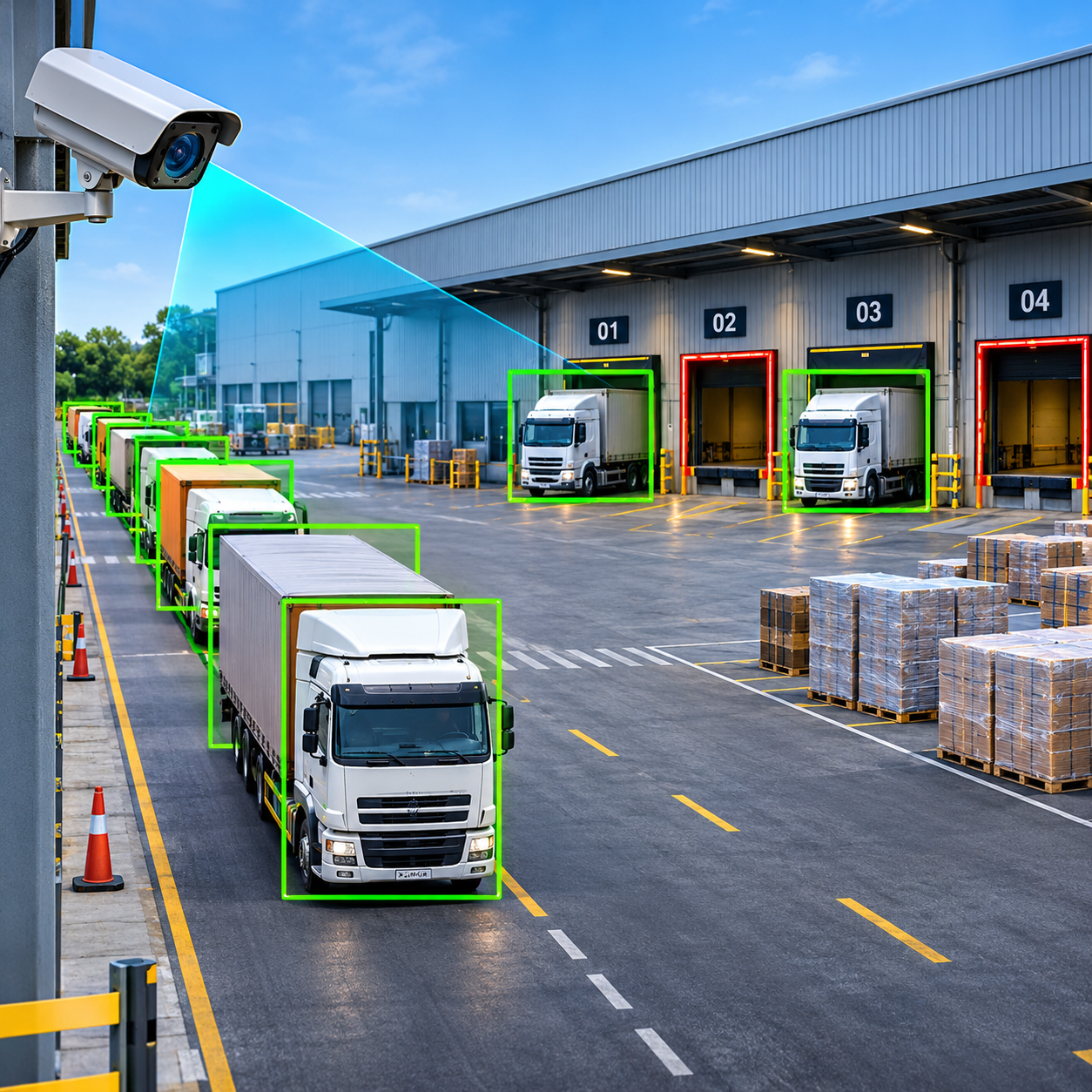
By analysing existing CCTV footage, businesses can detect trucks, monitor queue lengths, identify occupied loading docks and record vehicle movement across designated areas.
This allows logistics managers to understand what is happening across the yard without relying entirely on manual observation.
1. What Is Computer Vision in Logistics Yard Management?
Computer vision is a technology that analyses images and video streams to detect objects, recognise activities and identify operational events.
In a logistics yard, it can be configured to monitor:
Trucks and trailers.
Vehicle waiting queues.
Loading and unloading docks.
Parking and staging areas.
Vehicle entry and exit points.
Restricted operational zones.
For example, cameras installed at a warehouse entrance can detect incoming trucks and calculate the number of vehicles waiting in a designated queue.
Similarly, cameras overlooking loading docks can identify whether a dock is occupied or available.
This information can be displayed on a centralized dashboard, helping supervisors make better operational decisions.
2. Five Major Logistics Yard Problems Computer Vision Can Address
A. Truck Queue Detection
Truck congestion is one of the most common challenges in logistics yards.
When multiple vehicles arrive at the same time, they may create queues at entrance gates, inspection points and loading areas.
Computer vision can detect and count trucks within predefined zones.
The system can provide:
Number of trucks waiting.
Queue length.
Queue start and end times.
Vehicle movement status.
Alerts when queue thresholds are exceeded.
For example, if more than 10 trucks are waiting at a warehouse entrance, the system can notify the operations team.
B. Loading Dock Occupancy Monitoring
Loading docks are valuable operational resources.
When a dock remains occupied for longer than expected, other trucks may have to wait, reducing the facility's ability to process incoming shipments.
Computer vision can monitor each dock and identify:
Occupied docks.
Available docks.
Trucks arriving at docks.
Trucks leaving docks.
Dock utilization over time.
Managers can use this information to identify underutilized areas and operational bottlenecks.
C. Vehicle Waiting Time Monitoring
A truck's turnaround time includes multiple stages:
Gate arrival.
Security and vehicle verification.
Waiting for dock assignment.
Loading or unloading.
Final verification.
Gate exit.
Computer vision can record vehicle entry and exit events and monitor activity in configured yard zones.
These timestamps can help calculate total vehicle dwell time and identify where delays occur.
For more accurate stage-by-stage measurement, the system should combine camera events with dock, gate and warehouse workflow records.
D. Unauthorized Vehicle Movement
Logistics yards contain designated vehicle routes, loading areas and restricted zones.
Computer vision can detect configured events such as:
Vehicles entering restricted areas.
Trucks moving through prohibited zones.
Vehicles stopping in designated no-parking areas.
Unauthorised vehicle presence.
The system can generate alerts for security personnel and supervisors.
E. Limited Operational Visibility
Traditional CCTV systems provide recorded footage, but managers may still need to manually review multiple cameras.
Computer vision converts video footage into structured operational information.
A centralized platform can display truck counts, dock occupancy, queue activity and vehicle movement events in one place.
3. How an Intelligent Yard Monitoring System Works
A computer vision yard monitoring solution typically follows this workflow.
Step 1 – CCTV Camera Integration
Connect existing IP cameras or CCTV systems installed at gates, parking areas, loading docks and yard entrances.
Step 2 – Vehicle Detection
The system detects trucks, trailers and other configured vehicle types.
Step 3 – Vehicle Tracking
Object tracking algorithms follow vehicles across video frames within monitored camera areas.
Step 4 – Queue and Dock Detection
Virtual zones are configured to identify truck queues and loading dock occupancy.
Step 5 – Event and Time Recording
The system records vehicle arrival, zone entry, dock occupancy and departure events.
Step 6 – Automated Alerts
Notifications can be generated when predefined conditions occur, such as excessive queue length or prolonged dock occupancy.
Step 7 – Dashboard and Reporting
Managers can monitor vehicle activity, waiting times, dock utilization and operational events through a centralized dashboard.
4. Real-World Case Study: Transforming Yard Management with Computer Vision
A relevant implementation example is the yard management solution developed by 10xDS for a leading consumer goods company.
The business challenge
The company experienced limited real-time visibility into yard operations.
Truck movement inefficiencies, prolonged dock utilization and delayed driver exits affected operational workflows.
Managers also lacked immediate information about operational exceptions and safety compliance.
The solution
10xDS implemented a computer vision solution integrated with the company's existing CCTV infrastructure.
The system focused on:
Real-time yard activity monitoring.
Loading dock utilization.
Detection of safety-related events.
Identification of operational deviations.
Automated alerts through Microsoft Teams.
Live and historical operational dashboards.
Business value
The implementation helped improve yard visibility, support faster operational responses and provide managers with actionable information.
Read the complete case study:
https://10xds.com/case-studies/transforming-yard-management-with-computer-vision-solution/
5. What Should a Smart Yard Management Dashboard Include?
A well-designed dashboard should provide operational information rather than simply displaying camera footage.
Yard Overview
Total trucks detected.
Trucks currently inside the yard.
Trucks waiting in queues.
Occupied and available docks.
Vehicles entering and exiting.
Queue Monitoring
Current queue length.
Queue location.
Waiting time.
Queue threshold alerts.
Historical queue reports.
Loading Dock Monitoring
Dock identification.
Occupancy status.
Associated vehicle.
Dock arrival timestamp.
Dock departure timestamp.
Utilization reports.
Vehicle Movement History
Vehicle registration number, when ANPR is integrated.
Entry and exit times.
Camera location.
Movement events.
Related video evidence.
Management Reports
Daily vehicle movement report.
Average truck waiting time.
Vehicle turnaround time.
Dock utilization report.
Queue congestion history.
Operational exception report.
6. How Computer Vision Integrates with WMS, TMS and ERP Systems
Computer vision becomes more useful when its operational data is connected to existing business applications.
A logistics company may already use:
Warehouse Management System (WMS).
Transport Management System (TMS).
Enterprise Resource Planning (ERP).
Fleet Management Software.
Computer vision can provide additional information to these platforms.
Example integration workflow:
Stage | System Activity |
Truck arrival | Camera detects the vehicle |
Vehicle identification | ANPR reads the registration number |
Vehicle verification | TMS checks the assigned vehicle |
Queue monitoring | System records waiting activity |
Dock assignment | TMS or yard system assigns a dock |
Dock monitoring | Computer vision detects occupancy |
Departure | Exit event is recorded |
Reporting | Vehicle and dock activity is available for analysis |
APIs can connect the vision platform with existing business software, subject to the integration capabilities of each system.
7. Technologies Used in Computer Vision Yard Monitoring
A typical solution may include:
Technology | Application |
Python | Backend processing |
OpenCV | Video stream processing |
YOLO | Truck and vehicle detection |
ByteTrack | Vehicle tracking |
OCR | Number plate recognition |
PostgreSQL / SQL Server | Event and vehicle records |
REST APIs | ERP, WMS and TMS integration |
Web Dashboard | Yard monitoring and reporting |
The final technology selection depends on camera quality, site layout, lighting, traffic patterns and required detection accuracy.
8. Business Benefits of Computer Vision in Yard Management
Business Area | Potential Benefit |
Truck queues | Better congestion visibility |
Dock management | Improved occupancy monitoring |
Vehicle waiting | More accurate dwell-time records |
CCTV monitoring | Automated event identification |
Yard safety | Faster detection of configured violations |
Dispatch operations | Better coordination |
Management | Data-driven operational decisions |
Performance improvements depend on the facility's existing processes, camera coverage and implementation quality.
9. The Future of Smart Logistics Yard Management
The future of logistics operations will involve greater integration between computer vision, IoT, GPS tracking, warehouse software and transport management platforms.
Computer vision can identify vehicles and monitor activities, while IoT sensors can provide equipment and occupancy information. GPS can provide vehicle location outside the facility.
When these technologies work together, logistics businesses can develop a connected operational environment.
For example, a manager could monitor:
Which trucks are approaching the facility.
How many vehicles are waiting at the entrance.
Which loading docks are occupied.
How long vehicles have been waiting.
Which trucks have completed their dispatch process.
This information can help businesses improve yard coordination and operational planning.
Conclusion
Logistics yard management is an important part of transportation and warehouse efficiency.
Truck queues, loading dock congestion and limited vehicle visibility can affect daily operations and increase waiting times.
Computer vision offers businesses a way to convert existing CCTV infrastructure into an intelligent monitoring platform.
By detecting trucks, monitoring queues, tracking dock occupancy and recording vehicle events, businesses can gain better visibility into their yard operations.
For logistics companies, distribution centres and 3PL providers, this technology creates opportunities to improve operational control and build more connected transportation workflows.
Looking to automate your logistics yard operations?
atlasml.ai develops custom computer vision, vehicle monitoring, CCTV analytics and logistics automation solutions.
Contact our team to explore how computer vision can improve your warehouse and transportation operations.