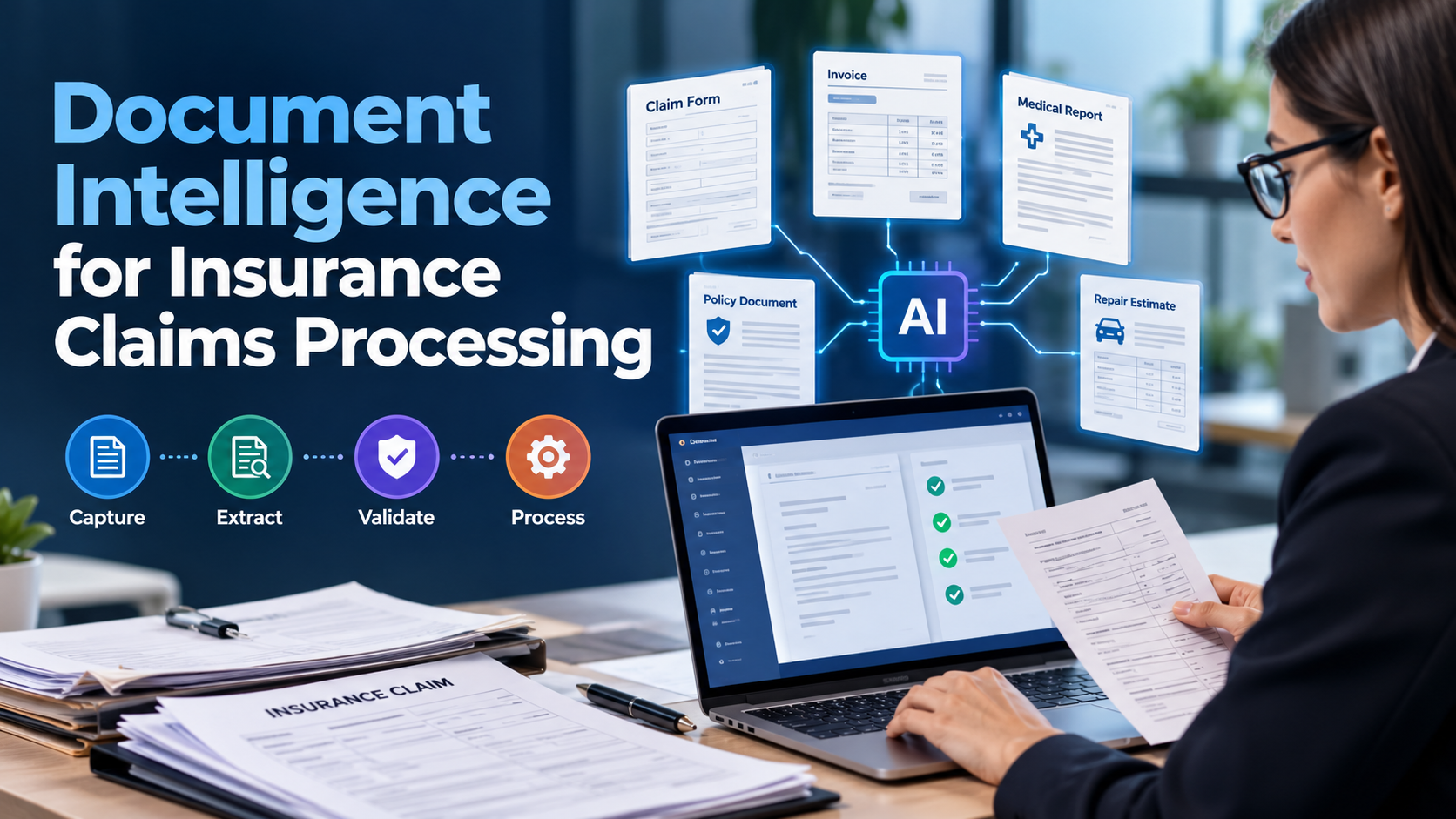

Introduction
Insurance claims processing involves reviewing policy documents, claim forms, invoices, medical reports, repair estimates, photographs, and other supporting records. As claim volumes increase, managing these documents manually can become time-consuming, expensive, and difficult to scale.
Traditional claims processing often requires employees to extract information from multiple documents, verify policy details, identify missing information, and enter data into insurance management systems. These repetitive tasks can delay claim settlements, increase administrative costs, and create opportunities for human error.
Document intelligence for insurance claims processing helps insurance companies automate document-heavy workflows using technologies such as Artificial Intelligence (AI), Optical Character Recognition (OCR), Natural Language Processing (NLP), and Machine Learning (ML).
By converting unstructured documents into structured, usable information, document intelligence enables insurers to process claims more efficiently, improve data accuracy, and support faster decision-making.
What Is Document Intelligence in Insurance?
Document intelligence is the use of AI-based technologies to capture, extract, classify, interpret, and validate information from digital and scanned documents.
In the insurance industry, it helps transform documents such as claim forms, policy schedules, medical bills, accident reports, and repair invoices into structured data that can be used by claims management systems.
Unlike basic OCR, which primarily converts images of text into machine-readable text, document intelligence can also identify document types, recognize relevant fields, understand relationships between information, and support validation against business rules.
For example, when an insurer receives a motor insurance claim, a document intelligence solution can identify the accident report, extract the policy number, recognize the incident date, capture repair costs, and flag missing or inconsistent information for further review.
This reduces the amount of manual data entry required and allows claims professionals to focus on complex cases, customer communication, and decisions that require human judgment.
Why Insurance Companies Need Document Intelligence
Insurance claims frequently involve large volumes of documents collected from policyholders, hospitals, repair centers, surveyors, brokers, and third-party service providers.
Managing these documents manually creates several operational challenges.
1. High Volumes of Manual Data Entry
Claims teams often need to enter the same information into multiple systems. Manual entry consumes time and can introduce errors in policy numbers, claim amounts, dates, customer details, and other critical fields.
2. Unstructured Document Formats
Documents arrive in different formats, including PDFs, scanned images, emails, spreadsheets, photographs, and handwritten forms. Extracting consistent information from these sources can be difficult without automation.
3. Delays in Claim Verification
Before processing a claim, insurers may need to verify policy coverage, supporting evidence, invoices, medical reports, and other documentation. Reviewing every document manually can slow down the process.
4. Missing or Inconsistent Information
Claims may contain missing signatures, incomplete forms, inconsistent dates, incorrect policy references, or mismatched amounts. Identifying these issues early is essential to prevent avoidable rework.
5. Limited Operational Scalability
When claim volumes increase after severe weather events, road accidents, or other large-scale incidents, manual processing teams can struggle to keep up with demand.
Document intelligence helps address these challenges by automating repetitive document-related tasks while allowing human reviewers to handle exceptions and sensitive decisions.
How Document Intelligence Works in Insurance Claims Processing
A typical document intelligence workflow combines document ingestion, classification, data extraction, validation, and integration with existing insurance systems.
Step 1: Document Collection and Ingestion
The system collects claim documents from multiple sources, such as customer portals, email attachments, mobile applications, document management platforms, and insurance management systems.
Supported documents may include:
Insurance claim forms
Policy documents and schedules
Medical reports and hospital invoices
Vehicle accident reports
Vehicle repair estimates and invoices
Property damage assessments
Proof of identity and supporting records
Receipts and payment documents
Documents are organized and prepared for further processing.
Step 2: Document Classification
AI models identify the type of document submitted and categorize it according to the claims workflow.
For example, the system may classify incoming files as a claim form, medical bill, repair invoice, policy schedule, or accident report.
Classification helps route each document to the appropriate extraction process and reduces the need for employees to sort files manually.
Step 3: OCR and Intelligent Data Extraction
OCR converts text in scanned documents and images into machine-readable text. AI-based extraction techniques then identify important information within that text.
Depending on the document type, the system may extract:
Policy number and claim reference
Policyholder name and contact details
Date of incident and claim submission
Invoice number and total amount
Medical procedure and billing details
Vehicle registration number
Repair costs and estimated damages
Provider details and payment information
Modern document intelligence solutions may also use layout analysis and language models to interpret complex forms, tables, and document relationships.
Step 4: Data Validation and Cross-Checking
Extracted information is checked against predefined business rules and available records.
For example, the system can compare the policy number on a claim form with the insurer's policy database, check whether required documents have been submitted, and identify differences between an invoice total and the amount recorded in a claim.
Validation rules depend on the insurer's products, policies, and operational requirements.
Step 5: Exception Detection and Human Review
Not every document can be processed automatically. Poor image quality, handwritten content, ambiguous information, and conflicting records may require additional review.
The system can flag low-confidence fields, missing documents, and inconsistent values for human verification.
A claims professional can review the original document, correct extracted information, and approve or reject the proposed data before it moves to the next stage.
Step 6: Integration With Claims Management Systems
After validation, structured information can be transferred to the insurer's existing claims management platform, policy administration system, CRM, or document management solution through APIs and other approved integration methods.
This reduces duplicate data entry and helps maintain a consistent record of claim information across connected systems.
Step 7: Audit Trails and Performance Monitoring
The system records relevant processing activities, extraction results, corrections, and review decisions according to the insurer's requirements.
Operational dashboards can help teams monitor document volumes, processing times, extraction accuracy, exception rates, and outstanding reviews.
These insights help insurers identify bottlenecks and continuously improve their claims workflows.
Key Benefits of Document Intelligence for Insurance Claims Processing
1. Faster Claims Processing
Automating document classification, data extraction, and routine validation can reduce the time employees spend reviewing individual documents.
Claims teams can move eligible cases through the initial processing stages faster, particularly when supporting documentation is complete and consistent.
2. Improved Data Accuracy
Automated extraction and validation reduce reliance on repetitive manual data entry.
Confidence scores, field-level checks, and human review help identify errors before information is transferred into core insurance systems.
Accuracy still depends on document quality, model performance, and the complexity of the information being processed.
3. Reduced Administrative Workload
Employees spend less time sorting documents, copying data, and checking basic fields.
This gives claims professionals more time to investigate complex cases, coordinate with customers, and handle situations that require professional judgment.
4. Better Customer Experience
Delays caused by missing documents and repetitive requests can frustrate policyholders.
Document intelligence can help identify incomplete submissions earlier and support clearer communication about what information is required.
It can improve the efficiency of the claims journey, although overall settlement time also depends on investigation, coverage decisions, approvals, and payment procedures.
5. Improved Operational Scalability
Automated document processing can support larger volumes of incoming claims without requiring the same increase in manual document-handling effort.
This can be particularly useful during catastrophe-related claim surges or periods of seasonal demand.
6. Stronger Compliance and Traceability
Document intelligence can support consistent document handling, field validation, access controls, and audit logging.
When configured appropriately, these capabilities help insurers maintain records of processing activities and support internal reviews and applicable regulatory obligations.
Automation does not guarantee compliance; insurers must still implement appropriate governance, retention policies, security controls, and human oversight.
7. Better Claims Data and Business Insights
Structured data extracted from claims documents can help insurers analyze claim patterns, repair expenses, medical billing trends, processing bottlenecks, and documentation issues.
When combined with appropriate analytics, this information can support operational planning and improve the visibility of claims performance.
Common Use Cases of Document Intelligence in Insurance
Document intelligence can support multiple insurance products and claims workflows.
1. Motor Insurance Claims Processing
Motor insurance claims may involve accident reports, vehicle photographs, repair estimates, invoices, and surveyor reports.
Document intelligence can extract policy details, vehicle information, incident dates, and estimated repair costs. It can also compare information across documents and flag discrepancies for review.
This helps claims teams organize evidence and prepare cases for assessment.
2. Health and Medical Insurance Claims
Health insurance claims can include hospital bills, medical reports, prescriptions, treatment records, and reimbursement forms.
AI-based document processing can extract billing information, patient or policy references, service dates, and relevant document fields.
Insurers can use validation rules to identify missing records or inconsistencies before routing claims for clinical, coverage, or payment review.
Sensitive health information requires particularly strong access controls, secure processing, and appropriate data retention practices.
3. Property Insurance Claims
Property claims may require damage assessment reports, photographs, contractor estimates, receipts, and supporting evidence.
Document intelligence can organize these records, extract estimated repair costs, identify missing documentation, and support comparison of reported information across submissions.
For complex property damage claims, human assessors remain important for determining the extent of damage and evaluating evidence.
4. Life Insurance Claims
Life insurance claims may involve death certificates, beneficiary documents, identity records, policy details, and supporting forms.
Automated document processing can identify required documents, extract relevant fields, and flag incomplete or inconsistent submissions.
Sensitive eligibility and payout decisions should remain subject to the insurer's established review and approval procedures.
5. Claims Fraud Detection Support
Document intelligence can help identify potential inconsistencies, duplicate documents, unusual invoice patterns, and conflicting information across claim records.
For example, the system may flag invoices containing repeated reference numbers or claim documents with conflicting incident dates.
These signals can be passed to fraud analytics systems or investigation teams. A flagged discrepancy is not proof of fraud and should not automatically be treated as such.
6. Document Completeness Checks
Insurers often require specific supporting documents before a claim can progress.
A document intelligence system can compare submitted files against a product-specific checklist and highlight missing items.
This enables claims teams to request the correct documents earlier and reduce repeated follow-ups.
7. Invoice and Expense Verification
Claims may include repair bills, hospital invoices, contractor estimates, and reimbursement receipts.
Automated extraction can capture invoice numbers, line items, tax amounts, dates, and totals. Business rules can then check mathematical consistency and compare amounts against relevant claim records.
Additional review may be necessary when invoices contain complex pricing, handwritten changes, or ambiguous charges.
Document Intelligence vs. Traditional OCR in Insurance
Although OCR is an important component of document intelligence, the two approaches offer different capabilities.
Capability | Traditional OCR | Document Intelligence |
Text recognition | Converts images into text | Uses OCR and other methods to process document content |
Document classification | Usually requires separate logic | Can classify document types using configured models |
Field extraction | Often relies on templates or rules | Can combine layout analysis, rules, and AI models |
Context understanding | Limited on its own | Can interpret relationships between extracted fields |
Data validation | Requires additional rules or systems | Can combine extraction with business-rule validation |
Exception handling | Often needs custom workflows | Can flag uncertainty and route cases for review |
System integration | Depends on implementation | Can connect structured outputs to insurance workflows |
Traditional OCR remains useful for straightforward documents. Document intelligence adds capabilities for interpreting, validating, and routing information across more complex document workflows.
The right solution depends on document variability, processing volumes, accuracy requirements, integration needs, and implementation cost.
Technologies Used in Insurance Document Intelligence
A document intelligence platform may combine several technologies to support the claims lifecycle.
Optical Character Recognition (OCR)
OCR converts printed or handwritten text from scanned documents and images into machine-readable text. Handwriting recognition quality varies depending on the writing style and image quality.
Artificial Intelligence and Machine Learning
AI and ML models can classify document types, recognize fields, identify patterns, and help interpret complex document structures.
Natural Language Processing (NLP)
NLP techniques help identify relevant entities and relationships in text, such as names, dates, policy references, invoice details, and descriptions of incidents.
Large Language Models (LLMs)
LLMs can assist with extracting information from complex documents, summarizing claim records, and answering questions about submitted evidence.
Their outputs should be validated against source documents and business rules, especially when the information influences claim outcomes.
Computer Vision
Computer vision can support the analysis of document images, page layouts, tables, stamps, signatures, and image quality. Separate computer vision models may also be used to analyze damage photographs when appropriate.
Robotic Process Automation (RPA)
RPA can automate repetitive actions in legacy applications where direct APIs are unavailable or unsuitable. API-based integrations are generally preferable when they provide a reliable and supported interface.
APIs and Workflow Automation
APIs connect document intelligence components with claims management systems, policy databases, CRM platforms, and document repositories. Workflow engines route cases based on validation results, business rules, and approval requirements.
Challenges of Implementing Document Intelligence
Despite its benefits, document intelligence requires careful planning and ongoing monitoring.
Poor Document Quality
Blurry scans, low-resolution photographs, skewed pages, and handwritten content can reduce extraction accuracy.
Recommended approach: Apply image preprocessing, document quality checks, and manual review for documents that cannot be processed reliably.
Different Document Layouts
Insurers receive documents from multiple hospitals, repair centers, brokers, and third-party providers. Layouts and field labels may vary considerably.
Recommended approach: Test the solution against representative documents from different sources and maintain configurable extraction rules and models.
Integration With Legacy Systems
Existing insurance platforms may use older interfaces, complex data structures, or restricted integration options.
Recommended approach: Assess integration requirements early, define clear data mappings, and use secure APIs or supported integration mechanisms wherever possible.
Data Privacy and Security
Insurance documents may contain personal, financial, medical, and identity information.
Recommended approach: Implement encryption, role-based access control, secure storage, audit logging, appropriate data retention, and jurisdiction-specific privacy safeguards.
Model Accuracy and Explain ability
AI systems may misread fields, misinterpret document context, or produce incorrect summaries.
Recommended approach: Measure extraction accuracy at the field level, use confidence thresholds, preserve source-document references, and require human review for uncertain or high-impact cases.
Change Management
Claims teams need to understand how automated workflows operate, when to trust extracted information, and how to handle exceptions.
Recommended approach: Start with a limited pilot, train employees, collect feedback, and expand gradually after the system meets agreed performance targets.
How to Implement Document Intelligence for Insurance Claims Processing
A structured implementation approach helps insurers reduce operational risk and demonstrate business value.
Step 1: Assess the Existing Claims Workflow
Map the current claims journey, from document submission to validation, assessment, approval, and settlement.
Identify repetitive tasks, frequent documentation errors, bottlenecks, and the systems employees use.
Step 2: Define Business Objectives and KPIs
Establish measurable targets based on the current process.
Useful metrics include:
Average document processing time
Field-level extraction accuracy
Percentage of documents processed without manual correction
Document exception rate
Average time to identify missing documents
Cost per processed document
Claims handling time
Manual review rate
Record baseline performance before implementation so improvements can be evaluated fairly.
Step 3: Select a Suitable Pilot Use Case
Choose a workflow with sufficient document volume, relatively clear business rules, and measurable operational benefits.
For example, an insurer could begin by automating data extraction from motor repair invoices or checking whether health reimbursement submissions contain all required documents.
Step 4: Prepare Representative Training and Testing Data
Collect legally authorized, representative samples of the documents the solution will process.
Include different layouts, document quality levels, languages where relevant, and realistic exceptions. Protect personal information and use appropriate access and data handling controls.
Step 5: Configure Extraction and Validation
Define the fields to extract, the rules to validate them, and the confidence thresholds that determine whether a field requires review.
Map extracted information to the insurer's claims data model and establish exception-handling procedures.
Step 6: Integrate With Existing Systems
Connect the solution to document repositories, claims platforms, policy systems, and other relevant applications.
Define how data will be transferred, how failures will be retried, and how duplicate submissions or conflicting records will be handled.
Step 7: Conduct a Controlled Pilot
Run the solution on a limited set of claims and compare its outputs with verified human-reviewed results.
Evaluate extraction accuracy, processing speed, exception rates, integration reliability, security controls, and user feedback.
Step 8: Deploy, Monitor, and Improve
Expand deployment only after the pilot meets the agreed acceptance criteria.
Monitor performance over time, review extraction errors, update rules or models when necessary, and maintain human oversight for decisions requiring professional judgment.
Measuring the ROI of Document Intelligence
The return on investment (ROI) depends on document volumes, existing labor costs, implementation expenses, and the amount of manual work that can be safely automated.
A practical evaluation should consider the following components.
Potential operational savings
Reduced manual document handling
Fewer repeated data-entry tasks
Less rework caused by incorrect or incomplete information
Improved employee capacity during periods of high claim volume
Implementation and operating costs
Software licensing or cloud usage
Development and integration
Data preparation and testing
Security and compliance controls
Ongoing monitoring, maintenance, and employee training
A simple calculation is:
Net annual benefit = Annual operational savings − Annual operating costs
ROI (%) = (Annual net benefit ÷ Initial implementation investment) × 100
For a more complete business case, insurers should also account for implementation costs, ongoing operating expenses, the time required to realize benefits, and any measurable improvement in customer service.
Avoid assuming a fixed percentage improvement before testing the solution with real operational data.
Best Practices for Successful Implementation
To get the most value from document intelligence, insurance organizations should follow these practices:
Start with a focused use case. Automate a clearly defined document workflow before expanding across the claims department.
Measure field-level accuracy. Overall document accuracy can hide errors in critical fields such as policy numbers, dates, and amounts.
Maintain human oversight. Route low-confidence extractions and high-impact decisions to qualified reviewers.
Protect sensitive information. Apply appropriate security, access, privacy, and retention controls throughout the document lifecycle.
Integrate with existing workflows. Ensure extracted data reaches the systems employees already use, with clear handling for failures and exceptions.
Maintain auditability. Keep relevant source references, validation outcomes, corrections, and approval records.
Monitor performance continuously. Evaluate accuracy and processing times as document formats, products, and claim patterns change.
Plan for scalability. Design the architecture to handle increasing document volumes while maintaining reliability and cost control.
The Future of Document Intelligence in Insurance
Document intelligence is evolving from basic data capture toward more connected, context-aware claims workflows.
Several developments are shaping its future.
Generative AI for Document Summarization
Generative AI can help summarize lengthy claim files, organize key facts, and highlight missing information. Claims professionals can use these summaries to navigate large document collections more efficiently, provided the summaries remain grounded in source records.
Intelligent Claims Workflow Automation
Document processing can be combined with workflow engines to route claims based on completeness, validation results, and predefined business rules.
This can reduce unnecessary handoffs and help employees prioritize cases that need attention.
Multimodal Document Processing
Multimodal systems can process combinations of text, tables, scanned documents, and images. In insurance, this may help connect information from invoices, reports, and damage photographs within a single review workflow.
Human-Guided AI Systems
Future systems are likely to combine automated extraction with human review, approval controls, and continuous quality monitoring. This approach helps balance efficiency with accountability and appropriate oversight.
Deeper Integration With Insurance Platforms
More connected systems can make extracted information available across claims management, customer service, analytics, and document management workflows, reducing the need for repeated data entry.
These developments can improve operational efficiency, but insurers must continue to evaluate accuracy, security, explainability, and suitability for each use case.
Conclusion
Document intelligence for insurance claims processing helps insurers manage complex document workflows by combining OCR, AI, NLP, machine learning, validation rules, and system integration.
From extracting information from repair invoices to organizing medical records and identifying missing claim documents, this technology can reduce repetitive administrative work, improve data consistency, and support more efficient claims operations.
Successful implementation requires more than selecting an AI model. Insurers must understand their existing processes, define measurable objectives, protect sensitive information, integrate with core systems, and maintain human oversight where needed.
A focused pilot, supported by representative data and clear performance metrics, provides a practical starting point for organizations exploring intelligent document processing.
The Unique IT Solution helps businesses explore AI, machine learning, intelligent document processing, and workflow automation solutions tailored to their operational requirements. With the right architecture and implementation strategy, insurance organizations can modernize document-heavy processes while maintaining control, security, and accountability.
Frequently Asked Questions (FAQs)
1. What is document intelligence in insurance claims processing?
Document intelligence uses AI, OCR, NLP, and related technologies to classify insurance documents, extract relevant information, validate data, and route records through claims workflows.
2. How does AI improve insurance claims processing?
AI can automate document classification, information extraction, completeness checks, and selected validation tasks. This reduces repetitive manual work and helps claims teams identify missing or inconsistent information earlier.
3. What is the difference between OCR and intelligent document processing?
OCR converts text in scanned documents and images into machine-readable text. Intelligent document processing builds on OCR by identifying document types, extracting structured fields, validating information, and integrating results into business workflows.
4. Can document intelligence integrate with existing insurance software?
Yes. Depending on the platform, document intelligence can integrate with claims management systems, policy administration software, CRM platforms, and document repositories through APIs or other supported integration methods.
5. Can document intelligence detect insurance fraud?
It can flag suspicious patterns, duplicate documents, and inconsistencies for further investigation. These signals support fraud detection but do not independently establish that fraud has occurred.
6. Is document intelligence suitable for health insurance claims?
Yes. It can help extract information from medical bills, reimbursement forms, and supporting records. Because these documents contain sensitive information, appropriate privacy, security, and human review controls are essential.