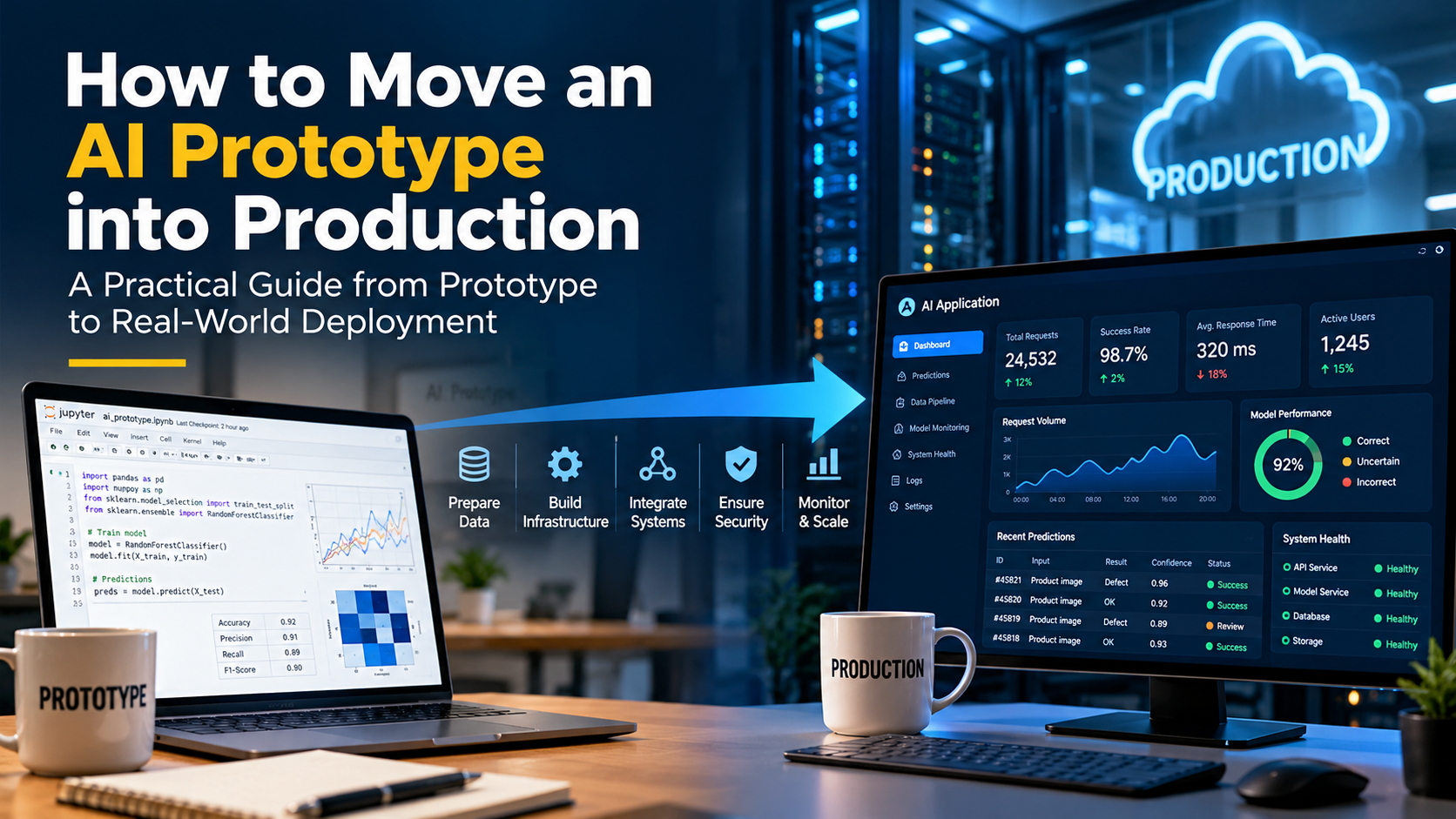

Introduction
Building an AI prototype is an important first step toward solving a business problem with artificial intelligence. A prototype can demonstrate how a chatbot answers customer questions, how a machine learning model predicts demand, or how a computer vision system identifies objects in images.
However, a successful demonstration does not automatically mean the solution is ready for real-world use.
An AI prototype may work well with a small dataset, a controlled environment, and a limited number of users. A production application must handle real business data, unexpected inputs, multiple users, system failures, security requirements, and changing operational conditions.
For example, an AI chatbot might answer questions accurately during a demonstration but provide incorrect information when customers ask unfamiliar questions. A predictive analytics model might perform well on historical data but produce unreliable forecasts when market conditions change. Similarly, a computer vision model that detects products in clear images might struggle with poor lighting, overlapping objects, or high-speed production lines.
These challenges highlight the difference between demonstrating an AI capability and delivering a dependable business application.
Moving an AI prototype into production means transforming an experimental solution into a secure, reliable, measurable, and maintainable application that can operate within real business workflows.
This transition requires more than deploying a trained model to a cloud server. It involves validating the use case, preparing production data, building application infrastructure, integrating existing systems, implementing security controls, testing failure scenarios, and establishing continuous monitoring.
In this guide, you will learn how to move an AI prototype into production, which technical components are required, what challenges to expect, how MLOps supports deployment, and how to determine whether an AI solution is ready for business use.
1. What Does It Mean to Move an AI Prototype into Production?
An AI prototype is an early version of a solution created to test an idea, evaluate technical feasibility, or demonstrate a specific capability.
It is commonly developed using sample datasets, existing AI models, APIs, notebooks, or lightweight application interfaces.
A production AI application goes further. It must work consistently with real users and business data while meeting defined requirements for performance, security, reliability, and operational support.
For example, a prototype might demonstrate that a language model can extract information from invoices. A production application must also process invoices securely, validate extracted fields, handle unreadable documents, connect with the finance system, record processing results, and route uncertain cases for human review.
The AI model is only one component of the complete solution.
Prototype vs. Production AI Application
Area | AI Prototype | Production AI Application |
Data | Sample or limited datasets | Governed, representative business data |
Users | Developers and selected testers | Intended business users or customers |
Infrastructure | Local machine or development environment | Managed deployment environment |
Testing | Initial functionality and feasibility | Functional, integration, security, performance, and failure testing |
Integrations | Mock data or limited connections | Reliable connections to approved business systems |
Security | Basic development safeguards | Defined authentication, authorization, and data protection |
Monitoring | Manual observation | Automated health and performance monitoring |
AI evaluation | Initial accuracy checks | Repeatable evaluations and production-quality tracking |
Scaling | Limited users and requests | Capacity designed for expected workload |
Maintenance | Informal updates | Version control, ownership, updates, and recovery procedures |
The goal is not to eliminate every possible risk before launch. It is to establish enough evidence, safeguards, and operational capability to deploy the application responsibly and improve it over time.
2. Why Do AI Prototypes Fail to Reach Production?
Many AI prototypes demonstrate technical potential but encounter difficulties when they need to operate within an organization's existing processes.
The reasons are often related to data, application architecture, business ownership, and operational readiness rather than the AI model alone. <Cite refs={["turn997155search0","turn997155search3"]}/>
2.1 Poor Data Quality
A prototype may use clean, carefully selected data. Real business data often contains missing fields, duplicate records, inconsistent formats, outdated information, and unexpected values.
These differences can reduce model accuracy and create unreliable results.
Example: A sales forecasting model trained on historical sales data may produce misleading predictions if the production data uses different product categories or inconsistent date formats.
Solution: Validate the production data pipeline, define data-quality rules, and test the model using representative examples from the intended operating environment.
2.2 No Production Architecture
A prototype may run in a notebook or a single script without a reliable API, database integration, deployment process, or error-handling mechanism.
This setup can be sufficient for experimentation but difficult to maintain or scale.
Solution: Convert the prototype into a structured application with clearly defined components, configuration management, appropriate APIs, and a repeatable deployment process.
2.3 Limited Testing
A successful demonstration usually covers the expected workflow. Production users introduce unexpected inputs, unusual requests, simultaneous activity, and incomplete information.
Solution: Test normal scenarios, edge cases, invalid inputs, integration failures, and realistic user behavior before release.
2.4 Security and Privacy Gaps
An AI prototype may use test credentials or unrestricted development access. Production applications may handle customer records, financial information, internal documents, or confidential business data.
Solution: Implement secure authentication, least-privilege access, data protection, secret management, audit logging, and appropriate controls over model access.
2.5 No Monitoring or Maintenance Plan
AI performance can change when data patterns, business processes, user behavior, or external dependencies change.
A model that performs well at launch may become less reliable over time.
Solution: Monitor technical health, data quality, model performance, application costs, and user feedback. Define who investigates issues and how fixes are deployed.
2.6 Unclear Business Value
A prototype can be technically impressive without solving a sufficiently important business problem.
Solution: Define measurable business outcomes before scaling, such as reduced processing time, improved detection performance, fewer manual corrections, or faster customer support.
3. Step-by-Step Guide to Moving an AI Prototype into Production
A structured implementation process helps teams reduce technical uncertainty and avoid rebuilding the application after the prototype has already been approved.
Step 1: Validate the Business Problem
Before investing in production infrastructure, confirm that the AI solution addresses a real business requirement.
Document the problem, target users, current process, expected outcome, and limitations of the proposed solution.
For example, if the prototype is an AI document-processing application, determine whether the main objective is to reduce manual data entry, accelerate invoice processing, improve document classification, or support another measurable outcome.
Define success criteria that can be evaluated after deployment.
Possible metrics include:
Average task completion time.
Percentage of correctly processed records.
Manual correction rate.
Model accuracy on representative data.
Cost per processed transaction.
User adoption and satisfaction.
A clear business objective helps prevent the team from expanding the project with features that do not contribute to its primary purpose.
Step 2: Evaluate the Prototype's Performance
The next step is to determine whether the prototype performs well enough to justify further development.
Evaluate it using representative test data that was not simply reused during model development.
For a machine learning model, this may include measuring precision, recall, classification accuracy, or prediction error.
For a generative AI application, evaluation may include factual accuracy, relevance, groundedness, instruction adherence, and the rate of unsupported responses.
For a computer vision application, testing may include missed detections, false positives, object-counting accuracy, and inference latency.
The metrics should reflect the consequences of errors in the intended business process.
For example, a document extraction system used for preliminary categorization may tolerate different error levels from a system that prepares financial transactions.
Important: Do not rely on a single overall accuracy score. Evaluate the failure cases that matter most to the business.
Step 3: Prepare Production Data
Data preparation is one of the most important stages in production AI development.
Determine which data sources the application requires, who owns them, how frequently they are updated, and which permissions govern their use.
Depending on the project, this may involve:
Cleaning and validating records.
Standardizing formats and identifiers.
Removing duplicate information.
Establishing reliable data pipelines.
Defining source-of-truth rules.
Managing access to sensitive information.
Documenting data transformations.
Testing missing, delayed, or invalid data.
For AI applications that use company documents or internal knowledge, also consider document indexing, retrieval quality, access permissions, and how updated information becomes available to the application.
A reliable data foundation helps prevent the model from producing misleading results because of incorrect or incomplete information.
Step 4: Design the Production Architecture
A prototype often combines several tasks in a single script. A production application should have an architecture that supports maintenance, testing, deployment, and future improvements.
A typical architecture may include:
Frontend or user interface.
Backend API.
AI model or external AI service.
Data processing and validation layer.
Database or document storage.
Integration services.
Authentication and authorization.
Monitoring and logging.
Deployment infrastructure.
For example, an AI chatbot may use a frontend for user interaction, a backend to manage conversations, a retrieval component to access approved documents, a language model to generate responses, and monitoring tools to track latency and quality.
The architecture should match the application's complexity. A small internal tool may not need a large distributed system, while a high-volume enterprise application may require additional services and capacity planning.
Step 5: Convert the Prototype into Maintainable Application Code
Prototype code often prioritizes speed of experimentation over long-term maintainability.
Before production, review the codebase and establish a structure that separates responsibilities.
Typical improvements include:
Separating model inference from business logic.
Moving configuration into managed settings.
Implementing reusable modules.
Adding input validation.
Handling exceptions consistently.
Managing dependencies.
Protecting credentials and API keys.
Adding automated tests.
Documenting setup and deployment procedures.
Version control should be used to track changes to the application code, configuration, and relevant model artifacts.
The objective is to make the application easier to test, troubleshoot, update, and maintain.
Step 6: Build Reliable API and System Integrations
Many production AI applications must communicate with existing ERP, CRM, document management, payment, inventory, or customer support systems.
These integrations should be designed for real operational conditions.
For example, an AI assistant that checks order status should retrieve the information from an authorized order-management API rather than inventing a response.
The integration should account for:
Authentication and permissions.
Request validation.
Timeouts and unavailable services.
Rate limits.
Retry behavior.
Duplicate requests.
Data consistency.
Error logging.
Confirmation of successful actions.
For operations that create or modify business records, define how the application verifies that the requested action was completed successfully.
An AI-generated statement that an operation succeeded is not a substitute for confirmation from the connected business system.
Step 7: Implement Security and Governance
Production AI systems require controls that protect users, data, and business processes.
The appropriate controls depend on the application's purpose, users, data sensitivity, and potential impact.
Important measures include:
Authentication: Verify the identity of users and services accessing the application.
Authorization: Restrict access to the information and actions each user is permitted to use.
Data protection: Protect sensitive information in transit and at rest where applicable.
Secret management: Store credentials in appropriate secret-management systems rather than embedding them in source code.
Audit logging: Record relevant application events, errors, and sensitive actions.
AI safeguards: Validate model outputs, restrict available tools, and protect against malicious instructions in user input or retrieved documents.
Human review: Require approval for actions where an incorrect result could create significant financial, legal, operational, or customer impact.
For applications using external AI providers, review the provider's data-handling terms, retention settings, processing arrangements, and applicable contractual requirements.
Step 8: Test the Complete Application
A production-ready AI system requires more than model testing.
The complete application should be tested from input to final business outcome.
Testing Type | Purpose |
Unit Testing | Check individual functions and components |
Integration Testing | Verify communication between the AI service, APIs, databases, and other systems |
Model Evaluation | Measure the quality of predictions, classifications, or generated responses |
Security Testing | Identify vulnerabilities and unauthorized access paths |
Performance Testing | Measure latency, throughput, and resource consumption |
Load Testing | Evaluate behavior under expected and peak demand |
Failure Testing | Check how the application responds to outages, invalid inputs, and unavailable data |
User Acceptance Testing | Confirm that the application meets business requirements |
Test cases should include both successful and unsuccessful scenarios.
For example, an AI invoice-processing application should be tested with clear invoices, low-quality scans, missing invoice numbers, duplicate documents, unexpected formats, and unavailable supplier records.
The application should handle uncertainty and errors predictably rather than continuing as if every request were successful.
Step 9: Set Up Deployment and CI/CD
Once the application passes its release criteria, establish a repeatable deployment process.
Continuous Integration and Continuous Delivery or Deployment (CI/CD) pipelines help automate building, testing, packaging, and releasing application changes.
A deployment workflow may include:
Commit code to version control.
Run automated tests.
Validate dependencies and configuration.
Build a deployable application package or container.
Deploy to a staging environment.
Run integration and smoke tests.
Approve the release when required.
Deploy to production.
Verify application health.
For machine learning systems, the pipeline may also need to track model versions, evaluation results, training data versions, and model-specific release approvals.
Deployment strategies such as canary releases or blue-green deployments can help limit risk when introducing changes to suitable production applications.
A rollback plan should be established before release so that the team can restore a previous stable version when necessary.
Step 10: Deploy Gradually
A production release does not need to begin with every user or every business process.
A gradual rollout helps the team identify issues while limiting their impact.
Possible approaches include:
Internal testing with selected employees.
A controlled pilot with a small user group.
Read-only operation before allowing changes to business records.
Shadow evaluation alongside an existing process.
Limited release to selected workflows.
Gradual expansion after acceptance criteria are met.
For high-impact use cases, human review may be appropriate during the initial rollout.
The team should define the conditions required to expand deployment, pause the rollout, or revert to a previous version.
Step 11: Monitor and Improve the Production System
Production deployment is the beginning of ongoing operations, not the end of development.
Monitor the application for technical failures, changes in input data, reduced model performance, unexpected usage, and rising operating costs.
Important monitoring areas include:
Application uptime.
API error rates.
Response latency.
Model performance.
Data-quality changes.
AI response quality.
Resource utilization.
Cost per request or transaction.
User feedback and failure reports.
Security and access events.
Define thresholds for investigation and assign responsibility for responding to incidents.
When a model or application component is updated, repeat the appropriate evaluations before promoting the change to production.
This process helps ensure that improvements do not unintentionally reduce reliability.
4. What Is MLOps, and Why Is It Important?
Machine Learning Operations (MLOps) refers to the practices and tools used to manage machine learning systems throughout their lifecycle.
It applies software engineering and operational principles to the development, deployment, monitoring, and maintenance of machine learning applications.
Without an MLOps approach, teams may struggle to reproduce model results, track versions, deploy updates consistently, or identify when model performance changes.
Key Components of MLOps
Experiment tracking: Records model configurations, evaluation results, and relevant development experiments.
Data and model versioning: Helps identify which data and model versions were used for a particular release.
Model registry: Maintains organized records of model artifacts and their lifecycle status.
Automated pipelines: Support repeatable data processing, model evaluation, training, and deployment where appropriate.
CI/CD integration: Connects model and application changes to automated validation and release processes.
Monitoring: Tracks system health, input data, model behavior, and operational performance.
Retraining and updates: Defines when a model needs to be retrained, recalibrated, or replaced.
Tools may include MLflow, managed cloud machine learning services, workflow orchestration systems, container platforms, and monitoring solutions.
The correct toolset depends on the team's existing infrastructure and the complexity of the application.
A small AI application may only need version control, automated testing, a basic deployment pipeline, and monitoring initially. More complex applications may require a broader MLOps platform.
5. Production Requirements for Different Types of AI Applications
Not all AI applications have the same production requirements. The implementation plan should reflect the technology and the business problem.
Generative AI Applications
Generative AI applications include chatbots, document assistants, content generation systems, and AI agents.
Important requirements include:
Evaluation of answer quality and factual grounding.
Reliable retrieval of relevant information.
Prompt and model version management.
Protection against prompt injection.
Access control for retrieved data.
Rate limits and cost controls.
Human review for sensitive outputs.
Monitoring for unsupported responses.
For example, a company knowledge assistant should retrieve information that the user is authorized to access and clearly handle questions that cannot be answered from available sources.
Machine Learning and Predictive Analytics
Predictive applications estimate future outcomes or classify business events.
Important requirements include:
Representative training and validation datasets.
Reproducible model training.
Feature consistency between training and production.
Performance evaluation.
Data and concept drift monitoring.
Model versioning.
Defined retraining criteria.
Tracking of business outcomes.
For example, a demand forecasting model should be evaluated against actual demand over time and monitored when product behavior or market conditions change.
Computer Vision Applications
Computer vision systems analyze images and video to detect objects, classify products, identify defects, or track movement.
Production requirements may include:
Representative images and videos.
Camera and lighting validation.
Object detection or segmentation evaluation.
Frame-processing performance.
Hardware and edge deployment testing.
Camera health monitoring.
False-positive and missed-detection tracking.
Handling of overlapping objects and changing conditions.
For example, a manufacturing defect detection system should be tested on real production-line footage rather than only on carefully selected sample images.
AI Agents and Workflow Automation
AI agents can use approved tools to retrieve information or initiate actions across business systems.
Production requirements may include:
Strict tool permissions.
Defined action boundaries.
Validation of proposed actions.
Human approval for sensitive operations.
Protection against malicious instructions.
Execution logs and auditability.
Recovery from interrupted workflows.
Limits on repeated actions and resource usage.
An AI agent that prepares a purchase order may be suitable for automation, while approving the purchase or transferring money may require additional authorization.
6. Common Challenges When Moving AI into Production
Even when a prototype performs well, production deployment can introduce technical and operational challenges.
Challenge 1: Model Performance Changes
A model may encounter new data patterns that were not represented in its training dataset.
Solution: Monitor relevant data and performance indicators, investigate changes, and define criteria for retraining or updating the model.
Challenge 2: High Infrastructure and AI Costs
Production traffic may increase the cost of model inference, data processing, storage, and infrastructure.
Solution: Measure cost per request or transaction, optimize unnecessary processing, select suitable models, and establish usage limits where appropriate.
Challenge 3: Slow Response Times
Complex models, large prompts, database queries, and multiple external service calls can increase latency.
Solution: Profile the full application, optimize retrieval and API calls, use suitable caching where safe, and select infrastructure that meets the required performance.
Challenge 4: Unreliable External Services
AI applications may depend on external model APIs, cloud services, databases, or third-party integrations.
Solution: Design appropriate timeouts, retries, fallbacks, health checks, and user-facing error handling.
Challenge 5: Inaccurate AI Outputs
A model may generate incorrect information or make predictions that are unreliable for a particular case.
Solution: Evaluate realistic scenarios, validate outputs, set appropriate thresholds, and route uncertain or high-impact cases for human review.
Challenge 6: Lack of Operational Ownership
A development team may deliver the prototype without assigning responsibility for production incidents, updates, costs, or monitoring.
Solution: Define a clear owner for the application, its data dependencies, deployment pipeline, and ongoing support.
Challenge 7: Difficulty Scaling
An architecture that works for a few users may not handle increased traffic or larger datasets.
Solution: Estimate expected workloads, test realistic demand, identify bottlenecks, and scale only the components that require additional capacity.
7. How to Measure Production Readiness
Before releasing an AI application, evaluate it across several dimensions.
Area | Questions to Answer |
Business Value | Does the application solve the intended problem, and are success metrics defined? |
AI Quality | Has performance been tested on representative data? |
Data Readiness | Are required data sources reliable, documented, and accessible? |
Application Architecture | Can the system be maintained, tested, and deployed consistently? |
Security | Are authentication, permissions, data protection, and audit requirements addressed? |
Integrations | Are APIs and business workflows tested, including failure cases? |
Reliability | Are timeouts, recovery procedures, and fallback behavior defined? |
Performance | Can the application meet its expected latency and workload requirements? |
Monitoring | Can the team identify errors, degradation, and unexpected costs? |
Ownership | Is someone responsible for operating and improving the system? |
Release Management | Are approval criteria, versioning, and rollback procedures in place? |
An application should not be considered production-ready simply because the model meets an accuracy target.
Production readiness requires evidence that the complete application can perform its intended function within acceptable business, security, and operational constraints.
8. Example: Moving an AI Document Processing Prototype into Production
Consider a business that has developed an AI prototype to extract information from invoices.
The prototype accepts a PDF, extracts the supplier name, invoice number, date, and total amount, and displays the results on a screen.
Although the demonstration works, the finance team cannot immediately depend on it for daily processing.
A production implementation would require several additional components.
Stage 1: Validate the Extraction Quality
Test the model against a representative set of invoices from different suppliers, document formats, and scan qualities.
Measure field-level extraction accuracy and identify which fields most often require correction.
Stage 2: Implement Validation Rules
Check extracted values against business rules and approved supplier records.
Flag missing invoice numbers, inconsistent totals, unreadable fields, and possible duplicate invoices.
Stage 3: Connect the Finance System
Use an approved integration to submit validated information to the finance or ERP application.
Initially, the system may create draft records for employees to review rather than automatically approving transactions.
Stage 4: Add Security and Audit Logging
Restrict access to invoice documents and extracted information.
Record processing outcomes, validation failures, and approved changes while protecting sensitive financial data.
Stage 5: Deploy and Monitor
Release the application to a limited group of finance users.
Track processing time, extraction accuracy, correction rates, integration failures, and cost per invoice.
Stage 6: Expand Automation Gradually
Once the application consistently meets agreed acceptance criteria, consider automating additional low-risk steps.
High-impact actions, such as approving payments, should remain subject to the organization's financial authorization controls.
This example demonstrates that production AI is a complete business workflow rather than a model operating in isolation.
9. How Long Does It Take to Move an AI Prototype into Production?
There is no single timeline for every AI project. The effort depends on how mature the prototype is, the quality of the available data, the required integrations, the deployment environment, and the level of risk.
A limited internal application with a stable model and straightforward data source may require considerably less work than an enterprise application connected to multiple business systems.
The following is an illustrative planning framework, not a guaranteed delivery estimate.
Stage | Main Activities |
Assessment | Review prototype quality, business requirements, and production gaps |
Data and Evaluation | Validate data sources, prepare test cases, and establish performance criteria |
Architecture and Engineering | Develop the backend, application components, and deployment configuration |
Integration and Security | Connect business systems and implement required access controls |
Testing and Release | Complete integration, performance, security, and acceptance testing |
Monitoring and Stabilization | Observe the production system, resolve issues, and validate operational performance |
Some activities can run in parallel. Others depend on earlier decisions, such as data readiness or API availability.
A realistic project plan should be prepared after the team assesses the prototype, defines the production scope, and identifies the major technical risks.
10. Best Practices for a Successful AI Production Deployment
The following practices help teams move from experimentation to dependable AI applications.
Start with a measurable business outcome. Define the problem and success criteria before expanding the implementation.
Evaluate the complete workflow. Test the model, data, integrations, and user experience together.
Keep the architecture maintainable. Separate responsibilities where doing so improves testing, deployment, or scaling.
Use version control. Track application code, configuration, model versions, and evaluation results.
Automate repeatable checks. Use automated testing and deployment pipelines wherever practical.
Secure data and system access. Apply least-privilege permissions and protect sensitive information.
Plan for failure. Test unavailable services, invalid data, unexpected inputs, and recovery procedures.
Monitor real-world performance. Track technical health, AI quality, cost, and business outcomes.
Assign clear ownership. Ensure the organization knows who maintains the application and responds to incidents.
Scale based on evidence. Expand deployment only after the solution meets defined acceptance criteria.
The most effective production strategy is not necessarily the most complex one. It is the smallest reliable implementation that meets the business requirement and can be maintained over time.
Conclusion
Moving an AI prototype into production is the process of transforming an experimental capability into a reliable business application.
The transition requires more than selecting a model or deploying code. It involves validating the business use case, preparing production data, designing the application architecture, integrating existing systems, implementing security, testing failure scenarios, establishing deployment pipelines, and monitoring performance after launch.
The specific requirements depend on the type of AI solution. Generative AI applications need reliable grounding and output evaluation, predictive models need ongoing performance assessment, and computer vision systems need testing under realistic visual and operating conditions.
A structured implementation process helps organizations reduce uncertainty, control risk, and understand whether the solution delivers measurable value.
Planning to Move an AI Prototype into Production?
Start by assessing the prototype's current capabilities, identifying the gaps between the demonstration and the intended production environment, and defining measurable acceptance criteria.
A focused production-readiness assessment can help determine the required engineering work, integration approach, deployment architecture, and ongoing operational responsibilities.
With the right implementation strategy, an AI prototype can evolve into a maintainable application that supports real business workflows.
Frequently Asked Questions
1. What does it mean to move an AI prototype into production?
It means transforming an experimental AI solution into an operational application that can handle real users, business data, integrations, security requirements, and ongoing monitoring.
2. What is the difference between an AI prototype and a production AI application?
A prototype demonstrates feasibility in a controlled environment. A production application includes the reliability, security, testing, infrastructure, monitoring, and maintenance processes required for ongoing use.
3. What is the first step in moving AI into production?
Start by validating the business problem, evaluating the prototype's performance, and defining measurable acceptance criteria for the intended application.
4. What is MLOps in AI development?
MLOps is a set of practices and tools for managing the machine learning lifecycle, including model development, versioning, deployment, monitoring, and updates.
5. Does every AI application need an MLOps platform?
No. Smaller applications may need only basic versioning, automated tests, controlled deployment, and monitoring. More complex machine learning systems may benefit from a dedicated MLOps platform.
6. How do you test an AI application before production?
Test model quality, functional behavior, integrations, security, performance, failure handling, and user acceptance. Use representative data and include edge cases that reflect real operating conditions.
7. How can AI applications be monitored after deployment?
Monitor application health, latency, errors, data quality, model performance, usage, costs, and user feedback. Define thresholds and assign responsibility for investigating issues.
8. How do you reduce hallucinations in production generative AI applications?
Use approved knowledge sources, retrieve relevant context, validate structured outputs, evaluate realistic questions, restrict available tools, and provide a clear fallback when reliable information is unavailable.