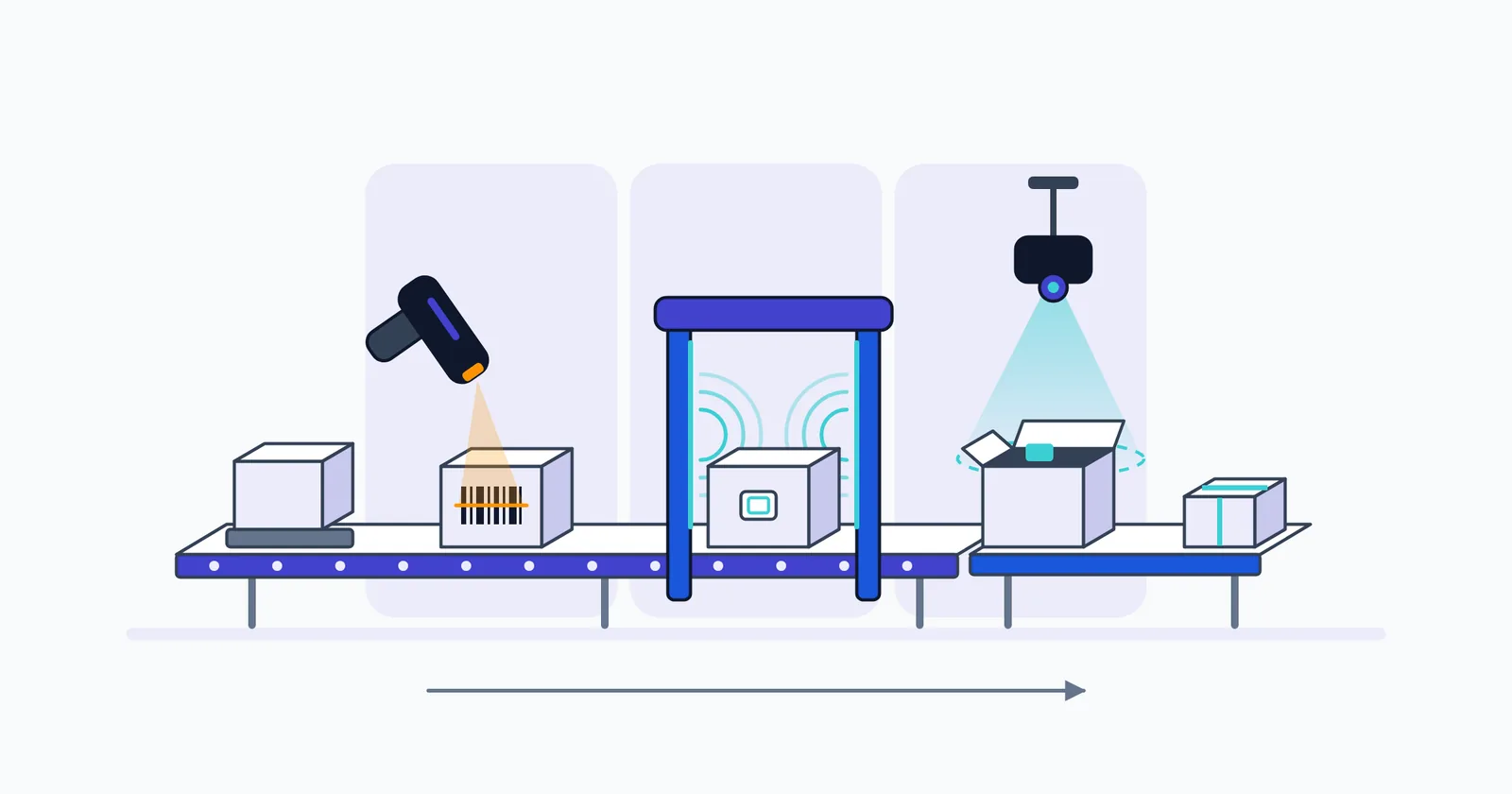

Most articles on barcode vs RFID vs computer vision compare the three as whole systems and pick an overall winner. Warehouses don't work like that. The receiving dock, the pick face and the pack bench each go wrong in their own way, so for retail and e-commerce operations the right answer changes from one process step to the next.
The short version: barcodes stay the system of record almost everywhere. RFID pays off where items arrive already tagged, usually because a retailer requires it. Cameras earn their place where errors happen without anyone scanning: the box being sealed, the pallet being loaded, the rack nobody has counted in months.
This guide takes six steps, from receiving to dispatch, and gives a winner, a runner-up and the failure mode to watch for each. It then covers the two things that decide whether any of this works in practice: who pays to apply RFID tags, and whether your SKU master data is clean enough to check reads against.
Why compare barcode vs RFID vs computer vision by process, not by technology
Each warehouse step has its own typical error and its own labour pattern. At receiving, the problem is supplier short-ships and miscounts. At putaway, it's stock placed in the wrong location. Cycle counts deal with slow drift between the WMS and the shelf. Picking goes wrong when someone grabs the wrong item. At packing it's the wrong quantity, a missing item or damage. At dispatch, the right pallet ends up on the wrong truck. A technology that handles one of these well can be useless or expensive for another, which is why "RFID is better than barcodes" doesn't hold up as a general statement.
Three factors come up at every step, and the rest of this article keeps returning to them:
- Tagging cost and who pays it. RFID has a cost for every item. Whether your suppliers apply tags at source decides whether that cost is yours.
- SKU master data. RFID and vision both check what they read against the item master and the advance ship notice (ASN). If that data is wrong, you get wrong answers faster.
- The hybrid pattern. Keep barcodes as the record and add cameras only where errors slip past a scan.
How each technology actually reads inventory
Barcodes: one scan, one item, line of sight
A barcode is printed on a label that costs almost nothing, and the scanner has to see it. Most WMS platforms are built around barcode scans, so they cost the least to run. Their limit is what a scan proves. It proves a barcode passed in front of a scanner. It doesn't prove the picker put three units in the box rather than two, or that the carton wasn't crushed on the way.
RFID: bulk reads without line of sight
Passive UHF tags have no battery. A reader powers them with radio energy, and each tag sends back its Electronic Product Code (EPC), a serial number unique to that one item, not just to its SKU. A reader can capture many tags at once through cardboard, which is what makes a full-pallet read at a dock portal possible.
It has two well-known weak spots. Metal reflects UHF energy and liquids absorb it, so standard tags on cans, foil packs or bottled goods read poorly. They need on-metal tags, careful placement and testing on site (Cykeo and Ideagen explain the physics). The second is cross-reads, where a reader picks up tags it wasn't meant to see, such as the pallet at the next dock door or the bin beside the one being picked.
Computer vision: cameras plus models that count, identify and inspect
Vision needs no tags. Cameras and trained models read printed barcodes and labels, count cases or units, spot damage and save an image as evidence. Vendors such as Vimaan say pallet scanning can read SKUs, counts, lot and expiry, dimensions and damage in a single pass. Those are vendor claims without published figures, but they show what the technology is designed to do.
The costs are effort rather than consumables. You need decent lighting, sensible camera angles, labelled images from your own site, and retraining when packaging changes. A camera also can't count what it can't see, so the inner units of a sealed case stay invisible.
| Technology | What it reads | Line of sight | Per-item consumable | Fixed infrastructure | Main failure mode |
|---|---|---|---|---|---|
| Barcode | Identity, one item at a time; location through location labels | Yes | Printed label, close to zero | Handheld and fixed scanners | Skipped scans; proves a scan happened, not the quantity |
| RFID (passive UHF) | Identity and quantity in bulk; location through reader zones | No | A tag on every item, about $0.08–$0.18 landed for apparel at volume | Portals, handheld readers, encoding | Metal and liquids, cross-reads, untagged items are invisible |
| Computer vision | Quantity, condition, occupancy; identity through visible labels | Yes (camera view) | None | Cameras, compute, model training and upkeep | Lighting, occlusion, camera angle, drift when packaging changes |
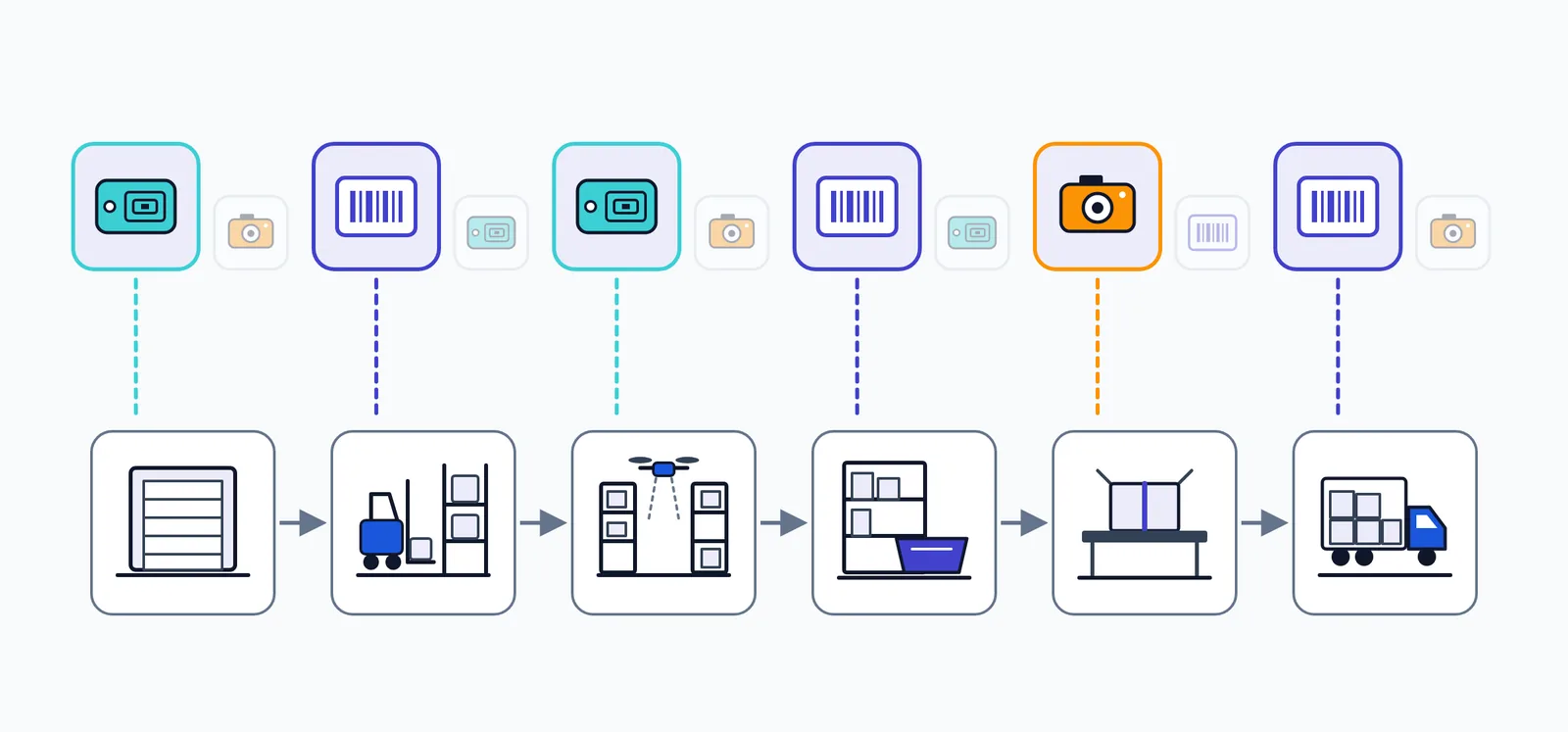
The decision matrix: which technology wins each warehouse process
| Step | Winner | Runner-up | Why | Watch out for |
|---|---|---|---|---|
| Receiving | RFID if suppliers tag at source; otherwise barcode | Vision on top of either | A portal can check the whole delivery against the ASN in one pass | Without source tagging, you tag on arrival, which is labour |
| Putaway | Barcode | RFID with forklift-mounted readers | Two scans (pallet, then location) are cheap and enough | Skipped location scans |
| Cycle count | RFID for item-tagged goods; vision drones or robots for pallet-level racks | Handheld barcode | Bulk reads or automated rack audits replace walking the aisles | Untagged stock; drones see labels, not what's inside sealed cases |
| Picking | Barcode scan-to-confirm | Vision at the tote | A scan confirms the right item for each pick | RFID cross-reads at dense pick faces |
| Packing | Barcode plus camera | Barcode alone | The camera checks quantity, contents and condition, and keeps a photo | Lighting, occlusion, packaging changes |
| Dispatch | Barcode pallet label | RFID portal or vision counting | A scan is cheap; add counting where quantities get disputed | Cross-reads between neighbouring dock doors |
Receiving
The baseline is scanning the pallet label against the ASN. That confirms the pallet arrived. It says nothing about what's inside, and that gap is where supplier disputes start.
RFID wins here only if suppliers tag at source. The best evidence is Project Zipper, a study by the Auburn University RFID Lab and GS1 US published in October 2018. It covered 8 brands and 5 retailers, mostly apparel already EPC-tagged at source. Without RFID, 69% of inbound orders contained errors. With it, the participants were "capable of achieving 99.9% order accuracy" (just-style). The gain came from a dock portal reading every item and checking the full delivery against the ASN without opening a carton.
The condition matters. Those goods were tagged before they reached the dock. If your suppliers don't tag, RFID at receiving means your own staff tagging items as they arrive, which adds labour to the step you were trying to speed up.
Vision sits on top of either approach. Cameras at the dock door count cases, flag visible damage and photograph each pallet, so a short-ship or damage claim comes with evidence. The loading and unloading case study at the end of this article shows that pattern.
Putaway
Barcodes win, and this step usually stays on them. The operator scans the pallet's license plate, then the location label, and the WMS records the move. RFID can automate this with forklift-mounted readers and tagged locations, but that hardware is only worth it on high-volume sites where wrong-location putaways are a known, measured problem. Vision is rarely worth the effort at putaway, because the barcode check already covers the main error.
Cycle count
This is the biggest RFID win for item-level tagged goods. Project Zipper found RFID "cuts cycle count times by 96%". A separate measure from the same study showed store inventory accuracy rising from an average of 63% to 95% (just-style). A handheld reader swept along a shelf captures hundreds of tags without anyone handling the items.
For pallet and case-level rack storage, where items aren't tagged, vision on drones or ground robots is the stronger option. The system reads location and pallet labels, checks whether each slot is occupied, and compares the result with the WMS. One Gather AI customer, Taylor Logistics, said the drone system "is 87% more efficient than having our team do physical cycle counting" (FreightWaves, April 2024). That is a single customer quote from a company release, not an independent benchmark. Handheld barcode counting remains the fallback, and it's still the right choice for low-volume or awkward locations.
Picking
Barcode scan-to-confirm wins. The picker scans the bin and the item, and the WMS confirms both match the order. RFID is risky at a dense pick face because the reader can pick up tags in neighbouring bins and confirm a pick that never happened. Vision verification at the tote is possible, but it usually works better one step downstream. Every order passes the pack bench, and that's where the camera sees the final contents.
Packing
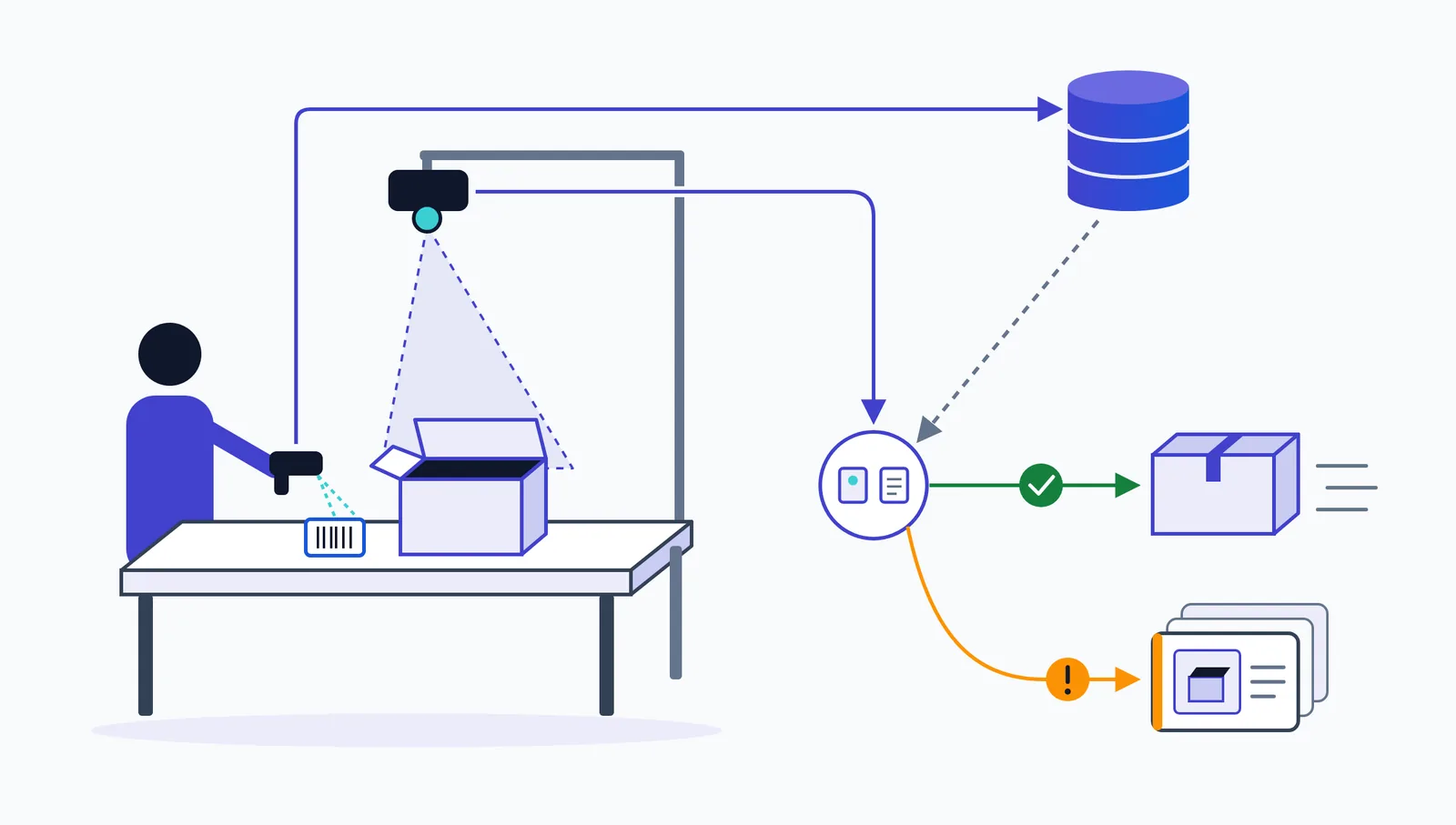
This is the clearest case for adding cameras on top of barcodes. The scan stays as the record of which items were packed. An overhead camera then checks what the scan can't: how many units are in the box, whether they match the order, and whether anything is visibly damaged. It also stores a photo of every packed order, which settles most "item missing" claims quickly.
We haven't found independent figures on how much pack-station cameras reduce mis-ships. Vendor percentages exist but aren't verified, so measure your own mis-ship and claims rate before a pilot and compare after.
Dispatch
Scanning the outbound pallet label is the baseline. An RFID portal works for tagged goods, as long as neighbouring dock doors are shielded against cross-reads. Where quantity disputes are the problem, vision counting at the dock checks units loaded against the dispatch order, as in this cement bag counting and dispatch monitoring project. For shipment verification and tracking more broadly, see AI in logistics.
Tagging cost: what RFID really costs per item
Most cost comparisons get this wrong. Figures such as "$20 to $50 or more per tag" appear in some comparison articles (PackageX, for example). Those prices refer to rugged or active tags used for logistics assets, not the passive UHF labels that go on retail items. The real per-item cost is a few cents to under twenty cents, and it has four parts (RFID News, August 2026):
| Cost component | Typical range |
|---|---|
| Passive UHF inlay | $0.15–$0.25 below 1,000 units; about $0.08–$0.12 at 10k–50k; about $0.05–$0.07 above 100k |
| Conversion (inlay to label) | $0.02–$0.08 per tag |
| Factory encoding | $0.01–$0.03 per tag |
| Application | About $0.03–$0.05 per item manually; under $0.01 with inline applicators, plus their capital cost |
Put together, a retail apparel RFID programme buying UHF labels at 50,000+ units "typically runs $0.08 to $0.18 per tagged item". At a million items a year, that's roughly $80,000 to $180,000 in tagging costs every year.
The price of the tag matters less than who applies it. If suppliers tag at source, the cost sits in their production line and you get the read benefit at your dock. Retailer mandates make this happen. Walmart required RFID for home goods, sporting goods, electronics and toys by September 2022, then extended the mandate to 14 categories, including apparel, hardware, books and paint, with a February 2024 deadline (Impinj). If you supply or operate in one of those categories, the tags may already be on the goods arriving at your dock. If you're a D2C brand with suppliers who don't tag, you pay the full landed cost yourself and add a tagging step.
Vision costs work the other way round. There's no per-item consumable, but there are fixed costs: cameras, compute at the edge or in the cloud, collecting and labelling training images, and keeping models accurate over time. RFID costs grow with volume. Vision costs grow with the number of stations you equip.
Clean SKU master data comes first
This is the part vendors rarely mention. An RFID reader returns an EPC. A vision model reads a label or counts units. Either way, the result is only useful once it's checked against the item master (GTIN, pack quantity, case dimensions, weight) and the ASN. That check is where bad data turns into bad exceptions:
- Wrong pack quantities create false shortages. The camera correctly counts 12 cases, but the master says 24 units per case when the real figure is 12, so the delivery looks half short.
- Wrong case dimensions or weights break volumetric and weight checks at receiving and packing.
- Missing GTIN-to-EPC mappings make correctly read tags show up as unknown items.
The problem isn't new. In a supplier data audit reported in 2005, Wegmans checked 50 random products and found that "not one product had information that was completely accurate". A later 250-product test found 12% fully accurate, and most errors were in case width, depth and weight (Supermarket News). Those figures are two decades old, but the problem persists. In 2025, Foodstuffs NZ spent weeks verifying packaging dimensions and gross weights for thousands of products and "found multiple errors in data previously uploaded by suppliers" (GS1 NZ).
Before any RFID or vision pilot, audit these for the SKUs in scope:
- Pack quantities (units per inner, inners per case, cases per pallet)
- Case dimensions and gross weights, measured rather than copied from supplier sheets
- GTIN mappings, and GTIN-to-EPC mappings if RFID is involved
- Whether ASNs from your main suppliers arrive complete and on time
The reads also have to reach your WMS and ERP in a form those systems accept. Our notes on how AI connects to existing systems cover that side.
The hybrid pattern: adding cameras on top of barcodes
Most warehouses that add vision end up with the same setup. Barcodes stay the system of record in the WMS. Cameras go at the points where errors happen without a scan: the pack bench, the dock door, the conveyor merge. Each camera compares what it sees with what the WMS expects and sends mismatches to an exceptions queue for a person to review. The camera doesn't replace the scan. It checks the things a scan can't confirm.
The appeal is practical. There's no per-item tag cost and no need to coordinate with suppliers. The existing barcode labels still do their job, and the camera can read them as well. It also starts small: one pack line can go live without changing anything upstream.
The effort goes into the details. Lighting has to be consistent across shifts. Camera angles have to cover the whole box or pallet face without blind spots. The model needs labelled images from your own stations, because a model trained on someone else's cartons won't recognise yours. And models drift: a supplier redesigns its packaging or you switch to a different box, and accuracy quietly drops. That's why production MLOps, with monitoring and a retraining loop, matters as much as the first model. Good computer vision development is built on your own camera footage from day one.
RFID plus vision is also an option where goods are already tagged. RFID covers identity and bulk quantity, and the camera adds condition and photo evidence.
How to choose: a short decision checklist
- Which step generates the most costly errors or labour hours? Start there, using measured numbers: mis-ship rate, claims, count hours, receiving disputes.
- Do your suppliers already tag at source, or are you in a mandated category? If yes, RFID at receiving and cycle count deserves a serious look. If no, add the full tagging cost to the business case.
- Is the problem identity, quantity or condition? RFID is strongest on identity and quantity. Vision is strongest on quantity and condition. Barcodes handle identity, one scan at a time.
- Are metal or liquid goods involved? If so, plan for specialist tags and a site test before committing to RFID.
- Is the SKU master clean enough for the SKUs in scope? If not, fix it first or the pilot will mostly produce false exceptions.
- Can you pilot on one dock, one pack line or one aisle? A narrow pilot with a measured baseline tells you more than any vendor deck.
If you're unsure which process to start with, an AI feasibility assessment can rank the candidates by error cost and data readiness. If you're comparing vendors for a camera-based system, see how to choose a computer vision development company.
Frequently asked questions
Is RFID better than barcodes for warehouse inventory?
For counting tagged items in bulk, yes. The Project Zipper study found RFID cut cycle count times by 96% for item-level tagged goods. For putaway and pick confirmation, barcodes are usually enough and much cheaper, so most warehouses keep both.
How much does an RFID tag cost per item?
Passive UHF inlays cost about $0.05–$0.07 each when bought in volumes above 100,000. Including conversion to a label, encoding and application, the landed cost for retail apparel programmes typically runs $0.08–$0.18 per tagged item. The $20–$50 figures sometimes quoted are for rugged or active tags, not retail labels.
Can computer vision replace barcodes in a warehouse?
Rarely, and it doesn't need to. Most deployments keep barcodes as the system of record in the WMS and add cameras at error-prone points such as pack benches and dock doors to check counts, contents and condition.
Does RFID work on metal or liquid products?
Standard tags work poorly on them. Metal reflects UHF energy and liquids absorb it, so reads become unreliable. You need on-metal or specialist tags, careful tag placement and a pilot in your own facility before rolling out.
Which is better for cycle counting: RFID or drones with computer vision?
RFID suits item-level tagged goods in stores and DCs, where a handheld reader captures hundreds of tags per sweep. Vision drones and robots suit pallet and case-level rack audits where items aren't tagged: they read location and pallet labels and check slot occupancy against the WMS.
Do I need clean master data before adding RFID or computer vision?
Yes. Both technologies check what they read against GTINs, pack quantities, case dimensions and ASNs. Wrong pack quantities produce false shortages and missing GTIN mappings produce unknown-item errors, so audit the master data for the SKUs in scope before any pilot.