
Published guides put AI development cost anywhere from about $10K for a simple feature (Decode) to $1M+ for an enterprise platform (Innowise). Both ends of that range are real. Neither helps you build a budget, because a range that wide tells you almost nothing about your own project.
The spread doesn't come from vendors being inconsistent. Five drivers set the price: how complex the solution is, how ready your data is, how deep the integration goes, what it costs to run, and what it takes to keep working after launch. These drivers multiply each other. They don't simply add up.
This article has no price table. It explains how each driver moves an estimate, shows which drivers matter most in different kinds of projects, and ends with a self-assessment and a list of questions that make vendor quotes comparable. It's written from a data analytics point of view, where the model is rarely the expensive part.
Why AI development cost estimates range so widely
An AI quote is a guess about scope. When the buyer hasn't said what data exists, which systems the output has to reach, or how many requests the system will handle each day, the vendor has to cover every possibility. So the range covers every possibility too.
The drivers also compound. Take a demand forecast that needs data from three systems with no shared product ID. Every modelling experiment now waits on a join that someone has to build and check by hand. If the forecast also has to write back into the ERP, every data fix touches one more system. A hard problem plus messy data plus deep integration costs far more than the three line items priced separately.
The published ranges aren't always internally consistent either. Cubix gives a top end of $500K+ in its introduction and $600K+ in its tables. Zignuts gives production systems as $60K–$500K in the text and $100K–$500K+ in its table. That isn't a scandal. It shows that a range with no stated assumptions about team size, rates, region or the state of the data can't be checked, so you can't hold anyone to it.
Driver 1: Where the solution sits on the complexity ladder
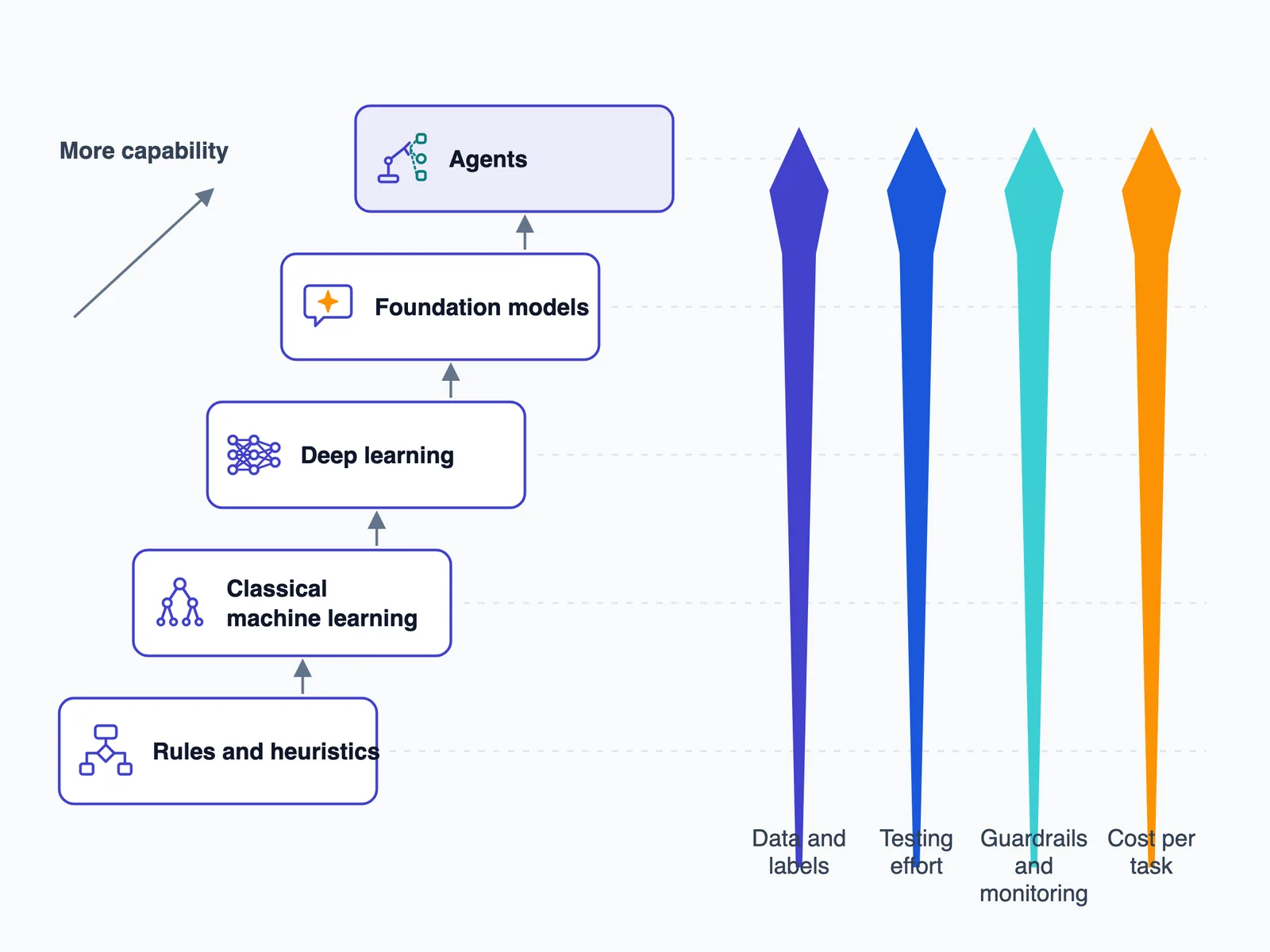
AI solutions fall into five rough rungs. Each rung up adds capability, along with new kinds of work that the rung below didn't need.
Rules, classical ML, deep learning, foundation models, agents
Rules and heuristics. If-then logic, thresholds and SQL. You don't train anything, but you need someone who knows the domain well enough to write the rules down. Testing is deterministic: the same input always gives the same output, so ordinary unit tests work.
Classical machine learning. Regression, gradient-boosted trees and similar models on tabular data, used for churn scores, demand forecasts or fraud flags. You need labelled historical records, which often already sit in the warehouse. Testing uses a held-out dataset and clear metrics such as precision, recall or forecast error.
Deep learning. Neural networks on images, video, audio or raw text. You need labelled examples, which usually means paid annotation, plus GPU time for training. Testing goes past a single score: per-class accuracy and edge cases such as poor lighting, blocked views and new camera angles.
Foundation models. Large language models used through an API or fine-tuned, often with retrieval over your documents or schema. You need less labelled training data, but you do need well-prepared context and an evaluation set of questions with known good answers. Outputs vary from run to run, so testing needs graded scoring by people or by another model.
Agents. Models that plan, call tools and take several steps to finish a task. You need tool definitions, permission boundaries and tests that cover whole sequences of actions, not just single outputs. Errors compound across steps, so the evaluation work grows with the number of steps.
Why each step costs more
Moving up a rung changes the type of work, not only the amount:
- More data and labels. Deep learning needs annotated examples that classical ML doesn't. Foundation models need curated context and evaluation sets.
- More compute. Training and serving neural networks needs GPUs. Foundation models add per-call inference charges.
- Harder evaluation. An exact-match accuracy check works for a churn model. Generated SQL, summaries or agent actions need rubric-based scoring, which costs people's time or model calls.
- Non-deterministic outputs. When the same input can give different outputs, you need guardrails such as input validation, output checks and fallbacks, plus the monitoring to see when they fire.
- Observability. Higher rungs need logging of prompts, retrieved context, tool calls and costs before anyone can debug a bad answer.
The practical lesson: the cheapest solution that works is often one rung lower than the buyer expects. A request for "an agent that answers questions about our sales data" may be met by a natural-language query layer on a well-modelled warehouse. A request for a computer vision system may turn out to be a rules engine reading sensor data that already exists.
Examples from AtlasML project types
A single-task computer vision system like cement bag counting sits on the deep-learning rung but stays tightly scoped. The cameras are fixed, there's one thing to detect and count, and success is easy to measure against manual tallies. That project was built in 8 weeks. Our automatic number plate recognition system has the same shape: detect vehicles, read plates, log entries and exits. Fixed cameras and one narrow task keep labelling and testing bounded, even though the models are deep networks.
Our Text-to-SQL system, which turns natural-language questions into SQL, sits on the foundation-model rung. The model call is the easy part. Most of the effort goes into grounding: describing the schema, encoding business definitions such as what counts as an "active customer", and building a test set of questions with known correct queries.
Agentic workflows sit at the top. They make sense when taking several steps across systems is the actual value, not when one well-grounded model call would do the job.
Driver 2: Data readiness, the cost that's hardest to estimate
Data readiness swings estimates the most, and it's the driver a vendor can't judge from a sales call. Two companies asking for the same churn model can be months apart in effort because of what their data looks like.
What "AI-ready data" means in practice
- Access. Can the team query the data directly, with permissions sorted out, or does every extract need a ticket?
- Joins. Do the systems share keys? Customer, product and location IDs that don't match across CRM, ERP and billing turn into a matching project of their own.
- Labels. Does ground truth exist? For a fraud model, are confirmed fraud cases recorded consistently, or buried in free-text notes?
- History. Is there enough history to cover seasonality and enough examples of the events you want to predict?
- Documentation. Is there metadata saying what each column means, who owns it and when its definition changed?
This is where projects fail as well as where money goes. Gartner forecasts that "through 2026, organizations will abandon 60% of AI projects unsupported by AI-ready data". In the same research, a survey of more than 1,200 data leaders, 63% of organizations said they lack, or aren't sure they have, the right data management practices for AI. The 60% is a forecast, and it applies only to projects without AI-ready data. It still shows that data readiness decides whether a project finishes, not just what it costs.
How much of the effort goes to data
No reliable figure exists for data's share of AI project budgets, but there are useful signals. Anaconda's 2022 State of Data Science survey found data professionals spend "about 37.75% of their time on data preparation and cleansing". That measures time, not budget, but time is most of what you pay for in a build.
Vendors estimate the budget share themselves. RaftLabs says data preparation "is often 20-40% of the total project cost", and Innowise gives the same range based on its own experience. Treat these as vendor estimates. The width of the range is the real lesson: data estates differ so much that nobody can give a single number until someone has looked at your tables.
The data analytics case
In data analytics and BI projects, a documented warehouse schema is often the biggest single saving. Clean, modelled tables with a semantic layer that already defines revenue, churn and active users give an AI project a head start. The model can be grounded in definitions that already exist, and evaluation can compare answers against trusted dashboards.
The expensive version is CSV exports spread across teams, each with its own idea of what a "customer" is. Before any model work starts, someone has to rebuild the shared definitions the warehouse would have provided. That work is real and necessary, but it's data engineering, and it should be budgeted that way.
Driver 3: Integration and the existing system estate
A model that works in a notebook produces nothing useful until its output reaches the people and systems that act on it. Zignuts puts it plainly: "the model itself is not the largest cost driver", and integrations "often create more engineering work than the AI layer itself."
Integration work usually covers:
- Read paths. Pulling inputs from the warehouse, ERP, CRM or document stores, on a schedule or in real time.
- Write paths. Pushing scores, flags or generated content back into the tools people use. Write paths cost more than read paths because a wrong write has consequences.
- Identity and access. Single sign-on, and making sure the AI respects existing permissions. A Text-to-SQL layer must not show a regional manager another region's rows just because the model can query them.
- Audit trails. Recording what the model saw, what it returned and who acted on it, which regulated teams need.
- Failure handling. Deciding what happens when the model times out, returns nonsense or the upstream system is down.
Knowing how AI connects to your CRM, ERP and legacy systems decides much of the estimate, so map it before asking for quotes. The cheapest integration reuses infrastructure you already have. Our PPE detection system ran on a facility's existing CCTV, which removed a hardware line item and helped reduce violations by 94%. Asking "what do we already have that this can run on?" is one of the most effective cost questions there is.
Driver 4: Running costs, where cost per task matters more than cost per token
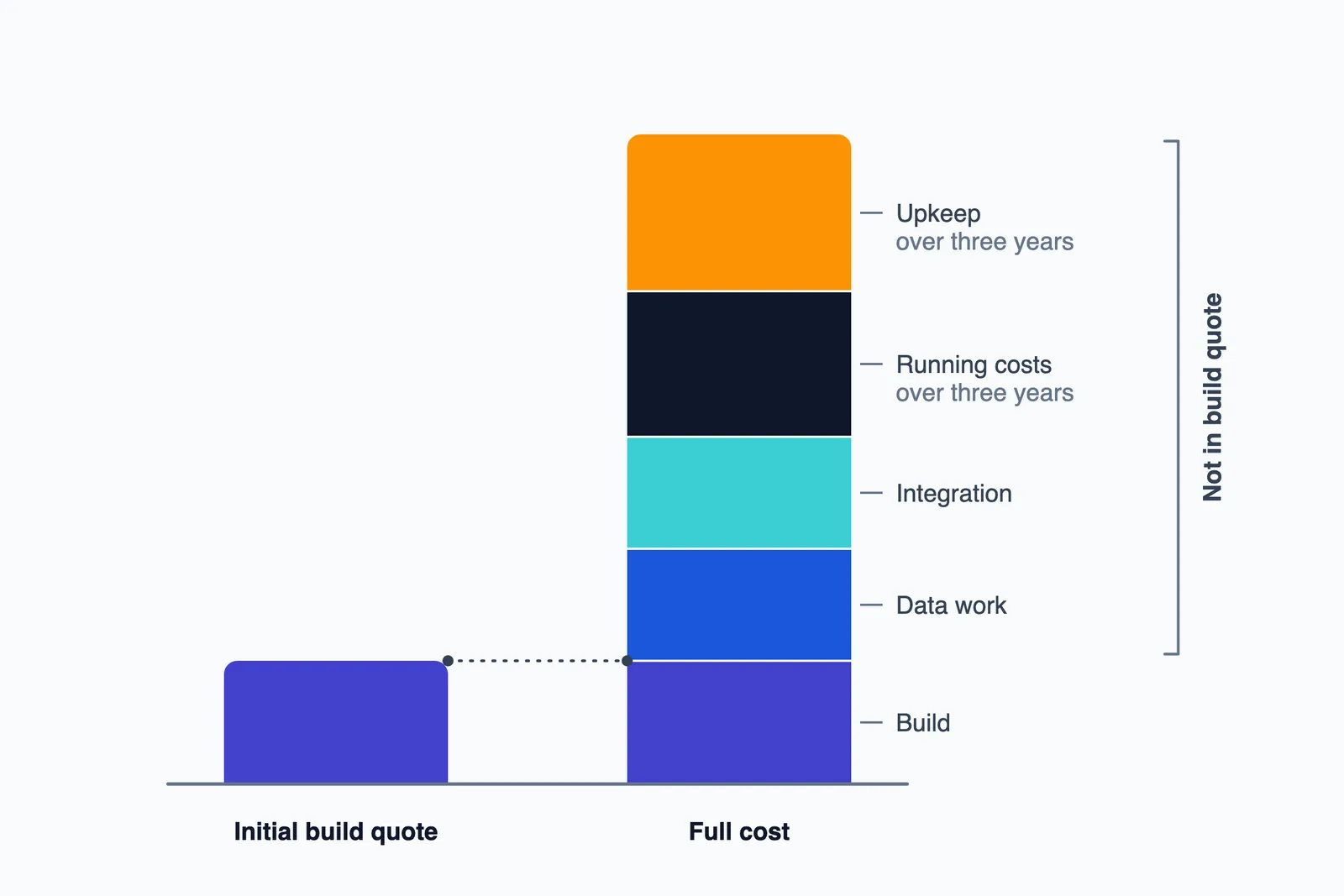
The build quote is a one-off figure. Running costs repeat every month and grow with usage. For foundation-model systems they're also the driver buyers most often get wrong, because they budget from the price per token instead of the cost of a finished task.
Model tier is a cost lever
Anthropic's published list prices, checked in November 2026, show how much the choice of tier matters:
| Model | Input (per million tokens) | Output (per million tokens) |
|---|---|---|
| Sonnet 5.5 | $2 | $10 |
| Opus 5.5 | $4 | $20 |
| Fable 5.2 | $8 | $40 |
Two more levers are on the same page. The Batch API gives "a 50 percent discount on both input and output tokens" for work that doesn't need an instant answer; batch Haiku 5.5 costs $0.05 input and $0.25 output per million tokens for prompts up to 100K tokens. Cache hits on a repeated prompt prefix cost 0.1× the base input price on most models, and 0.05× on Opus 5.5 and Sonnet 5.5. For an analytics assistant that sends the same schema description with every question, caching changes the economics.
Output tokens cost five times as much as input tokens at every tier above, so tasks that generate long outputs cost far more than tasks that read a lot and answer briefly. Good designs send each task to the cheapest model that handles it well: a small model for classification and routing, a larger one only for the hard reasoning.
Why per-task cost can rise while list prices fall
Unit prices are falling fast. The Stanford HAI 2025 AI Index reports that the price of GPT-3.5-level performance fell from $20.00 to $0.07 per million tokens between November 2022 and October 2024, "a more than 280-fold reduction". It also finds that LLM inference prices have fallen "anywhere from 9 to 900 times per year" depending on the task. That holds capability fixed; frontier models still cost more.
Your bill can still go up, because the number of tokens per task keeps growing:
- Tokenizers change. Anthropic's docs note that its newer tokenizer "produces approximately 30% more tokens for the same text". Same prompt, same list price, bigger bill.
- Tool use adds overhead. Enabling tools adds a system prompt of about 286 tokens to each request on current models, before counting your own tool definitions, which are also sent on every call.
- Agents make several calls per task. Each step resends the growing conversation, including earlier tool results.
- Volume grows. A system that works gets used more, by more people, for more kinds of questions.
An illustrative calculation using the Sonnet 5.5 prices above (our assumptions, not a benchmark): a single call with 3,000 input tokens and 500 output tokens costs about $0.011. An agent that finishes the same task in five calls, each carrying around 8,000 input tokens of accumulated context and producing 500 output tokens, costs about $0.105. That's roughly ten times more per task at the same price per token. Multiply by daily volume and the design choice outweighs the model choice.
Classical ML and computer vision run differently
Running costs for classical ML and computer vision don't come from tokens. A tabular churn or forecast model usually scores in batches inside or next to the warehouse, and its running cost is a small, predictable compute charge.
Computer vision costs come from inference hardware, either cloud GPU instances or edge devices on site. The bill scales with the number of camera streams, the frame rate, the image resolution and the model size. Processing every fifth frame instead of every frame, or using a smaller model tuned for one task, can cut hardware needs a lot when the task allows it. These costs are mostly fixed and planned ahead, unlike token bills that rise with every user.
Our Text-to-SQL project shows the foundation-model pattern in an analytics setting. Every business question becomes one or more model calls carrying schema context, the generated SQL and sometimes a retry when the query fails.
Driver 5: Upkeep after launch
An AI system starts to degrade the day it ships. The data it sees drifts away from the data it was built on. In their NeurIPS paper on hidden technical debt in ML systems, Sculley et al. wrote that "it is common to incur massive ongoing maintenance costs in real-world ML systems." That was true in 2015, and foundation models have added new kinds of upkeep since.
Upkeep typically includes:
- Drift detection and retraining. Customer behaviour, product mix and camera conditions change. Models need monitoring and a retraining pipeline that doesn't depend on one engineer's laptop.
- Prompt and model version upgrades. Providers release and retire model versions. Each upgrade means rerunning your evaluation set, because a newer model can change outputs you relied on.
- Upstream schema changes. In analytics settings this is the most common cause of breakage. A renamed column or a changed metric definition quietly breaks features or grounding.
- Monitoring. Accuracy, latency and cost per task, with alerts when any of them moves.
- Support. Someone on call when a business-critical prediction stops arriving.
Monitoring and retraining need a production MLOps setup budgeted from day one. Teams that treat upkeep as optional end up paying for it later, usually in emergency fixes.
How to estimate your own AI development cost before asking for quotes
You can't get a precise number without someone looking at your data and systems. You can work out where your project sits on each driver, which tells you which end of the published ranges you're near and where the uncertainty is.
A five-question self-assessment
| Driver | Low | Medium | High |
|---|---|---|---|
| Complexity: what rung does the simplest working solution need? | Rules or classical ML on tabular data | Single-task deep learning, or an LLM with retrieval | Multi-step agents or several models working together |
| Data readiness: can the team use the data as it is? | Documented warehouse tables, labels exist | Data exists but is spread out; partial labels | No labels, no shared keys across systems, unknown quality |
| Integration: where does the output have to go? | Read-only from one system, output to a dashboard | Reads from several systems, writes back to one | Write-backs to several systems, SSO, row-level security, audit trails |
| Running cost: how and how often does it run? | Batch scoring, low volume or fixed hardware | Daily interactive use, single model calls per task | High volume, agent loops, real-time video on many streams |
| Upkeep: how fast do inputs and requirements change? | Stable inputs, periodic review | Seasonal drift, scheduled retraining | Fast-changing inputs, regulated outputs, on-call needed |
If most answers are Low, you're near the bottom of the published ranges. A High in data readiness or integration widens a quote more than a High in complexity, because those are the drivers a vendor can least estimate from outside. If you can't answer a row at all, that's the first thing to find out.
Stage spend to reduce uncertainty
Wide ranges come from unknowns, and the cheapest way to remove unknowns is to stage the work: a short discovery phase, then a proof of concept on real data, then an MVP in front of real users, with a go/no-go decision between each stage. Discovery checks the data and maps the integrations. The proof of concept shows the approach works on your data. The MVP shows people will use it inside their real workflow.
Abandonment is common, which is why the gates matter. Gartner predicted that at least 30% of generative AI projects would be abandoned after proof of concept by the end of 2025, citing poor data quality, weak risk controls, rising costs or unclear business value. S&P Global Market Intelligence found that the share of companies abandoning most of their AI initiatives before production rose from 17% to 42%, and the average organization scrapped 46% of its proofs of concept.
A project stopped after a short discovery phase is a cheap lesson. The same project stopped after a full build is the most expensive outcome on this page. For what each stage typically involves, see our AI MVP timelines and cost questions.
Questions that make vendor quotes comparable
Two quotes for "the same project" often assume different projects. Ask every vendor:
- What does the quote assume about our data? Is cleaning, joining and labelling included, and up to what limit?
- Which integrations are in scope? Read or write, which systems, and whether SSO, permissions and audit logging are included.
- What is the projected monthly running cost at our volume? Ask for cost per task, not cost per token, along with the model tier and whether batching and caching are assumed.
- How will results be evaluated? What metric, against what test set, and who builds that set.
- What upkeep after launch is included? Monitoring, retraining, model version upgrades and support, and for how long.
A vendor who can't answer these hasn't scoped the work yet, whatever the number on the quote says.
This is how we scope custom AI and ML development work at AtlasML: place the project on all five drivers, test the riskiest assumption first, and price each stage only once the one before it has passed its gate.
Frequently asked questions
How much does AI development cost in 2026?
Published guides range from about $10K for a simple AI feature to $1M+ for an enterprise platform. Projects near the low end use rules or classical ML on clean, documented data, with one read-only integration. Projects near the high end combine foundation models or agents, scattered or unlabelled data, write-backs into several systems, high usage and strict compliance needs. Your position on those five drivers matters more than any average.
Why is data preparation so expensive in AI projects?
Most business data wasn't collected with AI in mind. Systems don't share keys, labels are missing or inconsistent, history is short and column meanings aren't written down. Fixing that is skilled engineering work: Anaconda's survey found data professionals spend about 38% of their time on preparation and cleansing. Vendors estimate data work at 20–40% of project cost, and the true share depends on your data.
Is it cheaper to use an LLM API than to build a custom ML model?
An LLM API usually costs less up front, because there's no model to train. Running costs scale with usage, though, and cost per task can rise even as token prices fall: tokenizer changes, tool definitions and multi-step agent loops all add tokens to each task. For high-volume, narrow tasks with good labelled data, a custom classical or deep-learning model can cost less to run over three years.
What are the ongoing costs of an AI system after launch?
The ongoing costs are inference (API tokens or GPU and edge hardware), monitoring, retraining when data drifts, rerunning evaluations when model versions change, fixing breakages caused by upstream schema changes, and on-call support. Research on ML systems has long described maintenance costs as large and ongoing, so budget them as part of total cost of ownership, not as an afterthought.
How can I reduce AI development cost without lowering quality?
Pick the lowest complexity rung that solves the problem. Check data readiness before committing to a build. Stage spending through discovery, proof of concept and MVP, with go/no-go gates between them. Reuse existing infrastructure such as current cameras or warehouse tables. For foundation-model systems, choose the model tier per task and use batch processing and prompt caching where the workload allows.
Why do AI vendor quotes for the same project differ so much?
Each vendor fills in unknowns with different assumptions: how clean your data is, which integrations are in scope, what volume the system will handle and what support after launch includes. Ask every vendor to state those assumptions, along with projected monthly running cost per task, and the quotes become comparable. A paid discovery phase replaces the assumptions with facts.