
Ask three vendors for a video analytics quote and you will probably get three numbers you can't line up. One prices per camera per month, one per "instance", and one gives an annual figure for the whole site. That is why AI video analytics cost in India is hard to pin down from published prices. Public numbers run from ₹999 for the first month of one entry plan to ₹1–5 crore a year for multi-site enterprise rollouts, and the units behind them are different.
This guide shows how a video analytics bill is built, line by line, so you can turn any quote into the same two figures: rupees per camera per month, plus fixed costs per site, added up over 36 months. Your finance team will want the numbers in that form anyway.
We quote published prices throughout as reference points. Most come from vendor pages, so read them as vendor list prices or vendor estimates, not market benchmarks. Check the current price before you put any of them in a budget.
Why per-camera quotes for AI video analytics don't compare
"Per camera" sounds like a standard unit. It isn't. Before comparing two quotes, find out what each vendor is actually counting and what comes bundled with each unit.
Per camera, per stream, per detection, per instance
Here are four billing models you'll see in published pricing:
- Per stream plus per detection. Camzify bills one stream instance for each camera and one detection instance for each detection you turn on. Its pricing starts "from $5 per camera per month" for the stream with motion and tamper detection, and it says "most cameras land between $20 and $90 per camera per month."
- Per instance. CoCompanion publishes INR plans per "instance" per month, not per camera.
- Annual band by scale. Agrex AI quotes annual INR bands for pilot, SME, enterprise and multi-site deployments.
- Flat per camera. Many quotes use a single per-camera monthly or annual rate. Each additional model per camera may or may not be included.
Take Camzify's own example: a 10-camera site with intrusion detection on 2 cameras. The number of billable units changes with the model:
| Billing model | What is counted | Billable units for this site | What to ask |
|---|---|---|---|
| Flat per camera | Cameras | 10 | Which analytics are included? Is a second model on the same camera extra? |
| Stream + detection instance | Streams, plus each enabled detection | 10 stream + 2 detection = 12 instances | What does each instance type cost? |
| Per instance (vendor-defined) | Whatever the vendor calls an instance | Unknown until defined | Is one instance one camera, one model, or one processing node? |
| Annual band | Site size | 1 band | Which line items does the band include: hardware, integration, retraining? |
Two quotes with the same headline "per camera" rate can differ by the whole cost of the detection layer. Write the unit down for every quote before you compare prices.
What a "camera" includes in each quote
Even within one vendor, the same unit can carry very different entitlements. CoCompanion's two published plans show this clearly:
| Essential | Performance | |
|---|---|---|
| Price per instance per month | ₹999 first month, then ₹2,399 | ₹5,999 first month, then ₹7,999 |
| Alerts included | Up to 750 | Up to 7,500 |
| Stated accuracy | "Up to 75%" | "Up to 95%" |
| Retention | 45 days | 90 days |
The vendor says pilots can run monthly but production contracts are usually annual, and the page doesn't say whether GST is included (CoCompanion pricing). Check current prices before using these figures.
When you compare quotes, normalise these items for every one of them:
- Retention days for footage and for event clips
- Alert caps and the price per alert above the cap
- Accuracy tier, and how accuracy was measured (on whose footage?)
- Support SLA: response time and on-site visits
- Hosting region for cloud processing and storage
- GST: included, excluded or not stated
- Contract term: monthly, annual or multi-year
What AI video analytics costs in India: the published numbers
Most vendors don't publish prices at all. Fora Soft says plainly that "most vendors no longer publish list prices." The figures below are the ones we could verify. USD figures are global references and we haven't converted them to INR.
| Item | Published price | Unit | Source type |
|---|---|---|---|
| SaaS analytics, entry plan | ₹999 first month, ₹2,399/month after | Per instance; GST not stated | Vendor list price (CoCompanion) |
| SaaS analytics, higher plan | ₹5,999 first month, ₹7,999/month after | Per instance; GST not stated | Vendor list price (CoCompanion) |
| Pilot / POC, 5–20 cameras | ₹2–6 lakh | Per pilot, 60–90 day deployment | Vendor estimate (Agrex AI) |
| Single SME site, 20–100 cameras | ₹8–25 lakh | Per year | Vendor estimate (Agrex AI) |
| Enterprise single site, 100–500 cameras | ₹30–80 lakh | Per year, incl. edge hardware and integration | Vendor estimate (Agrex AI) |
| Multi-site, 500+ cameras across 5+ sites | ₹1–5 crore | Per year | Vendor estimate (Agrex AI) |
| Custom integration, enterprise scale | ₹15–40 lakh, plus 3–4 months to go-live | Per project | Vendor estimate (Agrex AI) |
| SaaS analytics, global | $15–75 (the same page's FAQ says $15–50) | Per camera per month | Vendor estimate (Agrex AI guide) |
| Instance-based analytics, global | From $5; most cameras $20–90 | Per camera per month | Vendor guide (Camzify) |
| SaaS VMS, global | $15–40 | Per camera per month | Third-party estimate (Fora Soft) |
| Perpetual VMS licence, global | $50–200 | Per camera, one-time | Third-party estimate (Fora Soft) |
| Edge accelerator, global | $50–150 | Per camera, one-time, "plus modest power" | Third-party estimate (Fora Soft) |
| 2MP IP bullet camera, STQC model (CP Plus CP-UNC-TA21L3C-LQ) | ₹4,039 incl. GST (MRP ₹5,999) | Per camera | Marketplace listing (Moglix) |
| AI IP cameras | Basic ₹4,000–9,000; advanced ₹10,000–25,000+ | Per camera | Third-party estimate (Innova Industries) |
| NVIDIA Jetson Orin Nano Super Developer Kit | ₹54,999 incl. GST | Per unit (dev kit) | Reseller listing (Variety Infotech) |
| Cloud GPU, on-demand | T4 ₹30, L4 ₹49, L40S ₹102, A100 40GB ₹179, A100 80GB ₹189 | Per hour, taxes excluded | Vendor list price (E2E Networks) |
Marketplace and list prices change. The Moglix camera price changed between our first search and our check of the page. Use these numbers to sanity-check quotes, not as a budget.
Per-camera costs: the four lines that scale with camera count
Four cost lines rise each time you add a camera: the camera itself, its share of compute, the software licence, and storage and bandwidth. Get these right and most of the 36-month total follows.
The camera: reuse or replace
Reusing existing CCTV is usually the biggest saving in the project. An existing camera can often be reused if it meets four conditions for the use case:
- Resolution on the target. A helmet or a number plate needs enough pixels where it actually appears in the frame, not just a high resolution overall.
- Angle. A camera mounted for general surveillance may look across a dock when the use case needs it looking down at it.
- Frame rate high enough to catch fast-moving objects.
- Lighting across all shifts, including night IR.
Agrex lists "camera upgrade costs if resolution is below the minimum" as a hidden cost (Agrex AI). Run a camera audit before you accept any quote, so replacements show up as a line item and don't arrive as a change request.
If you do need new cameras, you will be buying from the pool of models that meet India's Essential Requirements (covered below). One published example is a CP Plus 2MP IP outdoor bullet camera sold as an "STQC Model" at ₹4,039 including GST (₹3,422 plus ₹617 GST) on Moglix, against an MRP of ₹5,999. Check the current price. AI cameras that run analytics on board are listed at ₹4,000–9,000 for basic models and ₹10,000–25,000+ for advanced ones (Innova Industries). An AI camera moves the compute cost into the camera price, so don't count compute twice when you compare it with a plain IP camera plus an edge box.
A CCTV camera isn't always the cheapest sensor, either. For footfall counting, compare the options in our retail people counter buyer's guide.
Compute: edge box or cloud GPU
Compute is where quotes differ most, because the right amount depends on your workload. The work for one stream is roughly:
- Frames analysed per second. The camera may record at 25 fps, but the model doesn't have to look at every frame. Agrex puts typical analytics at 5–30 fps depending on use case (Agrex AI guide).
- Input resolution and model size. Larger inputs and heavier models cost more per frame.
- Models per stream. PPE plus intrusion on one camera means two models on the same frames.
Multiply those across all your cameras and you get the load that decides how many streams one box or GPU can carry. Counting is the clearest case. In cement bag counting at dispatch, bags move through the frame quickly, so the frame rate and camera angle have to be right or bags are missed. A perimeter intrusion camera can often run at a much lower rate. Two sites with the same number of cameras can need very different hardware.
For this reason we won't give you a generic "cameras per box" figure, and you shouldn't accept one either. The vendor should state the number for your frame rate, resolution and model list, and ideally prove it with a load test on your own footage.
Reference points:
- Edge. The NVIDIA Jetson Orin Nano Super Developer Kit lists at ₹54,999 including GST, with up to 67 TOPS (sparse), 8GB LPDDR5 and 7/15/25W power modes (Variety Infotech). It is a developer kit, with a purchase limit of four units per account for R&D use. It is not a ruggedised production enclosure, so a production edge box for a dusty plant floor will be a different product at a different price. Globally, Fora Soft puts edge accelerators at "$50–$150 per camera" one-time, amortised, "plus modest power" (Fora Soft).
- Cloud. E2E Networks lists on-demand GPUs at ₹30/hr (T4), ₹49/hr (L4), ₹102/hr (L40S), ₹179/hr (A100 40GB) and ₹189/hr (A100 80GB), excluding taxes. Reserved plans start at one month, with quotes from sales (E2E Networks).
Video analytics usually runs around the clock, so do the always-on arithmetic. At roughly 730 hours a month, one on-demand T4 comes to about ₹21,900 and one L4 to about ₹35,770 a month before tax. Divide by the number of streams that GPU can really carry and you have a per-camera compute cost to set against an edge box amortised over its life.
Software: licence, subscription or custom build
Software comes in three commercial shapes:
- SaaS subscription, billed per camera, stream or instance per month. Lowest upfront cost, and a recurring bill for as long as you use it. See the ranges in the table above.
- Perpetual licence, paid once per camera, usually with an annual maintenance fee. Fora Soft's $50–200 per camera figure is for perpetual VMS licences, not analytics specifically, so use it only as a structural reference.
- Custom build, when no packaged product handles your use case, such as counting a specific product on a specific line. Fora Soft puts a first release at $150k–600k depending on scope. That is a global figure and scope drives it heavily. A custom computer vision system trained on your own footage is the build option. For one-time build drivers such as data readiness and integration, see what drives AI development cost.
Over 36 months, a subscription that looks cheap per month can overtake a licence or a build. Compare all three over the same period.
Storage and bandwidth
Storage scales with bitrate × retention days × cameras. Fora Soft gives a reference point: a 4K H.265 camera at 6 Mbps generates about 65 GB a day. By simple arithmetic, that is about 1.95 TB per camera for 30 days of retention and about 5.85 TB for 90 days. Most existing CCTV runs at lower resolutions and bitrates, but the rule is the same: doubling retention doubles storage.
So the retention figure in a quote (45 days versus 90, as in the CoCompanion plans above) affects cost directly. Ask whether you need continuous footage kept for the full period, or only event clips around alerts. The second option is usually far smaller.
Cloud analytics adds upload bandwidth at every site. Camzify notes that upstream bandwidth may need upgrading (Camzify). At a plant on a single business broadband line, that can become a recurring cost per site.
See It Working: AI Video Analytics on an Existing Store CCTV
This demo shows AI people counting running on a retail store's existing surveillance camera, with no new hardware and no door sensors. Each person is detected with a bounding box and confidence score and tracked from frame to frame. The IN and OUT counters update as people cross the entry line. If an analytics workload can run on cameras you already have, you skip the camera hardware line in the per-camera costs.
Want to know what video analytics would cost on the cameras you already have? Call +91 95372 90206 or message us on WhatsApp and we'll walk you through it.
Per-site costs that don't scale with cameras
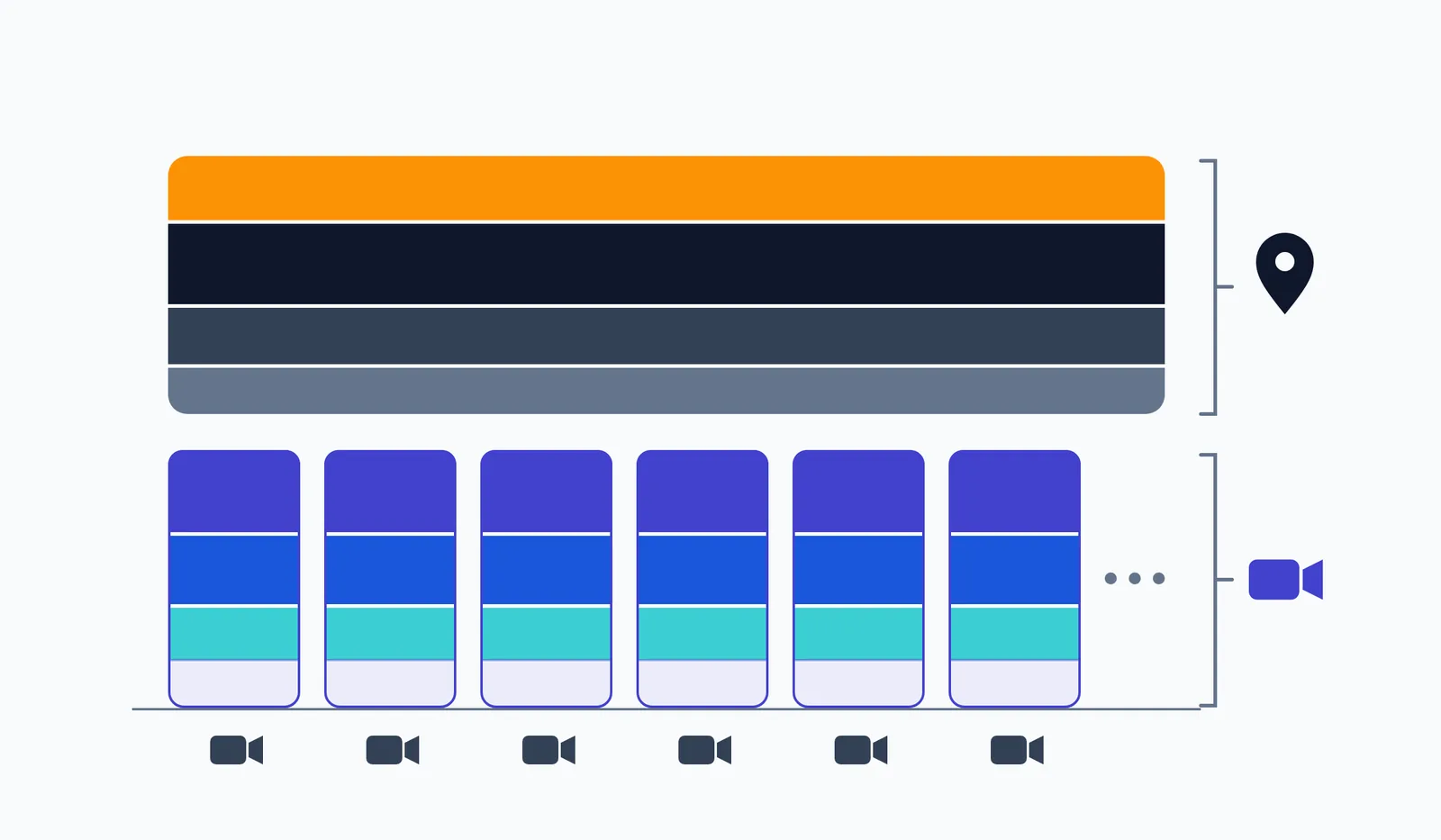
Some costs are paid once per location whether it has 8 cameras or 80. They are often left out of "per camera" quotes, and they are why small sites cost more per camera than large ones.
Site survey, network, power and mounting
Each site needs a survey to check camera positions, network paths and power. Camzify lists the site-level items: on-prem deployments often need a GPU server per site, private networks may need an on-site connector PC to relay streams, and upstream bandwidth may need upgrading (Camzify). Add PoE switch capacity, UPS backup for the edge box, and mounting work for any camera that has to move. None of these are priced in the sources we found, so ask each vendor to list them separately.
Integration with ERP, VMS, alerting and BI
Analytics only pays off when its output reaches a system people already use. Typical integrations:
- VMS, so alerts link to the recorded footage
- ERP or WMS, for example matching dispatch counts against invoices
- Alerting by email, SMS, messaging apps or sirens
- BI dashboards for trends across shifts and sites
At enterprise scale, Agrex puts custom integration at ₹15–40 lakh, adding 3–4 months to go-live (Agrex AI). A single site that only needs email or webhook alerts will cost far less. Settle the scope of integration before comparing quotes, because it can be larger than the software line.
Commissioning and false-alarm tuning per site
A model that works at one site doesn't automatically work at the next. Camera angles, lighting, background clutter, uniforms and workflows all differ, and every difference can produce false alarms. Commissioning means setting detection zones, thresholds and schedules for each camera, then reviewing alerts for a few weeks until operators trust them.
This is where budgets slip, because it is labour and it repeats at every site. We cover it in detail in deploying PPE detection on CCTV in an Indian plant. Ask vendors how many tuning days per site are included and what each extra day costs.
Edge vs cloud vs hybrid: where the money goes over three years
Choosing between on-premise and cloud video analytics mostly decides when you pay and what you pay for. It doesn't automatically decide how much. Here is how the cost lines shift:
| Factor | Edge / on-premise | Cloud | Hybrid |
|---|---|---|---|
| Upfront cost | High: boxes or GPU servers per site | Low: mostly setup | Medium: edge for inference, cloud for aggregation |
| Monthly cost | Low: power, support | GPU-hours, storage, subscription | Smaller cloud bill plus edge support |
| Bandwidth | Stays on the LAN | Continuous upload from every site | Events and metadata only |
| Data residency | Footage stays on site | Footage leaves the site; confirm hosting region | Mostly on site; clips or metadata leave |
| Refresh cycle | You replace hardware when it ages or models outgrow it | Provider handles it | Edge hardware refresh only |
| Who maintains it | You or your vendor, on site | Provider | Split; agree who owns what |
Fora Soft's published 500-camera hybrid model shows how to lay out the line items (USD, global, published November 2026): cloud inference of about $2–5k for aggregation workloads, storage of about $4–9k for 1 PB hot plus tiered archive, and monitoring and logs at about $500–1,500 a month (Fora Soft). Edge accelerators sit alongside these at $50–150 per camera one-time. The useful part is the structure, not the dollar figures: each of these lines should appear in your own model, priced in INR for your setup.
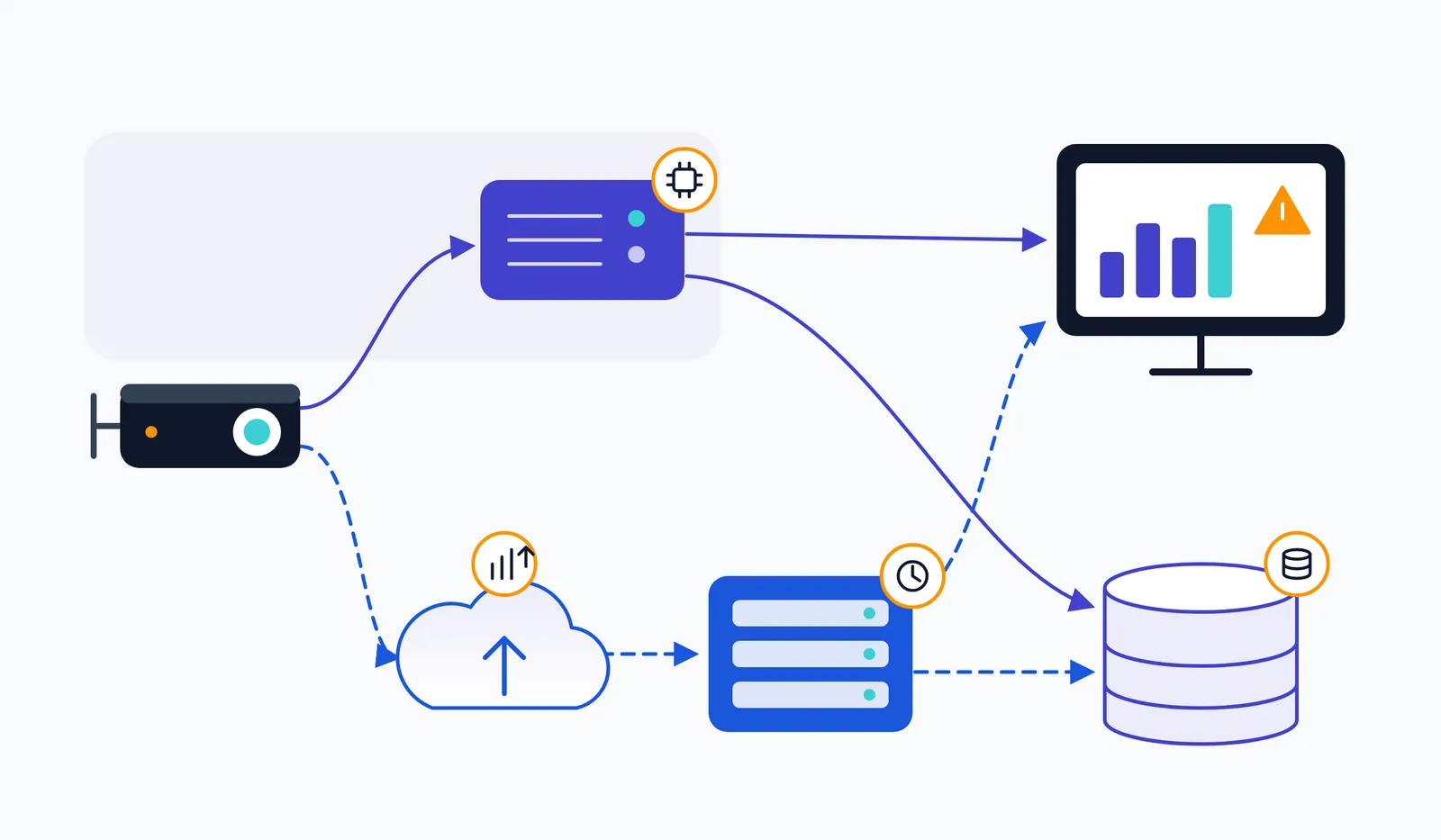
As a rule, edge wins when sites have many cameras, poor upload bandwidth, or a strong reason to keep footage on site. Cloud wins when sites are small and scattered and you don't want hardware to look after. Hybrid fits when inference has to be local but you want central dashboards across sites. Whichever you lean towards, compare all three as 36-month totals at your real frame rate and retention.
India-specific cost lines in 2026
Three cost lines apply specifically to Indian deployments, and the global cost guides leave them out.
STQC and Essential Requirements for CCTV cameras
MeitY's Essential Requirements for CCTV began with government procurement and were later extended to all CCTV cameras sold in India, as part of the STQC norms. According to Counterpoint Research (May 2025):
- The compliance deadline, originally October 2024, was extended to April 9, 2025.
- Analog cameras were exempted from April 1, 2025.
- By late February 2025, only five brands had compliant models: CP Plus, Prama, Matrix, Sparsh and Qubo.
- IP cameras make up more than two-thirds of the market, and government procurement accounts for 30–35% of CCTV demand.
- Counterpoint expected prices to rise as compliance costs were passed on, with consolidation in the short term. That was an analyst expectation, not a measured increase.
For your budget, this means any new IP camera, whether a replacement or an expansion, has to come from the compliant pool, which narrows your brand choice. It is another reason reusing existing cameras saves money. If a vendor's quote bundles cameras, ask for the exact models and confirm they are compliant.
DPDP Rules: what the 2027 deadline means for your budget
The Digital Personal Data Protection Rules were notified on November 13, 2025. According to AZB & Partners, Phase II (consent managers) applies from November 13, 2026, and Phase III, which covers notice and consent, data fiduciary obligations and data principal rights, applies from May 13, 2027. Business Today reported that the government was discussing a shorter 18-month timeline with industry, so watch the dates.
The security safeguards include encryption, masking or tokenisation, access controls, logging and monitoring, backups, keeping logs and relevant data for one year, and a detailed breach report to the Data Protection Board within 72 hours. For a video analytics system, each of these becomes an engineering cost line:
- Storage for one year of access and system logs, on top of footage retention
- Role-based access control on the dashboard and footage archive
- Encryption of footage and clips at rest and in transit
- Processor contracts with your analytics and cloud vendors
- A breach response process that can meet the 72-hour report
How CCTV footage and analytics outputs are classified under the Act depends on what you capture and how you use it. We are not making a claim about that here. Get legal review before you finalise retention periods and architecture.
GST and INR billing
Published Indian prices don't treat tax the same way. E2E Networks lists GPU rates excluding taxes. Variety Infotech's Jetson price and the Moglix camera price include GST. CoCompanion's plan prices don't say either way. Before adding up a total, bring every line to the same basis, either all pre-GST or all including GST, and confirm which way each vendor quoted. Ask USD-priced vendors whether they will invoice in INR and who carries the exchange-rate risk on a multi-year contract.
Running costs after go-live
The quote you sign covers year one. These lines carry on afterwards:
- Model retraining. Agrex names annual model retraining fees as a hidden cost (Agrex AI). Accuracy drifts when cameras move, lighting changes or uniforms change. Retraining is a recurring cost, not a one-off. Our MLOps playbook explains why.
- Labelling. Retraining needs labelled frames. Fora Soft puts bounding-box labelling at $0.03–1.00 per object and semantic masks at $0.05–3.00 (global figures).
- Per-alert overage. Plans with alert caps charge once you go over the cap. An untuned site can use up its cap within days.
- Support SLAs. On-site visits, response times and remote monitoring are often priced separately from the licence.
- Hardware refresh. Edge boxes and on-prem GPU servers age. New, heavier models may need newer hardware before the old boxes fail.
- Storage growth. Adding cameras or extending retention increases storage costs every month.
How to estimate your video analytics cost before calling vendors
Build your own estimate first. Then every quote becomes a check on your numbers rather than the only number you have. Work through these steps:
- List every camera by site, with model, resolution, mounting position and whether it is IP or analog.
- Assign a use case to each camera: PPE, counting, ANPR, intrusion, footfall. Note any camera that needs more than one model.
- Set the required frame rate and resolution for each use case, and mark the cameras that fail and need replacing with compliant models.
- Set retention days separately for continuous footage, event clips and logs, including the one-year log requirement.
- Choose edge, cloud or hybrid per site, based on camera count and upload bandwidth.
- Count sites and list the fixed per-site items: survey, network, power, connector PC or server, commissioning days.
- List integrations: VMS, ERP or WMS, alerting channels, BI.
- Add it up over 36 months: (per-camera monthly cost × cameras × 36) + (one-time cost per camera × cameras) + (fixed costs per site × sites) + integration + running costs (retraining, support, refresh, storage growth). Do it all on one GST basis.
Then send every vendor the same questions, so the quotes come back in the same units:
| Question | Why it matters |
|---|---|
| What exactly is one billable unit: camera, stream, detection or instance? | Puts every quote on the same unit |
| How many of our streams can one box or GPU handle, at our fps, resolution and model list? | Drives the per-camera compute cost |
| Which of our existing cameras will you reuse, and which need replacing? | Shows the hidden camera upgrade cost early |
| What retention, alert cap and overage rate are included? | Normalises what a "camera" includes |
| How was the accuracy figure measured, and will you test on our footage? | Separates marketing accuracy from site accuracy |
| How many commissioning and tuning days per site are included? | The per-site cost that most often slips |
| Which integrations are in scope, and which are change requests? | Integration can outweigh software |
| Are retraining, support and hardware refresh included, and for how long? | Running costs over 36 months |
| Is GST included? Which currency do you invoice in? | One tax and currency basis for all quotes |
| Where is footage processed and stored, and what logging and access control do you provide? | Hosting region and DPDP safeguards |
Use these questions together with our guide to choosing a computer vision development company, which covers how to assess the team behind the quote.
Frequently asked questions
How much does AI video analytics cost per camera per month in India?
One Indian vendor publishes plans from ₹2,399 per instance per month after a ₹999 first month, and its higher plan is ₹7,999. These are priced per instance, not per camera, and GST isn't stated. Global SaaS references run from about $5 to $90 per camera per month. Normalise retention, alert caps, accuracy tier and GST before comparing any of them.
Can I use my existing CCTV cameras for AI video analytics?
Often yes, as long as each camera's resolution on the target, angle, frame rate and night lighting suit the use case. Reusing cameras is usually the biggest saving in a project. Cameras that fall below the minimum need upgrading, which is a known hidden cost, so run a camera audit before accepting a quote.
Is edge or cloud video analytics cheaper over three years?
It depends on your workload. Edge means upfront hardware per site plus a refresh cycle, with low monthly costs. Cloud has low upfront cost but monthly GPU-hours, storage and upload bandwidth at every site, and video analytics usually runs 24/7. Compare 36-month totals at your actual frame rate, model count and retention.
What does a video analytics pilot cost in India?
One published vendor band is ₹2–6 lakh for a pilot of 5–20 cameras with a 60–90 day deployment. The use case, the number of cameras that need replacing, and how much integration the pilot includes all move that figure. Agree success criteria and production pricing before the pilot starts.
Do CCTV cameras need STQC certification in India?
New CCTV cameras sold in India must meet MeitY's Essential Requirements under the STQC norms. The compliance deadline was extended to April 9, 2025, and analog cameras were exempted from April 1, 2025. Any new IP camera you buy for an analytics project should be a compliant model, so ask vendors for exact model numbers.
How does the DPDP Act affect video analytics costs?
The DPDP Rules were notified on November 13, 2025, and substantive obligations apply from May 13, 2027. Budget for encryption, access controls, one-year log retention, processor contracts and a breach process that meets the 72-hour reporting requirement. How your footage is classified depends on your deployment, so get legal advice.