

Say the head of customer experience at a D2C apparel brand asks three vendors to quote for an "AI chatbot for order queries". The three numbers don't come close to each other, and one of them is a monthly subscription with no build fee at all. That doesn't mean any vendor is wrong. Each is pricing a different product under the same name, and that is the main reason AI chatbot cost is so hard to pin down.
Published figures don't settle it either. Two Indian cost guides from 2026 give ranges whose starting points are a factor of 100 apart: CodingClave starts at ₹35,000 and IDS Logic starts at ₹35 lakh.
This guide doesn't add a third range. It takes the six drivers that move a chatbot quote one at a time, so you can see which assumption each vendor made. It separates the one-time build from the monthly bill and covers two rules most cost pages skip: Meta's 2026 WhatsApp terms and India's DPDP Rules. It ends with a checklist for comparing quotes side by side. The examples come from retail, D2C and QSR, where the usual jobs are order status, returns, store locator, catalogue questions and franchise support. For more retail use cases, see our page on AI for retail and e-commerce.
Why AI chatbot cost estimates in India disagree
Same label, different products
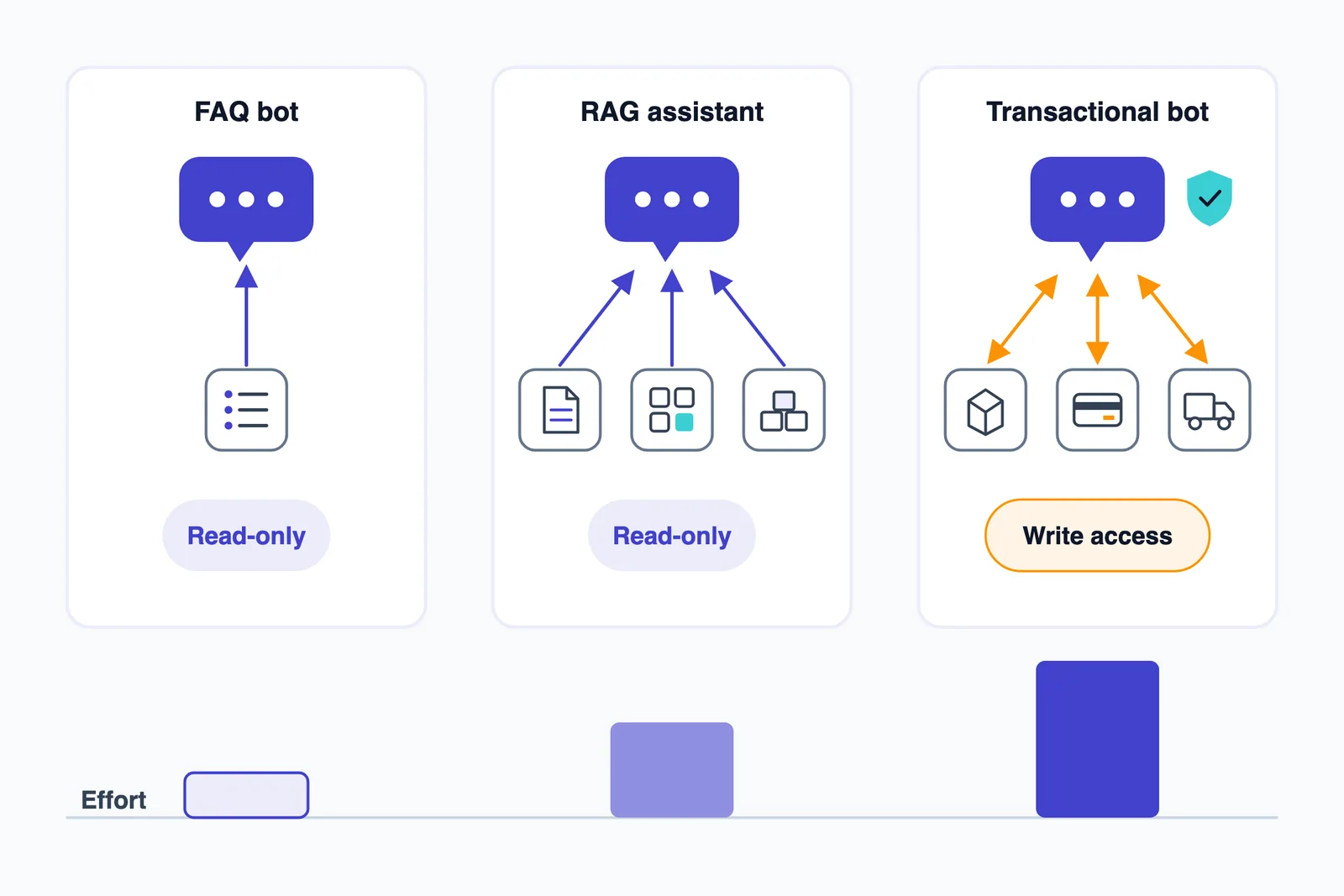
"AI chatbot" gets used for at least three different products:
- A rule-based or FAQ bot that answers a fixed list of questions: store timings, delivery areas, how to apply a coupon.
- A retrieval (RAG) assistant that reads your own documents and data, such as the return policy, the catalogue and franchise SOPs, and answers in its own words.
- A transactional bot that acts inside your systems: it cancels an order, books a return pickup or issues a refund.
Effort, risk and testing differ hugely between these three, and a quote rarely says which one it assumed. Here is how three Indian pages from 2026 handle the numbers:
| Source | What it gives | Note |
|---|---|---|
| CodingClave | ₹35,000 to ₹15 lakh+ across five tiers, from a rule-based FAQ bot to an enterprise bot | Defines each tier, which makes it useful for scoping |
| IDS Logic (21 January 2026) | "₹35 lakh to ₹3.2 crore" in its introduction; "₹40 lakh to ₹1 crore+" in a later section | Its USD entry tier also varies within the page: "around $40,000" in one place, $18,000–$45,000 in its FAQ |
| Brainguru (WhatsApp cost guide) | No build ranges: "this guide does not list market price ranges" | Lists Meta's message rates instead |
Taken together, these figures don't prove anyone is overcharging. They show that the label "AI chatbot" tells you nothing about scope. A ₹35,000 quote and a ₹35 lakh quote can both be fair for the product each vendor had in mind.
SaaS subscription vs custom build
Most pages that rank for chatbot pricing are written in US dollars and mix two different purchases. One is a SaaS subscription billed monthly, sometimes with a fee per conversation or per resolved query. The other is a custom build priced as a project. Put both on one chart and the range runs from tens of dollars a month to hundreds of thousands of dollars, which is no use to a buyer.
Vendors fall into three broad kinds:
- SaaS chatbot platforms. You configure the bot yourself in their tool and pay a subscription. They suit standard FAQ and lead-capture jobs and are quick to start.
- Agencies and WhatsApp solution providers. They set up a platform for you, sometimes with message fees bundled in and a markup on top.
- Custom development firms. They build on LLM APIs and your own stack, and hand over code you own.
To be fair to platforms: if your bot answers standard questions and collects leads, a platform is usually cheaper and faster. Custom work is worth its cost in three cases. The first is when the bot has to read from or write to your own order, inventory or loyalty systems. The second is when your rules are non-standard, such as returns that differ by city or SOPs that differ by franchise. The third is when per-resolution fees would grow faster than your chat volume.
Driver 1: scope (FAQ bot vs RAG assistant vs transactional bot)
Scope is the biggest driver, and most quotes leave it unstated. The table below uses retail examples.
| Bot type | What it does | What it needs from you | Where it fails | What pushes effort up |
|---|---|---|---|---|
| FAQ bot | Answers a fixed list, e.g. "What are your store timings in Surat?" | A clean list of questions and approved answers | Questions phrased differently or outside the list; answers go stale when timings change | Number of questions; number of stores with different answers |
| RAG assistant | Answers from your documents and read-only data, e.g. "Is this kurta available in M?" or "Can I exchange a sale item?" | Policies, catalogue and SKU data, plus a stock or order-status API it can read | Conflicting or outdated documents; questions that need a live lookup it doesn't have | Volume and quality of documents; how often they change; number of read-only lookups |
| Transactional bot | Acts in your systems, e.g. "Cancel my order and refund to UPI" | Write access to order management and payments; business rules for every exception | Wrong customer identified; partial failures (order cancelled, refund never raised); policy edge cases | Number of write actions, identity checks, approval rules and test cases |
Effort jumps when the bot moves from reading data to writing it. A bot that tells a customer their order status can get away with the odd clumsy answer. A bot that cancels orders can't afford to cancel the wrong one. Each write action needs:
- Identity checks, such as an OTP or a match on the registered phone number, before anything changes.
- Guardrails that set what the bot may do alone, what needs the customer's confirmation and what goes to a human. Refunds above a set value, or orders already handed to the courier, are typical cases for a human.
- Failure handling for when one system succeeds and the next one fails, so a cancelled order is never left without a refund.
- Testing against real exceptions: COD orders, partial shipments, exchanges in progress, payments pending.
CodingClave's tiers show how one vendor frames this. Its lowest tier answers 20–50 predefined questions. Its third tier answers from the business's own documents. Its top tier has deep integration with core systems and a 99.9% uptime SLA. Whatever framing your vendor uses, ask which of the three rows above the quote covers, and which write actions are included by name.
Driver 2: channels (website, app, WhatsApp, voice)
Each channel is a separate integration, with its own message formats, limits and login model. RaftLabs estimates "a week or two" of engineering for each added channel. A website widget and an in-app chat share most of their logic, but each still needs its own front-end work and testing. WhatsApp adds message templates, opt-in rules and Meta's billing.
Voice is a separate build, not just another channel. It adds speech recognition, text-to-speech, latency targets and telephony, and it fails in its own ways: background noise, poor phone lines, callers who talk over the bot. If a vendor prices voice as a small add-on, ask what they have assumed. We cover this in our guide to AI voice agents for customer service.
WhatsApp: what Meta's January 2026 terms mean for scope
For most Indian retailers WhatsApp is the channel that matters most. Few cost pages mention the rule that decides what kind of bot you may run on it. Clause 4.7 of the Meta Terms for WhatsApp Business Platform prohibits AI and ML providers, including LLM providers, from using the platform "when such technologies are the primary (rather than incidental or ancillary) functionality being made available for use".
TechCrunch reported that the rules took effect on 15 January 2026. In its paraphrase of Meta's position, the change "doesn't affect businesses that are using AI to serve customers on WhatsApp". OpenAI, Perplexity and Microsoft announced that their WhatsApp chatbots would stop working, and regulators in the EU, Italy and Brazil opened antitrust probes.
For a retailer, the cost effects are practical:
- Keep the bot's scope tied to your business. Order status, returns, store locator and catalogue questions are customer service. An "ask me anything" assistant that also answers general-knowledge questions puts your number at risk.
- Budget for an out-of-scope path. The bot has to decline unrelated questions politely and bring the chat back to what it does. That is a small but real item to design and test.
- Ask about training on your chats. The same clause bars using WhatsApp Business Platform Data, including anonymous, aggregate or derived forms, to train or improve AI models. The exception is fine-tuning a model "for your exclusive use". If a vendor plans to improve a shared model with your conversations, ask how that fits the terms.
The terms page shows "Last Modified: September 23, 2026", so read the current version before you sign. This isn't legal advice. Our WhatsApp AI chatbot guide covers clause 4.7 and handover design in detail.
Meta's message fees are a running cost
Meta charges for WhatsApp messages, and that charge lands in your monthly bill, not the build. Meta's pricing documentation sets out these rules:
- Pricing has been per message since 1 July 2025. The rate depends on the message category and the recipient's country calling code.
- Each business phone number gets 1,000 free service messages a month, and unused ones don't roll over. From 1 October 2026, service messages beyond the free tier are charged.
- Chats started from Click to WhatsApp ads get a free entry point window of up to 7 days.
- Volume tiers apply only to utility and authentication messages.
- India's marketing rate went up from 1 January 2026.
- INR billing for India launched on 1 January 2026. Eligible accounts must migrate by 31 December 2026. From 1 January 2027, Meta stops delivering messages from non-INR accounts.
- Meta Business Agent messages are a separate, charged category.
For scale, Brainguru reads Meta's India rate card, effective 1 October 2026, as ₹0.8631 per marketing message and ₹0.115 each for utility, authentication and service messages. Those figures are before taxes and provider markup. They are a third party's reading, so check Meta's own rate card for current rates.
Two scope questions follow. First, what will the bot send: replies to customers, order-update templates or promotional broadcasts? Each falls in a different category at a different price. Second, does the vendor's monthly fee include Meta's fees, or are they passed through to you, and at what markup? If your WhatsApp account still bills in another currency, the INR migration is a task with a deadline, and someone needs to own it.
Driver 3: knowledge-base preparation
Nobody quotes for this work, and for a retailer it is often the biggest hidden cost. A RAG assistant is only as good as the content it reads, and retail content typically looks like this:
- Return and exchange policies that differ by city, by store format, or between franchise and company-owned outlets.
- PDFs holding three versions of the same policy, none marked as current.
- SKU attribute data with missing sizes, inconsistent colour names and old product codes.
- Price lists and offers that change every week.
- Franchise SOPs written for staff rather than customers, full of internal shorthand.
Someone has to decide which version is true, strip out internal notes, fill the gaps and structure the content so the bot finds the right passage. Retrieval keeps answers tied to your documents (our AI chatbot development FAQ explains how). It can't settle a contradiction between two documents, though. Give it a 2023 return policy and a 2025 one, and it may quote either.
A wrong answer about refunds does more damage than no answer. Tell a customer they can return a sale item within 30 days when the real limit is 7, and they will hold the store to it. The argument then lands on store staff in Ahmedabad or Kochi. That is why, for most retail bots, the knowledge base matters more than the choice of model.
Effort depends on three things: how many documents you have, how many conflicting versions exist and how often the content changes. Ask every vendor:
- Who cleans and structures the content: your team, theirs or both?
- How many documents and SKUs does the quote assume?
- Who owns updates after launch, and how does a new policy reach the bot?
- How often is content re-indexed? Does it sync automatically from your systems, or does someone upload it by hand?
Driver 4: ERP, CRM and order-system integrations
Every system the bot connects to is a separate piece of work. RaftLabs estimates 1–3 weeks per integration. For a retail bot, the usual list is order management, the POS, a Shopify or custom storefront, a loyalty CRM and the tracking APIs of your logistics partners.
Where an integration falls within that range depends on the system:
- A documented API is the fastest case, as long as it exposes what the bot needs.
- No sandbox means every write action has to be tested carefully against live data, which slows the work down.
- Rate limits can block the bot. An API that allows only a few calls a minute won't keep up with a festive-sale spike in order-status queries, so the build needs caching or a sync layer.
- CSV exports only is common with older POS and ERP setups. The bot then reads a copy that is only as fresh as the last export, and someone has to build and watch that pipeline.
- Several logistics partners means several tracking formats and sets of status names. Each has to be mapped to one answer a customer understands.
Read-only integrations cost less than write integrations, for the reasons given under Driver 1. A quote should list each system and say whether the bot reads, writes or does both. For the integration side in more depth, see our guide to connecting AI to your existing ERP and CRM systems.
See It Working: An AI Chatbot Answering From Business Records
In this demo, TransportGuru's AI assistant answers real club-management questions typed in plain English: who is available for Saturday's fixture, current injuries with return dates, season ticket renewals by stand, and pitch booking clashes. No reports or spreadsheets are needed. It shows what you get when a chatbot can reach a business's own operational data, which is exactly the integration work that pushes some quotes far above others.
Want a chatbot that answers from your own business systems? Call +91 95372 90206 or message us on WhatsApp and we'll walk you through it.
Driver 5: human handoff
Every retail bot needs a way to pass a chat to a person, for an angry customer, a damaged delivery or a refund outside policy. RaftLabs says escalation design adds 20–30% to development time. Handoff has five parts:
- Queue routing decides which team gets which chat: online orders, a particular store or franchise support.
- An agent console is where agents pick up chats. It can be your existing helpdesk tool or a new screen.
- Context passing shows the agent the conversation, the order and what the bot already tried, so the customer doesn't have to repeat themselves.
- Office-hours logic covers what the bot says at 11 pm, on Sundays and during festive peaks, when agents are offline or overloaded.
- WhatsApp's 24-hour customer-service window limits when you can reply freely, so it affects how long a chat can sit in an agent queue.
Then there is the people cost, which no build quote includes. Someone has to answer the handed-off chats, across every shift. A bot that hands off too often moves cost onto your support team rather than removing it. Ask each vendor how they will measure the handoff rate after launch.
Driver 6: Indian languages
"Supports Indian languages" can mean three very different builds:
- English plus Hinglish typed in Roman script. This is the cheapest case. Customers type "order kab aayega", and many LLMs accept input like that. How well a model copes with your customers' spelling is something to test, though, not assume. You need a test set built from real customer messages.
- Regional scripts such as Hindi, Gujarati or Tamil. Each language needs its own test set, either a translated knowledge base or retrieval that works across languages, and QA by native speakers. Policy wording needs the closest check, because a mistranslated return condition is still a wrong answer.
- Voice. This adds speech recognition and text-to-speech, with accents, dialects and noisy surroundings on top of everything in case 2.
MeitY's BHASHINI mission provides open language APIs, including translation and speech, and is one option to evaluate alongside commercial models. Whichever you use, test quality for each language on your own content before you commit. Be wary of any vendor's blanket claim about language coverage. Each added language multiplies the testing, so one sensible path is to launch with English and Hinglish, then add a regional language where chat volume justifies it.
AI chatbot build cost vs running cost
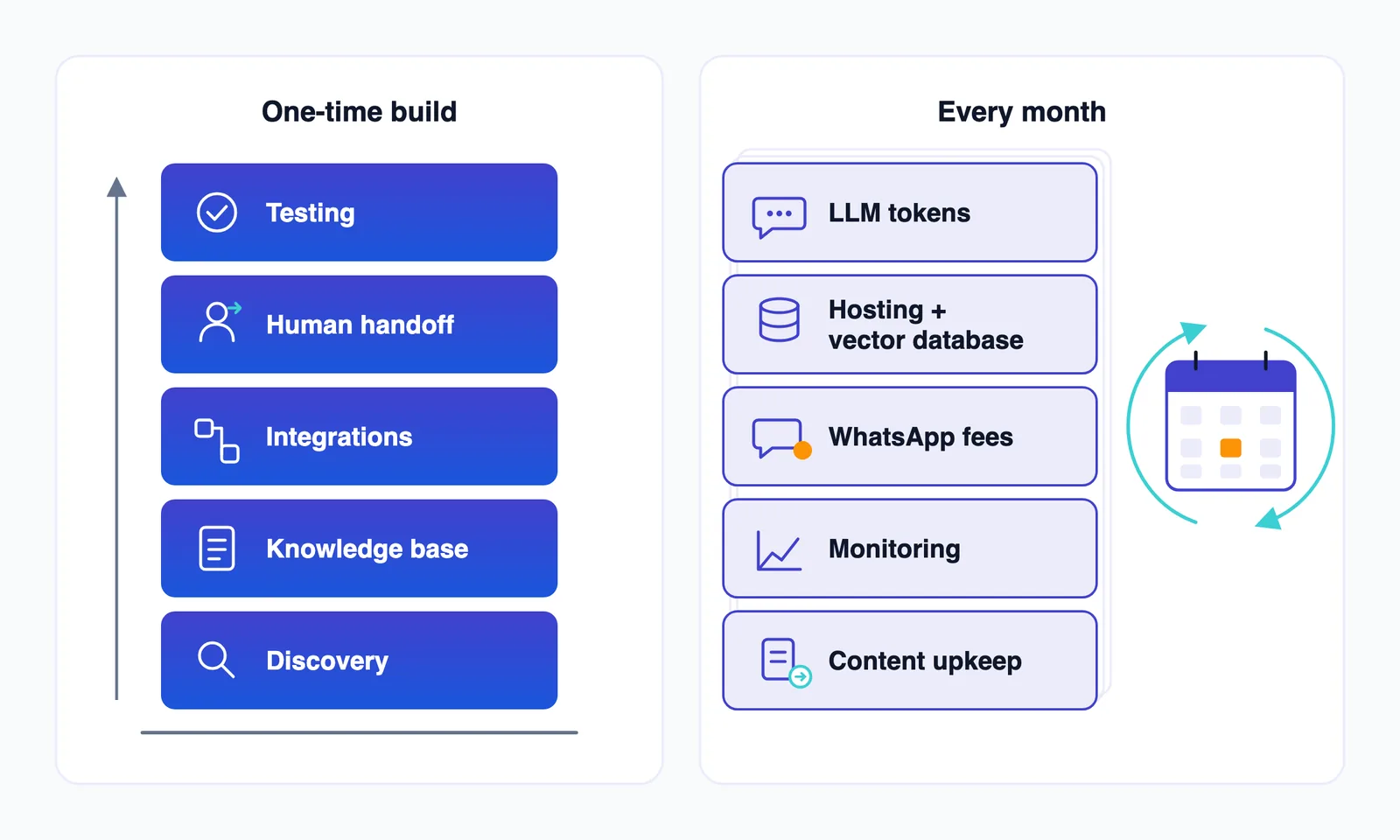
Every chatbot quote has two parts. Buyers who compare quotes on the first part alone are the ones who get caught out by the second.
What the one-time build pays for
- Discovery: agreeing scope, listing the questions and actions, collecting real chat samples.
- The knowledge-base pipeline: cleaning content and setting up how it is indexed and refreshed.
- Integrations: each system, read or write.
- Handoff: routing, console, context and office-hours logic.
- Testing: test sets for each language and each action, plus failure cases.
- Launch: WhatsApp number setup and templates, a staged rollout and a staff briefing.
For how AI project budgets are built in general, see our guide to what drives AI development cost in 2026.
What you pay every month
- LLM usage, billed in tokens, which roughly means by the amount of text sent to and returned by the model.
- Hosting and the vector database that stores your indexed content.
- Meta message fees for WhatsApp, as described above.
- Monitoring: reviewing wrong answers, the handoff rate and failed actions.
- Knowledge-base upkeep: adding new policies, offers and SKUs.
- Model and prompt updates, needed when a provider retires a model or your rules change.
Published monthly figures disagree as much as build figures do. RaftLabs puts running cost at $400–$6,000 a month, with LLM fees of $200–$1,500 a month at 10,000 conversations. CodingClave's monthly ranges run from ₹600–₹2,000 for its lowest tier to ₹40,000–₹3 lakh for enterprise. The two are in different currencies and rest on different assumptions, so don't compare them directly. What they show is how wide the range is.
Per-request LLM cost is a topic of its own. In short, the monthly bill is roughly chats per month × turns per chat × tokens per turn × the model's price per token. Ask each vendor to show you that calculation at your own chat volume, including festive-season peaks.
Why a low build quote can mean a high monthly bill
- Per-resolution platform fees. These are cheap at the start, but the bill grows with every chat the bot handles. The better the bot works, the more you pay.
- A model chosen without cost testing. "Where is my order" rarely needs the most capable model. A smaller model may handle routine queries for much less, but someone has to test it on your chats.
- No caching. Customers ask for store timings and the return policy over and over. If the bot generates each answer from scratch, you pay for it every time.
- The full chat history sent on every turn. If the whole conversation and a large block of documents go with each message, token use climbs with every reply.
How to sense-check payback
The owner who signs off the spend needs a simple calculation, and you can do it with your own numbers:
- Count the chats your team handles today that the bot could resolve on its own, such as order status, store timings and return-policy questions.
- Multiply that count by what one human-handled chat costs you in agent time.
- Subtract the bot's monthly running cost and the cost of the chats it still hands off.
- Set the monthly saving that remains against the one-time build cost. That gives you the payback period.
If a vendor can't help you fill this in from your chat logs, their quote is a guess.
DPDP Rules: what to scope into the build before 13 May 2027 (not legal advice)
A retail chatbot collects personal data in almost every chat: names, phone numbers, addresses and order histories. The Digital Personal Data Protection Rules 2025 were notified on 13 November 2025, and their obligations start in phases. Ikigai Law's analysis gives this timeline:
- Consent-manager obligations and the Data Protection Board's powers start 12 months after publication.
- Notice, security safeguards, breach reporting, retention, children's data and the other operational duties start 18 months after publication, "i.e., 13 May 2027".
Some firms, including AMS Shardul, give the date as 14 May 2027. Check the Gazette notification for the exact date.
The cost point is simple: these items cost less to build into a chatbot now than to retrofit next year. Working from Ikigai Law's summary, they turn into these scope items:
- Notice and consent in the chat flow. Rule 3 notices must stand alone and use plain language. They must list the personal data and the specified purposes, and give a way to withdraw consent, exercise rights and complain to the Board. On WhatsApp or a web widget, that means deciding where the notice appears and how a customer withdraws consent.
- Security safeguards. The minimum measures include encryption, masking or tokenisation, and access controls. In a chatbot, that means masking phone numbers and addresses in logs and in the agent console wherever they aren't needed.
- Access logs kept for at least one year, showing who viewed chat transcripts and customer data.
- Retention and deletion. Set rules for how long chat logs are kept and how they are deleted, including copies in analytics tools and the vector database. Large e-commerce intermediaries above the user thresholds must erase data after three years of inactivity, with 48 hours' notice before deletion.
- A breach runbook. Breaches must be reported "without delay", with a detailed report to the Board within 72 hours, and there is no harm threshold. Your team and the vendor both need to know who does what.
Ask each vendor which of these items their quote includes. This section summarises third-party legal commentary and is not legal advice, so check your obligations with your own counsel. For the engineering side, see our article on access controls and data handling in generative AI applications.
Cost-driver checklist for comparing chatbot quotes
Print this table, send the second column to every vendor and fill in their answers. A row a vendor leaves blank shows you an assumption hidden in their price.
| Driver | Ask the vendor | What a good answer includes | Vendor A | Vendor B | Vendor C |
|---|---|---|---|---|---|
| Bot type | Is this an FAQ bot, a RAG assistant or a transactional bot? | The list of questions it answers and every action it takes | |||
| Channels | Which channels are in the price? | Each channel listed; voice priced separately if included | |||
| Knowledge-base prep | Who cleans the content, and how many documents and SKUs are assumed? | A named owner, a document count, and the update and re-index process | |||
| Integrations | Which systems, and read or write for each? | The system list, API or CSV for each, sandbox needs, write actions named | |||
| Human handoff | How does a chat reach an agent, and what does the agent see? | Routing, console, context passed, office hours, WhatsApp window handling | |||
| Languages and voice | Which languages, in script or voice, and how is quality tested? | A test set for each language and QA by native speakers | |||
| LLM and hosting | What will it cost to run at our monthly chat volume? | The model named, the token calculation at your normal and peak volume, caching | |||
| Meta fees | Are message fees included or passed through, and with what markup? | The message categories expected and your INR billing status | |||
| DPDP items | Which of notice, retention, access logs and a breach runbook are included? | Each item scoped, or clearly marked as excluded | |||
| Monitoring and support | How long is post-launch support, and what does it cover? | The period, response times, and who reviews wrong answers | |||
| Ownership | Who owns the code, prompts, knowledge base and chat data? | You own them, or the terms are stated in writing | |||
| Exit terms | What happens if we move to another vendor? | Export of data, content and prompts in usable formats, plus handover notes |
Here is what a specific answer looks like. Every AtlasML project includes 90 days of post-launch support and monitoring. A proof of concept can be ready in 4 weeks, and most projects run 8 to 16 weeks from kickoff to production (about AtlasML). Whichever vendor you choose, get the support period, what it covers and what happens when it ends in writing.
Once every vendor has answered the same rows, you are comparing like with like. The gap between quotes then has an explanation you can check, row by row.
Frequently asked questions
How much does an AI chatbot cost in India?
No single figure holds, because published 2026 ranges disagree by about 100 times at the low end: CodingClave starts at ₹35,000 and IDS Logic at ₹35 lakh. The price depends on six drivers: scope (FAQ, RAG or transactional), channels, knowledge-base preparation, integrations, human handoff and languages. Ask vendors to price each one separately, and ask for the monthly running cost alongside the build cost.
Can I still run an AI chatbot on WhatsApp after Meta's 2026 policy change?
Yes, for customer-service bots. TechCrunch reported Meta's position that the change, in force since 15 January 2026, doesn't affect businesses using AI to serve customers on WhatsApp. Clause 4.7 of Meta's terms targets AI offered as the "primary" function, such as general-purpose assistants. Keep your bot's scope tied to your business, read the current terms, and treat this as general guidance rather than legal advice.
What does an AI chatbot cost to run every month?
The monthly bill covers LLM usage, hosting and the vector database, WhatsApp message fees, monitoring, knowledge-base upkeep and model or prompt updates. On WhatsApp, each business number gets 1,000 free service messages a month, and since 1 October 2026 service messages beyond that are charged. Ask vendors to show the running cost at your own chat volume, including festive peaks.
Is a SaaS chatbot platform cheaper than a custom chatbot?
For standard FAQ and lead-capture bots, usually yes: platforms are quicker to start and need little engineering. A custom build makes sense when the bot must read from or write to your order, inventory or loyalty systems, when your policies vary by city or franchise, or when per-resolution fees would rise steeply as chat volume grows.
Does the DPDP Act affect my chatbot's cost?
It adds scope items: notice and consent text in the chat flow, security safeguards, access logs kept for at least a year, retention and deletion rules for chat logs, and a breach runbook. Ikigai Law puts the start of these duties at 13 May 2027 (some firms say 14 May; check the Gazette). Building them in now costs less than retrofitting later. This is not legal advice.
How long does it take to build an AI chatbot?
At AtlasML, a proof of concept can be ready in 4 weeks, and most projects run 8 to 16 weeks from kickoff to production. 94% of AtlasML projects ship within the timeline agreed at kickoff. For a chatbot, the number of integrations and the state of your knowledge base move the timeline more than anything else.