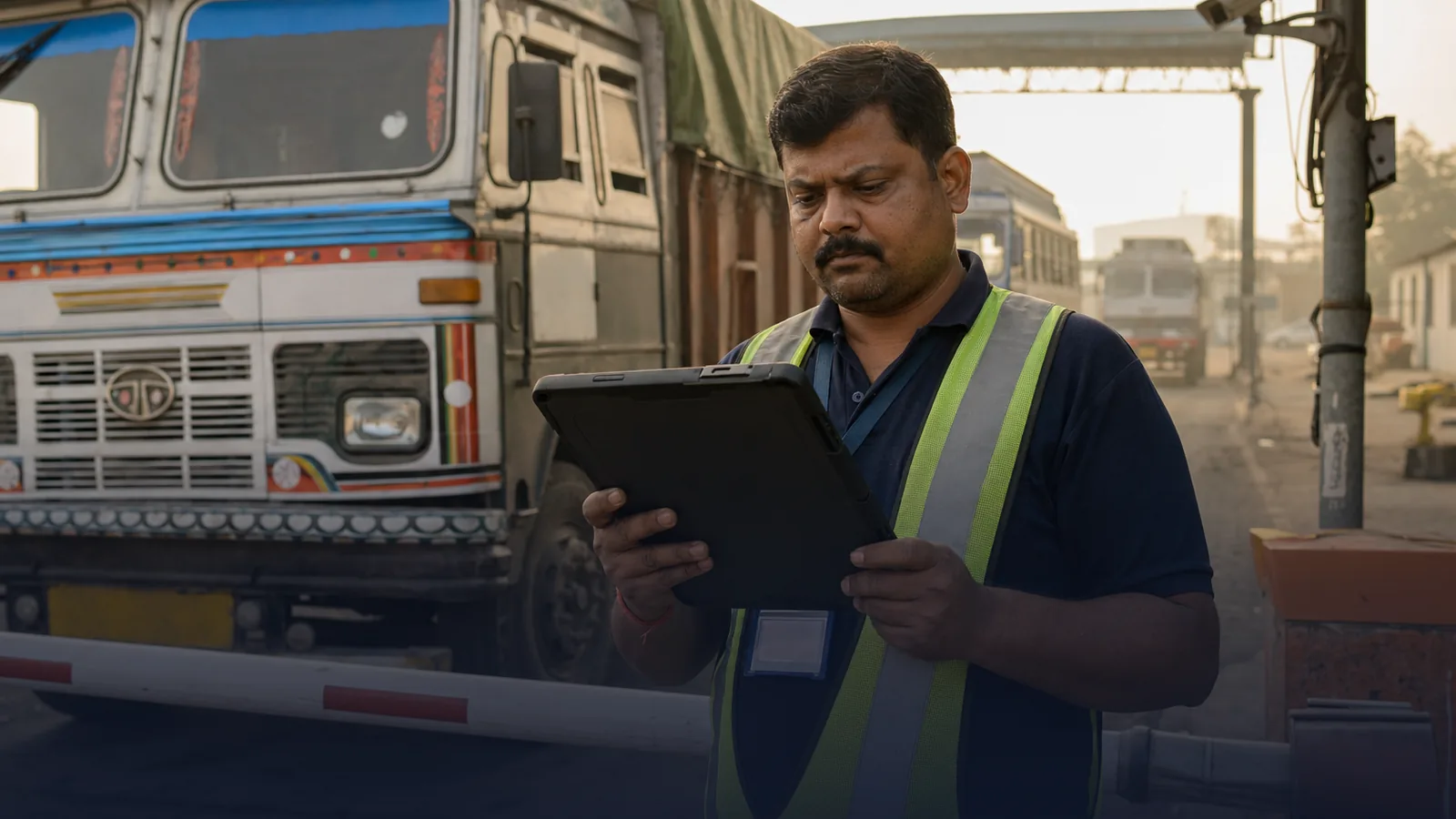

Since 1 May 2026, vehicles crossing the Choryasi toll plaza on NH-48 between Surat and Bharuch have paid without stopping. There is no barrier and no booth. Overhead gantries read the FASTag, cameras capture the number plate, and a central system settles the charge. This is multi-lane free flow tolling (MLFF), and ANPR is one of the two ways it identifies a vehicle.
Most coverage stops at "cameras read the plate." The cameras are the part you can see, but they aren't the hard part. MLFF runs two independent identifiers, an RFID tag and a plate, plus a matching layer that has to decide what to do when they agree, when they disagree, and when one or both fail. The rollout numbers show that exceptions make up a large share of traffic. They aren't rare edge cases.
Here is where things stand. As of July 2026, contracts had been awarded for 17 plazas, five were live, and bids had been invited for 104 more, according to Business Today. The national completion dates you'll see in the news are ministerial targets. This article explains how the matching works, what happens to vehicles that don't match, and which parts of the design are worth copying at a plant gate, logistics park, campus or car park.
What India actually chose, and what it dropped
The technology choice changed more than once before it settled, and that history matters if you're planning around it.
- April 2025. The road ministry said "no such decision has been taken" on nationwide satellite tolling from 1 May 2025. It said an ANPR-FASTag barrier-less system would go to selected plazas first, and a national decision would depend on how it performed and how users responded. The same Gulf News report put the count at about 855 national highway plazas (675 government-funded, about 180 private).
- December 2025. Nitin Gadkari told the Rajya Sabha that AI-based barrier-free tolling would roll out by the end of 2026, with vehicles passing at up to 80 km/h. That report also described satellite tracking and said MLFF would replace FASTag. Neither of those turned out to be the plan.
- July 2026. In a written reply on 22 July, the government said MLFF would be implemented "through ANPR with AI analytics and RFID-based FASTag." GPS-based tolling went back for "further deliberations" after the Apex Committee and High-Level Empowered Committee raised concerns about security, privacy, breach risk and operational control. More than 98% of national highway user-fee collection already runs through FASTag (Business Today).
- 6 November 2026. An NHAI circular requires MLFF on national highway projects of four lanes and wider. Projects still at the DPR stage build it in, and awarded or ongoing ones adopt it "through applicable contractual provisions." It sets no date for removing barriers at existing plazas, as reported by Transclew citing the PIB release. The same piece notes that Indian Express counts about 1,200 plazas, which differs from the 855 figure above. Totals depend on who is counting.
The practical point is that the scope has moved repeatedly. Satellite tolling was coming, then it wasn't. FASTag was being replaced, then it became the primary identifier. Plan around the direction of travel, which is now clearly FASTag plus cameras, and treat the dates as targets.
How multi-lane free flow tolling with ANPR works at the gantry
Two identifiers, captured independently
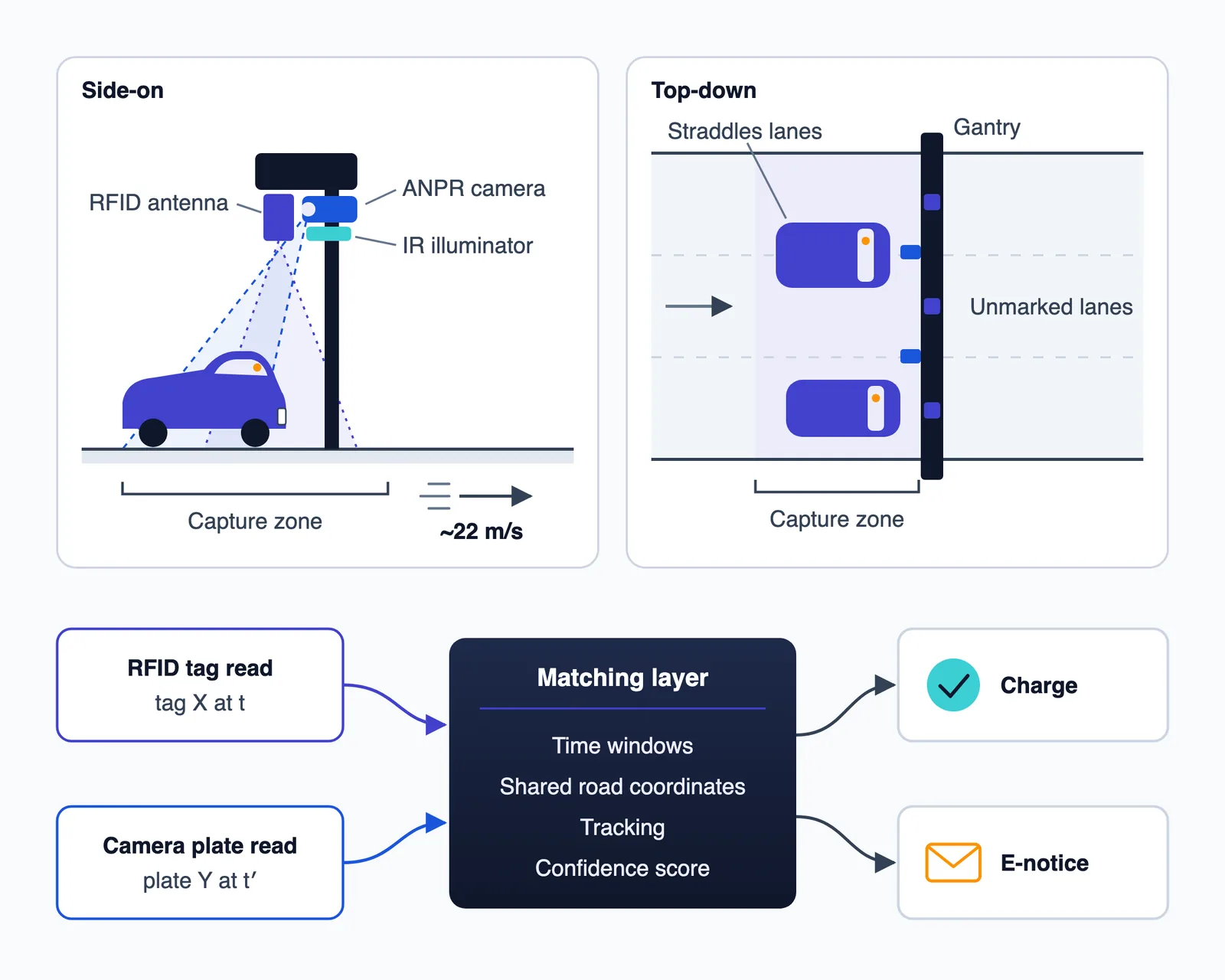
A gantry carries three kinds of sensor. An RFID reader picks up the FASTag on the windscreen. ANPR cameras capture the plate. A classification system records vehicle type and axle count, which sets the toll class (Anantam IAS lists these components). A central system then verifies identity and calculates the toll (India.com). The Tamil Nadu plazas are described as matching tag and plate "in real time" (DTNext).
We won't re-explain plate reading here. We cover the ANPR pipeline itself, from plate detection to OCR on Indian plates, in our guide to how ANPR works and where it fails.
Pairing the two works because they fail in different ways. RFID doesn't care about a muddy plate or headlight glare, but it misses when the tag is absent, badly mounted, damaged or blacklisted. A camera doesn't care about the tag, but it misses on dirty, bent or non-standard plates. Because the failures are mostly independent, one identifier usually covers for the other. We compare the two technologies process by process in barcode vs RFID vs computer vision in the warehouse.
Pairing a tag read with a plate read
At a conventional plaza, the lane does the pairing for you. One vehicle stops at one barrier, the reader in that lane reads one tag, and the camera in that lane sees one plate. Remove the lanes and that guarantee goes. Two cars can pass under the gantry side by side, a truck can straddle the line between two notional lanes, and a motorbike can tuck in behind a bus.
The two reads come from different sensors, at slightly different moments, with different ideas of position. The RFID reader reports that it heard tag X at time t through a particular antenna at some signal strength. The camera reports plate Y at time t′ at a position in its frame. The matching layer has to decide that X and Y belong to the same vehicle. In data terms this is an association problem: link records from two streams using time and position, and attach a confidence score to each link.
The usual tools are:
- Time windows. Only consider tag and plate reads that fall within a short interval of each other.
- Shared road coordinates. Map each antenna's read zone and each camera's field of view onto the same road position, so "antenna 3" and "left third of camera 2's frame" mean the same strip of tarmac.
- Tracking. Follow each vehicle through the capture zone and attach the tag and the plate to the track, rather than trying to match them to each other directly.
The awkward cases fall out of this. A straddling truck can appear in two cameras and be heard by two antennas, so the system has to merge those into one transaction or it charges twice. Two cars side by side may both be heard by both antennas, and then position and timing have to break the tie. When they can't, the right answer is to send the event for review, not to guess. A low-confidence pairing should be treated as its own outcome.
Reading plates at up to 80 km/h
The 80 km/h figure comes from the minister's December 2025 description (Gulf News), not from a published tender spec. It is still a useful number to work with. 80 km/h is about 22.2 metres per second.
That speed causes three problems:
- Motion blur. With a 1/250 s exposure, the vehicle moves about 9 cm while the shutter is open, which is enough to smear the characters on a plate. At 1/2,000 s it moves about 1.1 cm. Short exposures are not optional.
- Light. A short exposure lets in very little light, so the scene needs its own illumination. Infrared strobes synchronised to the shutter are the usual answer. They work at night and don't dazzle drivers.
- Time in view. Suppose the usable capture zone is about 10 m long (an illustrative figure). A vehicle at 80 km/h crosses it in under half a second. The camera therefore takes several frames per pass, reads each one, and combines the results, so a single frame spoiled by headlight flare or a bumper doesn't decide the read.
None of this helps if the plate itself is the problem. Dirty, damaged and non-standard plates are the main cause of failed camera reads (CivilsDaily), which is why issuers such as ICICI Bank tell MLFF users to fit a valid HSRP. A private gate has an advantage the highway doesn't. If vehicles approach at 10 km/h (about 2.8 m/s), blur, lighting and time in view all become roughly eight times easier.
What happens when the plate and the FASTag don't match
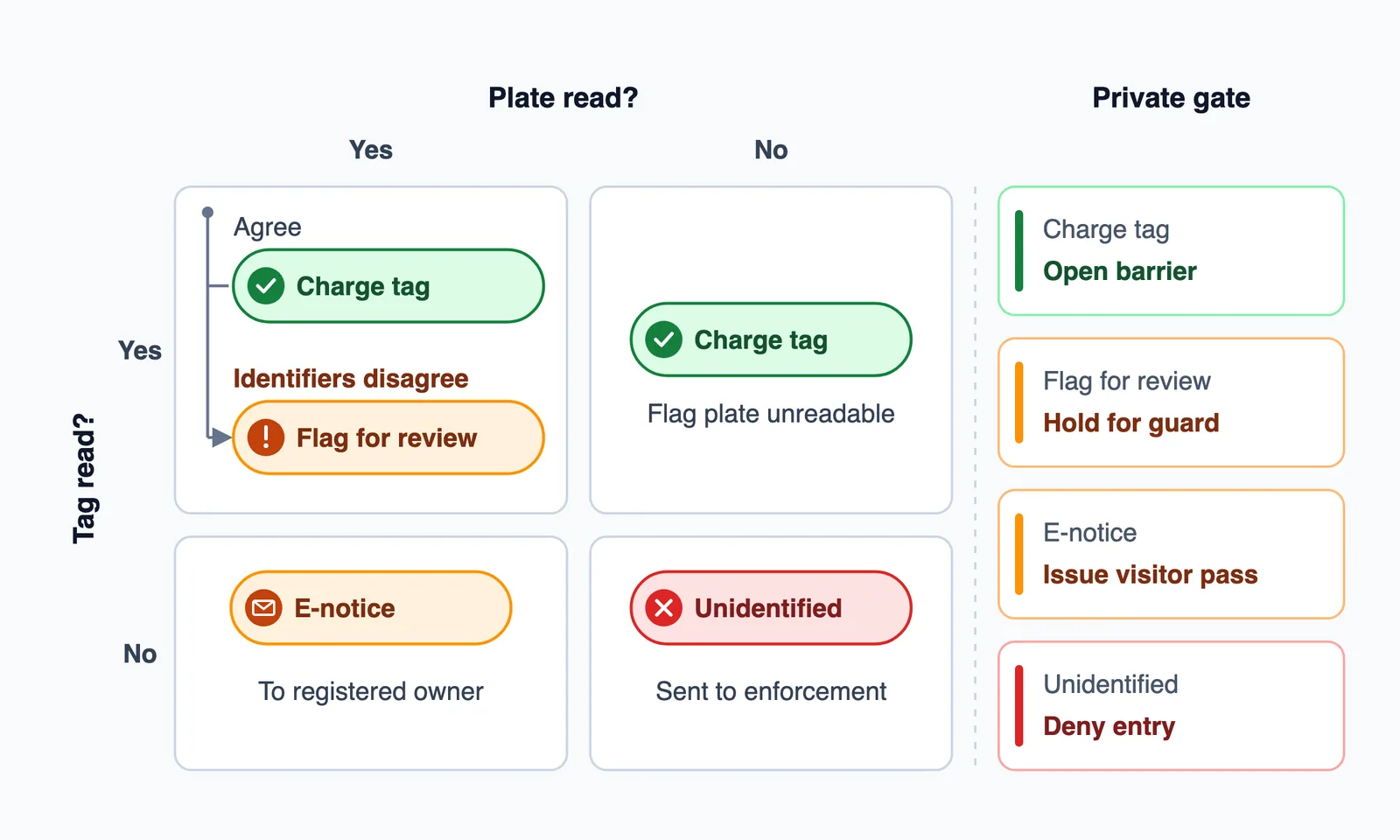
Every crossing lands in one of five outcomes. The public sources describe the e-notice and "unidentified" paths in detail. The rules for when the two identifiers disagree sit in tender documents we couldn't verify, so the table below describes the logic any system of this kind has to implement. It is not a quotation of NHAI's rulebook.
| Tag read? | Plate read? | Agree? | What the system has to do | Typical cause |
|---|---|---|---|---|
| Yes | Yes | Yes | Charge the tag and store the evidence | Normal crossing |
| Yes | Yes | No | Flag for review. Don't silently charge either identity | Tag linked to the wrong registration number, tag moved to another vehicle, fake or cloned plate, tag class doesn't match the observed vehicle |
| Yes | No | n/a | Charge the tag and flag the plate as unreadable | Dirty, damaged or non-standard plate, or the plate is blocked from view |
| No, or unusable | Yes | n/a | Issue an e-notice to the registered owner | No tag, low balance, blacklisted tag, badly mounted tag |
| No | No | n/a | Mark as "unidentified" and pass to enforcement | Plate and tag covered or invisible, fake plate, no tag |
The e-notice path
The rules, as reported by DeshGujarat in March 2026:
- An e-notice with location, date and amount goes out by SMS, email and apps.
- Pay within 72 hours and you pay the original fee. After that the fee doubles.
- You can contest the notice within 72 hours. The authority must resolve the grievance within 5 days or the claim is cancelled.
- If it is still unpaid or uncontested after 15 days, the due goes to VAHAN and vehicle services may be restricted.
Some explainers describe penalties of 1.5 to 2 times the fee and mention licence cancellation. The rules as reported are simpler than that: the normal fee within 72 hours, double after. ICICI lists the usual triggers as insufficient balance, improper tag placement, invalid vehicle details and non-compliance.
The 5-day deadline matters to engineers. It is a commitment on the operator, not the motorist. If the review queue backs up, disputed claims lapse and the revenue goes with them. That makes review capacity a hard requirement of the system.
How big the exception queue gets
At five plazas between May and July, Indian Express counted 10.52 lakh e-notices against 1.10 crore crossings (via Transclew). That is roughly one crossing in ten. One official estimated that about 40% of those dues had been recovered, a figure the source couldn't verify. PropNewsTime reports e-notices declining as road users adjust, so some of that rate is a launch effect.
Unidentified vehicles are a separate and harder problem. CivilsDaily reports:
- Shahjahanpur: 2.60 lakh unidentified out of about 24 lakh vehicles since go-live, which is more than one in ten.
- Manoharpura: about 3%.
- Mundka-Bakkarwala: about 2%.
- Paranur: more than 500 in its first 20 days.
The measures under consideration include penalties above twice the toll, FIRs, and AI matching against the make, model and colour data in VAHAN. The risks cited go beyond lost tolls. Because e-way bills are linked to FASTag, an untraceable truck is a smuggling and GST-evasion risk too.
There is also a corridor effect. Where consecutive plazas are all barrier-free, as on the Delhi–Jaipur stretch of NH-48, a vehicle that can't be identified at one plaza is unlikely to be caught at the next. A barrier used to be the backstop. On an all-MLFF corridor, the backstop is enforcement after the fact.
Master data is the weak point
On 15 April 2026, NHAI told every FASTag issuer bank to validate the vehicle registration numbers linked to their tags and to blacklist tags with wrong ones (Free Press Journal). Many of the mismatches trace back to tags issued before VAHAN integration, when checks were limited and done by hand. The order says accurate mapping matters especially for MLFF e-notices.
This is the part most explainers miss. A perfect camera and a perfect reader still produce a wrong answer if the registry says tag X belongs to plate Z. The matching can only be as good as the registry behind it. That makes it a data problem as much as a vision problem, the kind that data engineering and analytics work addresses: reconciling registries, measuring match rates and reporting on exceptions.
Targets, not deadlines: reading the December 2026 and March 2027 dates
At the Global Fintech Fest on 11 September 2026, Gadkari said: "I directed officials to complete it by December 2026," and "I believe 60% to 70% of the work will be completed by the end of the year." He added that "by February-March, a barrier-free toll plaza system will be implemented across the country" (Outlook). Business Today reported the same event and noted more than 13 crore FASTags issued.
Compare that with the Economic Survey 2025-26, which, as reported by Transclew, projects barrier-free tolling on all four-lane-plus national highways and expressways by March 2029. That is two years later than the minister's target. With 17 plazas awarded in July and a November circular that sets no date for existing plazas, the later projection looks more like a planning baseline.
If you run a private site, don't time your own project to national dates. Do plan for the conditions they are creating. HSRP adoption and the VRN clean-up both make plate-plus-tag systems more reliable everywhere, including at your gate. If you're deciding whether a two-identifier gate is worth building, an AI feasibility and architecture review is a sensible first step.
Applying the ANPR and RFID design at factory gates, logistics parks and parking
A private site can copy the core of MLFF: two identifiers, a matching layer, an evidence record for every event and a dispute path. It also has two things a highway doesn't. It can slow vehicles down, and it usually knows which vehicles to expect.
Factory and plant gates
Use the plate as the primary identifier and an RFID tag (a site tag or the vehicle's FASTag) as the second. Match both against the list of vehicles you expect: purchase orders, the dispatch plan, gate passes. Keep the barrier. A gate that can slow or stop vehicles removes most of the 80 km/h problem, and it gives you a physical fallback when the reads disagree. Log a mismatch as a security event, not a billing event, because a plate that doesn't match its tag at a plant gate is a question for the guard. Matching a plate to a dispatch plan means reading from the ERP. See integrating AI with existing ERP and CRM systems.
Logistics parks and truck terminals
Pair each entry event with its exit event to measure dwell time. Flag any vehicle that enters as one plate and leaves as another, or leaves with a different tag. Link gate events to weighbridge tickets and e-way bill records so a truck's identity, weight and paperwork can be checked against each other. The highway's GST concern applies here too. Once a truck is identified at the gate, the next questions are queue time and dock turnaround, which we cover in computer vision for yard management.
Parking
Ticketless parking works the same way. Read the plate and tag at entry and exit and bill by duration. FASTag-based parking already exists: NPCI offers FASTag parking under its NETC programme. Reading a FASTag's ID needs a compatible reader, but charging against it means working with an acquiring bank on NETC, not just installing hardware. Keep ANPR as the fallback for vehicles without a usable tag. Be wary of proprietary RFID tags that aren't FASTag. Only your readers can read them, visitors won't have one, and you end up running a tag issuance desk.
Campuses
Here the goal is access control and an audit trail, not charging. Keep a whitelist of residents, staff and vendor vehicles, and let hosts pre-register visitors by plate. The five-outcome table still applies, but the actions change: open the barrier, hold for a guard, issue a visitor pass, or deny entry.
See It Working: ANPR Reading Truck Plates at a Plant Gate
This demo runs on a plant gate's existing CCTV feed. A vehicle is detected and classified as a truck, and its number plate is found and read automatically, at 98% recognition confidence in this clip. The plate is then checked against the approved vehicle list before the barrier lifts and the entry is timestamped and logged. That plate-read-and-check step is the camera half of the two-identifier design described above, and it is the part a factory gate or logistics park can put in first.
Want plate reads checked against your approved vehicle list at your own gate? Call +91 95372 90206 or message us on WhatsApp and we'll walk you through it.
A design checklist for a two-identifier gate
- Pick a primary and a secondary identifier, and decide which one wins when they disagree. Write the rule down for each site type. At a plant gate the answer may be "neither wins, call the guard."
- Clean the vehicle master data before go-live. That means registered plates, tag IDs and vendor fleet lists. NHAI's April order shows what happens when the registry is wrong.
- Store an evidence record for every event. Include the plate crop, full frame, tag ID, timestamp and position. Disputes are settled on evidence, not on the match result.
- Estimate the exception rate before launch and staff a review queue for it. The highway's launch figure of about one in ten is a warning about the scale, not a forecast for your site.
- Set a dispute window with a resolution deadline. The 72-hour window and 5-day resolution limit are a workable pattern to borrow.
- Control speed and lighting at the gate. Speed bumps, a stop line and IR illumination solve problems the highway has to fight with expensive cameras.
- Write down retention periods and limits on data use. Plates tied to people and times are personal data under India's DPDP Act. Decide how long you keep frames and who can search them.
- Report on the matching layer every week. Track match rate, mismatch types and unread rates for each camera and reader. A rising unread rate on one camera usually means a dirty lens or a shifted mount. Monitoring match rates after launch is part of moving an AI prototype into production.
India's MLFF rollout is a large, public test of an idea that applies to any site with a vehicle gate. The camera is a sensor. The value comes from matching its reads against a second identifier and a clean registry, and from handling every vehicle that doesn't match.
Frequently asked questions
How does multi-lane free flow tolling work in India?
Overhead gantries read the vehicle's FASTag by RFID while ANPR cameras capture its number plate, and a classification system records vehicle type. A central system matches the reads and deducts the toll without the vehicle stopping. If the toll can't be collected, an e-notice goes to the registered owner.
What happens if my FASTag and number plate don't match under MLFF?
The crossing is recorded with evidence and flagged. If the toll can't be collected from a valid tag, an e-notice is issued. NHAI told issuer banks in April 2026 to verify the registration numbers linked to FASTags and blacklist tags with wrong ones, so correct your tag's details with your issuer.
What is a FASTag e-notice and how long do I have to pay?
An e-notice is a message by SMS, email or app giving the location, date and amount of an unpaid toll. You pay the normal fee if you pay within 72 hours, and double after that. You can contest it within 72 hours, and the authority must resolve it within 5 days. Dues unpaid after 15 days go to VAHAN.
Can ANPR cameras read number plates at highway speed?
Yes, with very short exposures, synchronised infrared lighting and several frames per pass. At 80 km/h a vehicle moves about 22 metres per second. The main cause of missed reads is the plate itself: dirt, damage or non-standard plates.
When will all Indian toll plazas be barrier-free?
Nitin Gadkari has said 60–70% of the work should be done by the end of 2026 and barrier-free tolling should be in place nationwide by February–March 2027. The Economic Survey 2025-26 projects March 2029 for all four-lane-plus highways. All of these are targets, and the plan has changed before.
Can ANPR and FASTag be used for factory gates or parking?
Yes. NPCI offers FASTag-based parking under NETC, and ANPR works as a fallback for vehicles without tags. Private gates have an easier problem than highways because they can slow vehicles down, match against a list of expected vehicles, and keep a barrier as a physical fallback.